Friday, April 30, 2010

Review: WHITE FOR DANGER by David Stevens

WHITE FOR DANGER by David Stevens (1979) starts in New Zealand and heads to Antarctica, as renowned writer and adventurer Logan Adams is roped into tagging along with his brother-in-law's Antarctica expedition - his brother-in-law was the sole survivor of a previous mission, and he's determined to go back and find the two men left behind, that he believes are still alive and were taken to a hidden city on the frozen continent.

The wealthy backers of the return expeditition aren't worried about finding the men (who they presume are dead), but are very interested in the potential archaeological find. But (of course) there is much more than meets the eye to the motives of those on the expedition, and other outsiders as well. During the perilous journey to the target area a series of disasters which seem like sabotage effects the already strained relationships of the team. Even worse awaits them once they reach their destination.

I found myself really enjoying this book - in part because I think it brought back some nostalgic memories of reading Alistair McLean and Desmond Bagley tales of adventure when I was growing up. WHITE FOR DANGER is very much in that style, and to be honest it does read as of a different era, and as from an age gone by writing-wise, but this doesn't necessarily detract too much. It was fun to read a 1970s-style action/adventure novel set in New Zealand and Antartica, and to see some of the foreign characters thoughts on the New Zealand cities and towns as they were 30-plus years ago.

Stevens writes very much in the Bagley/McLean style, with plenty of interesting action, right from early on, and intrigue throughout. His characters are interesting, although some at times can seem a little cliched (its probably hard not to when they were written 30 years ago) - there are fewer of the moral ambiguities than we are perhaps used to with more modern tales.

However, Stevens does a great job with some of the characters, making them 'more than meets the eye' not just from a mystery/intrigue perspective, but from a personality/emotion/human perspective - particularly Adams' brother-in-law. Things build to a head as the team travels to Antarctica and then attempts to survive both the harsh environment, and unknown dangers of a more human kind. I found myself caught up in the story, and would be happy to read more of Stevens' work (if he wrote any more novels after this).

This book was read and reviewed for Dorte Jakobsen's excellent 2010 Global Reading Challenge.

LAST is first: John Hart becomes a multiple Edgar winner!

The news is starting to circulate from the Mystery Writers of America Edgar Awards ceremony - the 64th Gala Banquet, that was held over the past few hours at the Grand Hyatt Hotel in New York City.

And the big news is that North Carolina lawyer-turned-author John Hart has scooped his second Edgar Award for Best Novel, for his outstanding third novel THE LAST CHILD. It's his second Edgar for Best Novel, after scooping the same award in 2008 for his second novel DOWN RIVER.

Three novels, two Edgar Awards for Best Novel. Crazy. Oh, and THE LAST CHILD also won the CWA Ian Fleming Steel Dagger (for the year’s best thriller) at last October's 2009 Specsavers Crime Thriller Awards. Methinks the awards-hoarding Mr Hart has rapidly moved from rising star to well-established superstar amongst the crime and thriller writing world.

The extended publishers' blurb for THE LAST CHILD says:

"Thirteen year-old Johnny Merrimon had the perfect life: a warm home and loving parents; a twin sister, Alyssa, with whom he shared an irreplaceable bond. He knew nothing of loss, until the day Alyssa vanished from the side of a lonely street. Now, a year later, Johnny finds himself isolated and alone, failed by the people he’d been taught since birth to trust. No one else believes that Alyssa is still alive, but Johnny is certain that she is... confident in a way that he can never fully explain.

Determined to find his sister, Johnny risks everything to explore the dark side of his hometown. It is a desperate, terrifying search, but Johnny is not as alone as he might think. Detective Clyde Hunt has never stopped looking for Alyssa either, and he has a soft spot for Johnny. He watches over the boy and tries to keep him safe, but when Johnny uncovers a dangerous lead and vows to follow it, Hunt has no choice but to intervene.

Then a second child goes missing...

Undeterred by Hunt’s threats or his mother’s pleas, Johnny enlists the help of his last friend, and together they plunge into the wild, to a forgotten place with a history of violence that goes back more than a hundred years. There, they meet a giant of a man, an escaped convict on his own tragic quest. What they learn from him will shatter every notion Johnny had about the fate of his sister; it will lead them to another far place, to a truth that will test both boys to the limit."

You can read the prologue and first three chapters of THE LAST CHILD here.

Hat tip to Peter Rozovsky of the always-excellent Detectives Beyond Borders for the heads-up.

More commentary and reaction to come.

Review of BLEED FOR ME on Radio New Zealand

Earlier this week, as part of its daily book review slot on the Nine to Noon programme, Radio New Zealand addressed Australian author Michael Robotham's latest thriller, BLEED FOR ME, released in New Zealand this month.

One of the great things about the Nine to Noon show, hosted by Kathryn Ryan - who also regularly does interviews with New Zealand and visiting authors - is that they do semi-regularly cover some crime and thriller titles. They're also fascinating reviews to listen to, because rather than being just a print review of a reviewer's thoughts, Ryan 'interviews' the reviewer, and asks them questions about the book, drawing out comments. So it's more of a dialogue, than a monologue - which is a nice change of pace.

Today the reviewer was Emma Hart, who unfortunately didn't start too well when she assertively said Robotham was a Brit now living in the UK, so that's why he set his book in Bath (Robotham is in fact a born and bred Australian, who after spending his first 20+ years in Australia, travelled overseas and worked in a variety of places, including the UK, as a journalist).

However the rest of the review was quite good, and very positive about the book. "This is fantastically written," says Hart. You can listen to the full 7 and a half minute review of BLEED FOR ME here. I have recently read BLEED FOR ME, and really enjoyed my first taste of Robotham's writing. I have a couple of reviews of the book coming out in New Zealand and overseas publications in future, so I will link to them as and when they're available.

Have you read BLEED FOR ME or any of Michael Robotham's earlier books? What do you think? What do you think of the Hart's review? Does BLEED FOR ME sound like something you might enjoy? Thoughts and comments welcome.

Thursday, April 29, 2010

On the eve of the Oscars of Crime Writing


While it's Thursday here in New Zealand, for many other readers around the world it's still Wednesday night, making it the eve of the 2010 Edgar® Awards, often considered to be the 'Oscars' of the crime fiction world. There are of course many other prestigious award ceremonies for crime, mystery, and thriller fiction (see sidebar for some of them) - but I don't think anyone would argue that the Mystery Writers of America Edgars are right up there in terms of prestige (perhaps the CWA considers their Daggers the Oscars, and the Edgars the Golden Globes - but that's a whole 'nother discussion).

The Edgars (named of course after the man credited with kickstarting the detective fiction genre, Edgar Allan Poe) have been running since the mid 1940s - a Best First Novel by an American Author category began in 1946 - and have been honouring the creme de la creme of American (and international) crime writing, across a variety of categories ranging from novels to short stories to TV episodes to true crime, ever since. The MWA also gives a Grand Master award for lifetime achievement - this year this is being presented to Dorothy Gilman. New Zealand's own Dame Ngaio Marsh received this tremendous honour in 1978 (incidentally, the year my parents unleashed me on the earth).
Within the next 24 hours, we'll all learn who amongst the 2010 nominees will join that glittering list of previous winners. The Edgar Awards will be presented to the winners at our 64th Gala Banquet, April 29, 2010 from 7:30 - 11:00pm at the Grand Hyatt Hotel, New York City.

Looking at the Best Novel category, the shortlisted books are:
  • THE MISSING by Tim Gautreaux
  • THE ODDS by Kathleen George
  • THE LAST CHILD by John Hart
  • MYSTIC ARTS OF ERASING ALL SIGNS OF DEATH by Charlie Huston
  • NEMESIS by Jo Nesbo, translated by Don Bartlett
  • A BEAUTIFUL PLACE TO DIE by Malla Nunn

Of the above novels, I have only read one last year; THE LAST CHILD by John Hart (which also won the CWA Ian Fleming Steel Dagger). Quite simply, I thought it was superb - one of (if not) the best crime novels I read in 2009 - so I was very glad to see it make the Edgars shortlist when the announcement was made. It was one of only two 5-star ratings I gave for Good Reading last year.

In my review for Good Reading, I said "Put simply, THE LAST CHILD is an exceptional novel; a literary crime thriller that is as much about its rich cast of layered, authentic and damaged characters as its intelligent and engrossing storyline. Hart writes beautifully, evoking aspects of the human condition alongside echoes of the Southern Gothic tradition, building his tale towards a surprising yet most fitting conclusion."

I've also heard very, very good things about Nesbo's work (another of his books is in my TBR pile), but know little about the other four shortlisted books and authors.

What do you think of the nominees? Who should win? Do you follow the Edgars? Which awards do you see as the most prestigious? Thoughts and comments welcome.

A star-studded line-up, and a touch of Kiwi, at this year's Theakstons Old Peculier Crime Writing Festival in Harrogate

Although its history doesn't trace back as far as some literary festivals, the Harrogate Crime Writing Festival quickly established itself as a shining light on the European books scene, after the inaugural version back in 2003.

The upcoming 2010 version of the Theakstons Old Peculier Crime Writing Festival in Harrogate is touted as featuring "one of its strongest line-ups yet", and from a look at the authors in attendance, it would be hard to argue. It's a crime fiction lovers paradise, with numerous 'big names' and legends mixed with exciting newcomers and authors on the rise. Events range from panel discussions to murder mystery dinners to quizes to the presentation of the Theakstons Old Peculier Crime Novel of the Year. All presided over by 'bearded write-ist' Stuart MacBride, the clown prince of sinister Scottish crime.

I am gutted, absolutely gutted, that I won't be going (originally I had planned on attending Harrogate this year, but circumstances have conspired against me). However, there is a pleasant 'touch of Kiwi' at the festival, with both Christchurch's Paul Cleave and Dunedin-based Liam McIlvanney (pictured right) appearing. It's great to see some high quality New Zealand-based crime writers getting some great recognition and exposure in this way.

This year's festival takes place on July 22 to 25 at The Crown Hotel, Harrogate. Highlights includes a celebration of 120 years of Agatha Christie, special guest appearances from Jeffrey Deaver, Christopher Brookmyre and Jeff Lindsay and the much anticipated introduction to the "new blood" writers – a showcase of the most exciting emerging talent on the scene.

Both Cleave and McIlvanney are appearing at events on the Saturday. From the programme:

Saturday 24th July 2010

New Blood
International best-seller and Festival favourite Val McDermid introduces four bright new talents in crime fiction, Attica Locke, Liam McIlvanney, Belinda Bauer and Stuart Neville. An essential insight into names to watch for the coming years.

“No, I’m Ian Rankin.”
Pretty much every new writer of crime fiction is held up as “the next Ian Rankin” at some point – journalistic shorthand, or is it just laziness? The man himself talks fiction and friction with four of the biggest pretenders to his throne, Allan Guthrie, Alex Gray, Chris Simms and Paul Cleave (pictured left).

You can see the full programme of events here.
It should be a wonderful few days, packed with lots of interesting events. I'm crossing my fingers that I can make it next year - and/or that we can get several of those international authors down here for some events alongside our authors down here in New Zealand (wouldn't that be great?).
So, are you heading to Harrogate? Do you like attending author events, whether small individual ones or larger festivals? What is the favourite festival or event you've ever been to? Thoughts and comments welcome.

Wednesday, April 28, 2010

Happy Birthday Nancy Drew!

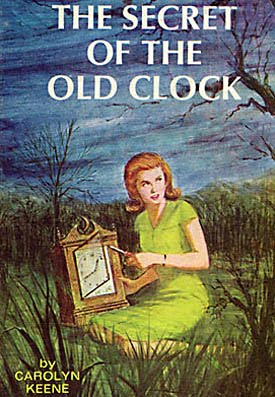
Wednesday 28 April marks the 80th birthday of one of the most famous and popular female heroines in literary history; teenaged amateur sleuth Nancy Drew. The very first three Nancy Drew mysteries, THE SECRET OF THE OLD CLOCK, THE HIDDEN STAIRCASE, and THE BUNGALOW MYSTERY, were all published on this day, way back in 1930.

I remember reading and enjoying a couple of Nancy Drew mysteries when I was growing up, although (unsurprisingly) I was more a Hardy Boys fan - I read all of the Hardy Boys books I could get my hands on - my friends and I read dozens of them, from the school or public library, bought from the store or received as presents.

In fact, when I was interviewing Linwood Barclay (NO TIME FOR GOODBYE, NEVER WALK AWAY etc) last year, I was reminded that it was the Hardy Boys stories that first sparked my interest in and passion for mystery, crime, and thriller fiction. Up until that point I'd always traced my adult love of crime fiction back to my adolescent and teenage reading of Sherlock Holmes and Agatha Christie's Poirot, but when Barclay mentioned the Hardy Boys tales as amongst his favourite childhood reading memories, I recalled that they too had been the first series of books I was really, really into (along with Asterix comics), back at primary (grade) school.

It won't surprise many, but the Hardy Boys tales (by Franklin W. Dixon) and the Nancy Drew stories (by Carolyn Keene) were actually both created by the same publishing company, and in fact, many of the same writers. Both were created by Edward Stratemeyer, founder of the Stratemeyer Syndicate, and both were written under pseudonyms by a team of writers. The Stratemeyer Syndicate also created the Tom Swift series, the Bobbsey Twins books, and the Rover Boys. Without a doubt, Edward Stratemeyer and his team certainly did wonders for getting many, many people to love reading from a young age, over the past 100 years and more.

For instance, the Rover Boys series alone (probably one of the lesser-known of the Syndicates series nowadays) sold more than 5 million copies between 1899 and 1926. That would still be a big number now, let alone then. In fact, it would be an interesting discussion about whether modern 'phenomenons' like Twilight, or the Harry Potter books are merely the recent versions of the type of widespread children and teenaged books embrace that Stratemeyer first created (up until his time, no one had focused on books for children and teens in that series manner).

But, back to the birthday girl. Paraphrased from Wikipedia, Nancy Drew is an 18-year old amateur sleuth (she was 16 in the earlier versions) who lived in the fictional town of River Heights with her father Carson Drew (an attorney) and their housekeeper Hannah. Her mother dided when she was young (3 in modern versions, 10 in the older books). Nancy is often assisted in solving mysteries by her best friends Bess and George, and occasionally by her boyfriend Ned Nickerson. American novelist and literary critic Bobbie Ann Mason described Nancy Drew as "immaculate and self-possessed as a Miss America on tour... as cool as a Mata Hria and as sweet as Betty Crocker".

Unsurprisingly, the Nancy Drew tales have been revised somewhat over the 80 years since they first began - and in fact there could be some great sociological insights into just how our culture has adapted and evolved over the decades (or not), when those revisions are examined.

According to Wikipedia, "the books were extensively revised, beginning in 1959, largely to eliminate racist stereotypes, with arguable success. Many scholars agree that in the revision process, the heroine's original, outspoken character was toned down and made more docile, conventional, and demure. In the 1980s a new series was created, the Nancy Drew Files, which featured an older and more professional Nancy as well as romantic plots. In 2004 the original Nancy Drew Mystery Stories series, begun in 1930, was ended and a new series, Girl Detective, was launched, with an updated version of the character who drives a hybrid electric vehicle and uses a cell phone. Illustrations of the character have also evolved over time, from portrayals of a fearless, active young woman to a fearful or passive one."

The books have sold more than 80 million copies over the years, and the character has starred in several films, television series, and a range of computer games. Not bad for an 80-year old, eh?

To celebrate the occasion, The Poisoned Pen in Scottsdale, Arizona is holding a 'Nancy Drew 80th Birthday' event. You can find more information here.
Hat tip to the always-excellent The Rap Sheet, for the heads-up.
So, were/are you a Nancy Drew fan? A Hardy Boys fan? Did you read the books, watch the TV shows or movies, or play the computer games? Do you think the old stories still hold up now? What did you like/dislike about them? Thoughts and comment welcome.

9mm: An interview with Andrew Grant

Welcome to the latest instalment in Crime Watch's ongoing series of quickfire author interviews; 9mm - 9 MurderMystery questions put to a variety of New Zealand and international crime, thriller, and mystery authors.

For the eighth in this regular series of quickfire author interviews, I put the 9mm questions to 'Andrew Grant' (the thriller writing pen name of Christchurch-based Grant Shanks, who writes in a variety of genres). Shanks has written five thrillers under his Andrew Grant pen-name over the past decade or so. His first two thrillers, HAWK (a local bestseller) and TYLER'S GOLD, were set in New Zealand. His award-winning third thriller, MESQUITE SMOKE DANCE, was an American police psychological thriller set in Texas.

Shanks/Grant's latest two thrillers have been set in Asia, and star former British secret agent and assassin Daniel Swann. Several years after Shanks started writing under the name Andrew Grant, another 'Andrew Grant' broke into the international thriller market as well (the younger brother of Lee Child), so things can get a little confusing on Amazon etc, where their books are often lumped together.

I have copies of the latest three Grant Shanks/Andrew Grant thrillers, and am very much looking forward to reading them.

But for now, I'll leave you with Andrew Grant/Grant Shanks himself

Who is your favourite recurring crime fiction hero/detective?
Travis McGee, the late John D. MacDonald character.
[Ed note: this seems to be a recurring theme with 9mm interviewees]


What was the very first book you remember reading and really loving, and why?
It was an anthology of horror stories compiled under an author/editor by the name of (someone) Wallace if I remember rightly. I was 1st or 2nd year at high school at the time. I ended up ordering each edition as it arrived in-store.

Before your debut thriller novel, what else had you written (if anything) unpublished manuscripts, short stories, articles?
I had and still have probably a half dozen manuscripts that have never been presented to any publisher. These were written during the learning process I guess, and in potential with a maturer eye and greater skill set they could very well be worth freshening up and presenting. Time of course is the thing. These manuscripts were written in locations as diverse as London, Scotland, Georgia (US), North Carolina and Thailand. Possibly the most ambitious of those was a saga based in Boston involving a wealthy family and a bloody inheritance/revenge theme. I also have a folder of collected short stories written over the years. I may tweak them and create my own anthology one-day.

Outside of writing, and touring and promotional commitments, what do you really like to do, leisure and activity-wise?
I am a very keen hunter and fly fisherman. Have been a member of the Christchurch Pistol Club for 25-years and shoot regularly. I do a lot of photography and I love cooking and travelling.

What is one thing that visitors to your hometown should do, that isn't in the tourist brochures, or perhaps they wouldn’t initially consider?
Yes, take a backcountry tour! We are fortunate in Canterbury to have genuine high country on our doorstep. A 4x4 trip through the Lees Valley is something I take all our visitors on and they love it. They simply can’t believe that from my home in Rangiora (30-minutes north of Christchurch), we can be in rugged country within another 30 minutes.

If your life was a movie, which actor could you see playing you?
Donald Duck. Oh, you mean real actors? Okay, Johnny Depp is out because I’m definitely not pretty. How about Simon Pegg (Shaun of the Dead, Hot Fuzz)?

Of your books, which is your favourite, and why?
Mesquite Smoke Dance I think, closely followed by Death in the Kingdom. I think my character in Mesquite, Mac Benton, is a good one. It’s sad that the book never received the promotion I believe it deserved (publishers going under will do that every time of course).

The thing is I have already written the second book in the proposed Mesquite trilogy and the main characters continue to evolve. Maybe one day it will find a publisher. My character in Death in the Kingdom, Andrew Swann is a close second. He’s a complex guy as well. Sexist, borderline alcoholic, unlovable and lovable at the same time, a good mix.

What was your initial reaction, and how did you celebrate, when you were first accepted for publication? Or when you first saw your debut story in book form on a bookseller’s shelf?
Incredible! Before Hawks, my first novel, I had a ghost written book entitled, A Long Goodnight published. That was the story of Greg Nesbit and Warren Ruscoe, at the time NZ’s most famous case of euthanasia. I wrote it with Warren. It was an incredible thrill seeing it as a reality.

However, holding that first copy of Hawks in my hands was fantastic. My newborn baby! Shortly after that, whilst on holiday in Thailand, I saw a guy reading Hawks on the beach at Patong. That was a real kick. I went and introduced myself. He was chuffed. I did the signing thing then and there.

What is the strangest or most unusual experience you have had at a book signing, author event, or literary festival?
In 2007 I went to Singapore to promote the publication of Death in the Kingdom. Amongst signing and other media events, the tour involved appearing on 2 popular radio shows and the crowning glory, ten minutes of breakfast television in front of an audience that numbered many millions. The NewsCorp channel broadcasts throughout Asia and is, I believe, second only to CNN in news coverage for the region.

Anyway, following my appearance, I had people stopping me in the streets to congratulate me and ask where they could get a copy of the book? These were local Singaporeans and tourists. I went into one book shop to check they had it in stock and two Australian tourists were in there buying copies. I signed their copies and the rest of the stock for a very happy retailer. The crowning moment perhaps was when my publisher, Phil Tatham took me to eat at one of Singapore’s famous foodmarkets. As I wandered from stall to stall checking out the amazing food, many of the stallholders came up to me to shake my hand. Amazing reception. The power of the media at work.

Thank you Grant. We appreciate you taking the time to talk with Crime Watch.

-----------------------------------------------

So what do you think of Grant Shanks' answers? Have you read any of his writings, either his thrillers under the name Andrew Grant, or his other work? If so, what did you think? Do you like the sound of some Asian-set thrillers? Feedback, thoughts, and comments greatly appreciated.

Tuesday, April 27, 2010

To e or not to e, that is the question?

I still like reading books in hard copy, rather than onscreen. But at the same time it annoys me that my desire to read some overseas books not widely available in New Zealand is curtailed by horrendous shipping costs (e.g I would love to read more Canadian crime, but it almost costs more to ship the books to NZ than the books themselves).

And at the same time, overseas readers can be similarly thwarted from trying more great Kiwi crime and thriller writers, because their books aren't widely available in the UK/US, or other Northern Hemisphere markets. So, the idea of e-book availability still has a lot of merit to me (not as a complete replacement for good old fashioned print copies, but as an addition that allows more readers more access to more books).

So I was very pleased to see yesterday's announcement that large New Zealand books chain Whitcoulls (who I have previously been a little scathing of in terms of their stock levels and support for New Zealand crime), are bringing the first mainstream, extensive, e-book service to New Zealand, as of next month. I imagine this may also flow through to benefit our Aussie cousins across the ditch, who likewise can have difficulties accessing territorially-limited e-books (e.g. from the likes of Amazon etc).

According to Claire McEntee in the Dominion Post, "Book lovers will be able to snap up any of two million electronic books from next month through the website of retailer Whitcoulls. New Zealanders will also be able to buy a matching e-reader, but can download and read the e-books on personal computers, smartphones and tablet devices such as the Apple iPad. The service will be the first mainstream digital books offering in New Zealand, despite e-books being widely available overseas for years."

I hope that this development may help New Zealand crime and thriller writers get more attention as well, although we will have to see, as later in the article it's said that: "Between 30 and 40 New Zealand publishers have committed to digitising their books and hundreds of New Zealand books are available in the digital format, as opposed to thousands... But there will be some more as we progress through the year and get some of these basic things in place for publishers..."

You can read the full story here.

So, to e or not to e, that is the question? Thoughts and comments welcome.

Good news for Travis McGee fans?

It's one of those funny things in life, that sometime when you hear about something for the first time (or the first time in a while), you often starting noticing things relating to the topic seemingly again and again in quick succession, all around (and I'm not just talking about the fact that in this Internet day and age, the identical press release-style stories are posted and re-posted everywhere).

Two of my very first 9mm interviewees, Lee Child and Jack Kerley, both highly recommended the Travis McGee crime novels by John D. MacDonald (pictured) as some of the best examples of the genre, ever. Child said: "There’s a lot of series of which I read every instalment - the best ever was probably the Travis McGee ... Twenty-one books long, set in Florida. And it’s just a great… you have your favourites amongst the 21, but there’s no weak ones, it’s just a very good series."

I'd heard of McGee as a famous detective, but had never read any of the books - so added MacDonald to my list of 'classic legends of the genre' that I need to get around to sooner rather than later (others on the American part of that list include Joseph Wambaugh, Ed McBain, Ross Macdonald, Sarah Paretsky, and Robert B. Parker, amongst others).

Then, I discovered in the past few days that Hollywood actually has some wheels in motion to bring the McGee books to the big screen. Earlier this month it was reported in a number of film-related publications that acclaimed director Oliver Stone is coming on board to develop (and potentially direct) a film entitled Travis McGee, with Leonardo DiCaprio signed up to star as the houseboat residing 'beach bum' of a detective.


The film will reportedly be based upon the first of the McGee novels, THE DEEP BLUE GOODBYE, in which McGee is searching for World War II treasure. The screenplay will be adapted by Dana Stevens, a former actress probably best known for penning the City of Angels film script, and creating the TV series What About Brian? Although for me personally, what stands out for me from her resume was the fact she wrote the screenplay for For Love of the Game, one of my favourite 'under-rated' sports movies.

So, what do you think of the idea of bringing MacDonald's acclaimed work to the big screen? Can you envisage Leonardo DiCaprio as a great Travis McGee? Have you read any of MacDonald's books? What do you think of them? Does the Stone-DiCaprio-Stevens combo have you excited, worried, or indifferent? Thoughts and comments welcome.

Monday, April 26, 2010

Swedish crime revealing the real-life truth beneath 'peaceful country' perception?

Well, it seems you can't escape the Swedish crime juggernaut. And it just goes to show that once something enters the wider media and public consciousness, it often tends to remain there for quite a while - not that this is a bad thing. Especially when you're dealing with a quality 'product', rather than just a media driven fad with little substance (too many other examples to mention)

Funnily enough, when I wrote a large 2000-word feature on Swedish Crime for the August 2009 issue of Good Reading magazine, I thought at the time that I was being pretty late on the uptake. But even now, months later, big-name newspapers and magazines around the globe are still hopping on the Swedish crime bandwagon, finding new ways to make the ongoing success 'newsy'. In yesterday's Sydney Morning Herald there was an interesting article at looking whether Swedish crime, with it's brutality and violence, is actually 'lifting the lid' on the truth about Sweden, which is generally thought of as a pleasant and peaceful place.

In the article, "A very, very dark side", Stephen Armstrong writes that "Larsson, as with [Swedish stand-up comic] Betner and Mankell, spends much of the time pulling apart the stereotype of happy-ever-after, perfectly educated, socially democratic and joyfully tolerant Swedes enjoying wild sex lives and perfectly cooked meatballs."

You can read the rest of this interesting article, here.

So, what do you think of Swedish crime? Is it strange to have such dark tales set in what was previously perceived to be a very peaceful place? Or is it merely the fact that everywhere has an underbelly - some just more hidden than others? Is Larsson lifting the lid on the truth beneath the facade? Thoughts and comments welcome.

Reading Globally...

Thanks to fellow book blogger Bernadette (Reactions to Reading), I've stumbled upon something called Weekly Geeks, and in particular its challenge for this week - which is all about reading globally.

As I'm someone who is trying to promote broadening your reading horizons to include books from countries like New Zealand (whether you're a New Zealand-based, or overseas, crime fiction fan), and I'm currently participating in and just about finished the Expert level of Dorte's excellent 2010 Global Reading Challenge, this type of reflection seemed right up my alley.

So this week's Weekly Geek task (if you chose to join in, click here), is to share a little about your experiences Reading Globally, by answering some or all of this week's questions. Here are my answers.

Do you deliberately read globally, and if so, do you track your reading in this area?
I try to read as broad a range of crime fiction as possible. I have my favourite 'must read' authors, but I am also always on the lookout for new authors. In the past two years in particular, this has included the conscious decision to expand the non-UK/US authors that I read - although I still read a lot of books from those countries.

Generally, I don't formally track my global reading, although sometimes I stop and reflect on the countries I've covered - particularly when participating in things like the 2010 Global Reading Challenge. Setting can be a very interesting part of crime writing, when it's done well, and so I do enjoy trying new settings, new authors, and new countries.

This year thusfar I've read books from or set in New Zealand (several different towns), Australia, England (big cities and rural areas), Greece, USA (Los Angeles, New York, Navajo reservation, South Dakota), Germany, Antarctica, Thailand, Indonesia, Singapore, Brazil, Botswana, Ancient Egypt, and Canada. I also have novels set in or from Bolivia, Iceland, Ireland, Scotland, Italy, Russia, and Sweden lined up to read soon, amongst others.

Last year, along with more books from or set in some of the places I've read in 2010, I also read several crime and thriller titles from and/or set in Sweden (cities and rural areas), Ireland, Scotland, Colorado ski towns, the Deep South (Alabama etc), New Orleans, Midwest USA, the oceans between Europe and the Pacific,

Have you joined any reading challenges which encourage reading from around the world? If so, what are they? I am participating in the 2010 Global Reading Challenge and am aiming for the expert level which requires me to read 2 books set in different countries of Africa, Asia, Australasia, Europe, North America and South America plus 2 books set in Antarctica.

My additional personal challenge is that all the books I’m going to count have to be by new-to-me authors, and in the crime fiction/thriller genre. So far I’ve read 12 books and am partway through my 13th - my second set in Antarctica, THE ICE LIMIT by Douglas Preston and Lincoln Child. Although I have just stumbled upon a New Zealand-written book from 1979 set in Antarctica, so I might switch to that, as it seems more crime/thriller-esque: WHITE FOR DANGER by David Stevens.

I have also just signed up for the 2010 Scandinavian Reading Challenge which requires me to read 6 books set in countries that make up Scandinavia (Denmark, Finland, Iceland, Norway, Estonia, and Sweden) - though I don't think you have to read one book from each country. I will try to read six books from six different authors however (ie no using Stieg Larsson's trilogy as half the challenge, etc), and at least three different countries.

I am also thinking of creating and hosting an ANZAC reading challenge (books from New Zealand and Australia) - stay tuned.

Do you visit bloggers who blog outside of your country? If so, what have you learned from reading their blogs? Consider sharing a couple of links to book bloggers who motivate you to read around the world. Well, given our size it would be hard to just read New Zealand based books blogs, although there are some good ones (e.g. Beattie's Book Blog, Overkill by Vanda Symon, etc), so I do visit a lot of bloggers who blog outside my country. I've learned a lot from many blogs, including author recommendations, crime fiction history I wasn't aware of, authors I wasn't aware of, upcoming events, awards and other things. Overall it's been a real education to the depth and richness of crime and thriller fiction around the world.

There are many fantastic book bloggers who inspire me to think about Global Reading. Here are a couple of examples:
  • DJ's Krimiblog (Danish blogger Dorte, who has created the excellent 2010 Global Reading Challenge, and also writes her own mysteries)
  • Detectives Beyond Borders (the award-winning blog by US-based crime fiction commentator Peter Rozovsky, which looks at global crime fiction outside of the dominant US market - there are many great discussions there too, which is an added bonus).

Where do your reading around the globe book suggestions come from? Magazines? Web sites which feature books in translation? Publishers? Other bloggers? If you have a particularly great site for recommendations, give us a link! A lot come from bloggers and websites - either by stumbling over things when I'm researching a story, or because something was recommended by someone on a blog, or in a comment on my blog, etc. Obviously I hope that my blog (where I share some of these discoveries) is itself a great resource for other readers, particularly for recommendations on New Zealand crime and thriller fiction, but also for other countries and settings.

Other than those bloggers like Bernadette, Dorte, and Peter already mentioned above, some particularly good sites for recommendations include:

There is also a very interesting blog called Murder is Everywhere, which has crime fiction writers from all over the world regularly blogging each week; including Cara Black (France), Leighton Gage (Brazil), Michael Stanley (Africa), and Yrsa Sigurdardottir (Iceland).

Do you read books in translation as part of your global reading experiences? Share some of your favorite books in translation.
Yes, I do. This year I have read several already, as I did last year, translated from languages including Spanish, German, and Swedish. This year I will also be reading translations from Icelandic, Norwegian, and Russian, amongst others.

Interestingly, some of my very favourite books as a youngster were in translation - the Asterix comics (from French), and the Agaton Sax comic detective stories (from Swedish). So I guess I was reading translated fiction from an early age, even if I didn't realise it at the time.

One of the first translated crime/mystery novels I read (since I returned to NZ in late 2008), was THE MURDER FARM by Andrea Maria Schenkel. In my review for the June 2009 issue of Good Reading magazine, I said:

"When Schenkel released her debut novel, Tannöd, in her native Germany in 2006, it quickly became a spectacular commercial and critical success, selling more than 300,000 copies, being optioned for film adaptation, and winning top crime-writing awards.

Now available in English translation, The Murder Farm is a unique take on the traditional crime novel; a tale of murder sans detective. Inspired by the unsolved real-life Hinterkaifeck murders in 1922, and with nods towards Truman Capote’s groundbreaking In Cold Blood, Schenkel weaves a fictional tale of an isolated farming family brutally slaughtered by an unknown attacker in post-war rural Bavaria.

The tale unfolds through speculative and rumour-filled testimony from local villagers, third person narrative following various suspicious characters, and passages of pious prayer or hymns. This inter-cutting of varying styles and voices could potentially frustrate readers in lesser hands, but Schenkel strikes a nice balance, and the story unfolds in an engrossing fashion, with various reveals, sub-text, uncovered secrets and hints snowballing towards the final, unexpected denouement.

The novel is short, at fewer than 200 pages, and the language is often clipped and punchy (although it’s hard to tell how much of that is due to translation), but Schenkel ably evokes a telling portrait of a prejudiced and bleak rural community."

Is there a particular country, or countries, which you would like to learn more about? Why? I've always been interested in a wide variety of places, and learning about both the culture and myths/legends of diverse peoples from around the globe - so nowhere in particular, but many places overall. I've travelled to around 25 countries, and intend to visit many more - both physically and via books.
Do you try to read globally? What are some of your favourite non UK/US crime novels or writers? Are you participating in any reading challenges? Please share your thoughts and comments.

Sunday, April 25, 2010

Review: SOUTHWESTERLY WIND by Luiz Alfredo Garcia-Roza

This in fact was the first crime/thriller novel I've ever read by a South American author. The booksellers' shelves here in New Zealand aren't exactly weighed down with translated South American crime fiction, but I was very pleased to spot this in Unity Books recently.

In SOUTHWESTERLY WIND, Chief of the Copacabana precinct Espinosa is more than happy to interrupt his paperwork when a terrified young man arrives at the station with a bizarre story. A psychic has predicted that he will commit a murder, it seems, and the prediction has become fact in the young man's mind. It's a case more appropriate for a psychiatrist or philosopher, but, rising to the challenge as usual, Espinosa slowly enters the web of a psychologically conflicted man. As the weather changes and the southwesterly wind - always a sign of dramatic change - starts up, what at first seems like paranoia becomes brutal reality. Two violent murders occur and their only link is the lonely, clever man who has sought Espinosa out a few days earlier for help.

I quite enjoyed this book, although it was a little slower-paced than most crime and thriller novels I read. In a way, the plot and story unfolds, unhurriedly - rather than racing along. I enjoyed Garcia-Roza's descriptions of Rio de Janeiro, a city I visited in early 2008, and it was quite an intriguing set-up, with the young man becoming increasingly erratic due to the paranoia and fear brought on by the pyschic's prediction. You wondered whether things might become a bit of a self-fulfilling prophecy because of this.

At times however, it felt like both the reader, and Espinosa himself, were just waiting to see what would eventually happen. The Police Chief, although an intriguing character, was pretty reactive - although that is probably quite authentic in a way. Rather than getting out there and doing much investigating, he often waited for things to happen, or the storyline of the book only moved forward once another character came to Espinosa with something. Perhaps that's being picky however. Garcia-Roza does a nice job of evoking Rio de Janeiro, and may be going for a 'realistic' version of the drudgery and procedure of police work. Although it wasn't particularly exciting, at times it was absorbing, and I was curious to know how things would unfold.

It was a good book, and I would read more of Garcia-Roza, although perhaps not race out and read him ahead of others on the TBR pile.

This book was read and reviewed for Dorte Jakobsen's excellent 2010 Global Reading Challenge.

Lest we forget...


Down here in New Zealand and Australia, and for others all around the world who have links to our two nations, the 25th of April is a very special, and sombre day; ANZAC Day. It is a day when we pause and remember the soldiers, sailors, and others who have served (and are still serving) our countries in wars and conflicts all over the world.

Ninety-five years ago to this very day, our two nations first fought side by side under the Australian and New Zealand Army Corps (ANZAC) banner – our soldiers landing together at dawn on a desolate beach on the Gallipoli peninsula in Turkey. It was a military bungle by the British commanders - but the attitudes, actions, and courage of the Australian and New Zealand soldiers both at Gallipoli and over the many battles and years since, stoked a burgeoning sense of independent identity and nationhood.

Despite being so far away from the conflict, and in no direct danger ourselves, more than 100,000 New Zealand troops and nurses served overseas during the First World War, from a population of just over one million. 42% of men of military age served.

Over the past century, Australia and New Zealand have contributed greatly on the world stage in many ways and in many diverse areas, generally 'punching far above our weight' given our geographic isolation and small populations - and in some ways this can be traced back to the values associated with 'the ANZAC tradition'.

Along with book reviews and author features, and my fulltime job as a legal journalist, I freelance write articles for New Zealand and overseas magazines and newspapers on a variety of other subjects, including sport, travel, and business. But one of the articles I am most proud of (not necessarily my best article, but one I'm proud of writing) is one I wrote for the April 2009 issue of WildTomato, interviewing modern military personnel about the ongoing importance of Anzac Day. If you have time, please take a few moments to read that article here.

I know this is a books-related blog, and I will look to tie something books-related in to ANZAC Day tomorrow, but for now, on this day, I'll leave you with a universal and distinct part of any Anzac dawn service, which is timed to coincide with the initial landings at Gallipoli on 25 April 1915 - the reading of the Anzac Dedication:

At this hour, on this day, ANZAC received its baptism of fire and became one of the immortal names in history. We who are gathered here think of the comrades who went out with us to battle but did not return. We feel them still near us in spirit. We wish to be worthy of their great sacrifice. Let us, therefore, once again dedicate ourselves to the service of the ideals for which they died. As the dawn is even now about to pierce the night, so let their memory inspire us to work for the coming of the new light into the dark places of the world.

They shall grow not old, as we that are left grow old;
Age shall not weary them nor the years condemn.
At the going down of the sun and in the morning
We will remember them.

Thoughts and comments welcome.

Stuart Neville wins Los Angeles Times Mystery/Thriller Book Prize

As I commented a few days ago, this weekend is a big one for crime in mystery fiction in LA, with the Los Angeles Times Festival of Books having plenty of great authors and events over its two days at the UCLA Campus.

To kick off the festival, so to speak, on Friday night (yesterday NZT), the winners of the Los Angeles Times Book Prizes were also annouced at a ceremony at the newspaper's building.

For the Mystery/Thriller prize, the five finalists for this year were:

And the winner is Stuart Neville!

I haven't yet read any of these five titles, although BLACK WATER RISING is in my TBR pile, and I have read some other McDermid titles. I have also been meaning to get my hands on Neville's debut, which was recommended to me by Liam McIlvanney late last year.

I was a little confused at first, because McIlvanney praised Neville's debut novel THE TWELVE as one of his favourite thrillers of the year - but then the Los Angeles Times Prize promoted THE GHOSTS OF BELFAST as Neville's debut work - then I discovered it was of course the same book, released under different titles in Europe and the USA.

In our interview for a Weekend Herald feature article late last year, McIlvanney said "I read an excellent thriller from a guy in Ireland, Stuart Neville, called The Twelve, which had a terrific premise; this former IRA hitman is haunted by the ghosts of his victims, who encourage him to take revenge, to seek revenge for them on the sort of paramilitary kingpins who directed his activities. It’s a terrific premise; done fantastically… it really is terrific."

The judges in the Mystery/Thriller category were Oline Cogdill, Dick Adler and Sarah Weinman. On her excellent blog, Confessions of an Idiosyncratic Mind, Weinman posted the judges' citation: "Stuart Neville's stunning debut novel delivers an inspired, gritty view of violence’s aftermath and the toll it takes on each person involved – especially on one haunted, redemption-seeking ex-IRA hitman. Along the way, Neville condenses the fear and hate that has troubled Northern Ireland, still under the thumb of decades of domestic terrorism, for decades."

It certainly sounds like a crime novel well worth reading, and I'm going to have to chase up getting a copy. Neville is also on a panel at the Los Angeles Times Festival of Books on Saturday afternoon (given our time difference, that's actually in about 1 hours time - although it's Sunday morning here in New Zealand), at the DODD147 location (hosted by the Mystery Writers of America), with fellow nominees Locke and Abbott.

The blurb for THE TWELVE/GHOSTS OF BELFAST reads:

Sooner or later, everybody pays - and the dead will set the price... Former paramilitary killer Gerry Fegan is haunted by his victims, twelve souls who shadow his every waking day and scream through every drunken night. Just as he reaches the edge of sanity they reveal their desire: vengeance on those who engineered their deaths. From the greedy politicians to the corrupt security forces, the street thugs to the complacent bystanders who let it happen, all must pay the price.

When Fegan's vendetta threatens to derail Northern Ireland's peace process and destabilise its fledgling government, old comrades and enemies alike want him gone. David Campbell, a double agent lost between the forces of law and terror, takes the job. But he has his own reasons for eliminating Fegan; the secrets of a dirty war should stay buried, even if its ghosts do not.

Set against the backdrop of a post-conflict Northern Ireland struggling with its past, THE TWELVE takes the reader from the back streets of Belfast, where violence and politics go hand-in-hand, to the country's darkest heart.

You can read the firsts two chapters here.
What do you think of Neville receiving the Book Prize? Have you read his, or any of the other nominated novel(s)? Does Irish-set thriller writing intrigue you? Do you like crime stories with politics entwined? Thoughts and comments welcome.

Saturday, April 24, 2010

A "sawn-off anthracite dildo” in hot demand - the Ned Kelly Awards

For a variety of reasons that may become more apparent in the coming weeks, I've been reflecting a fair bit on literary festivals, authors events, and crime writing awards lately.

As I've noted here in the past, unlike most of our English-language counterparts around the world (and many non-English speaking ones as well), New Zealand does not have a crime/thriller writing association, or an award recognising great crime writing. We love our crime fiction down here - the international stuff at least, while we are getting better (slowly) at publishing, supporting, and reading some of our own.


After seeing the shortlists for the Arthur Ellis Awards (Canadian crime fiction) yesterday, I was browsing the Australian equivalent to see who might be up for the Ned Kelly Awards this year. The Ned Kelly Award (pictured) has been around since 1996, and is given out in a variety of categories to recognise the best in Australian crime writing. The award itself has been memorably described by 2009 Lifetime Achievement winner Shane Maloney as looking like “a sawn-off anthracite dildo”. But it's held in high regard, and pretty prized by our cousins across the Tasman. Deservedly.

I've been reading a bit of Australian crime fiction lately, including Michael Robotham's BLEED FOR ME, and Leah Giarratano's BLACK ICE, both of which I really enjoyed. Last year I also read TROPIC OF DEATH by Robert Sims, which I felt fell way short, quality-wise. I also have a number of other Australian authors in my TBR pile, so I was very curious to see which of them might be up for this year's Ned Kellys.

According to the Crime Writers Association of Australia website, the nominations period for the 2010 Ned Kelly Awards has now closed. The full nomination list (a longlist, I guess you would call it) for the Best Fiction Award is as follows (bold titles being ones I've either read, or have copies of in my TBR pile to read soon):

  • Andy Semple, Eden Prime
  • Lenny Bartulin, The Black Russian
  • Barry Ward, The Nelson Conspiracy
  • Alex Palmer, Labyrinth of Drowning
  • Tara Moss, Siren
  • Wendy James, Why She Loves Him
  • Wendy James, Where Have You Been?
  • Peter Temple, Truth
  • Garry Disher, Wyatt
  • Garry Disher, Blood Moon
  • Michael Robotham, Bleed For Me
  • Philip McLaren, Murder In Utopia
  • Fiona McIntosh, Beautiful Death
  • David Owen, No Weather For a Burial
  • Steven Lang, 88 Lines about 44 Women
  • Bruce Pascoe, Bloke
  • Barry Maitland, Dark Mirror
  • Karry Greenwood, Forbidden Fruit
  • Peter Corris, Torn Apart
  • Catherine Jinks, The Reformed Vampire Support Group
  • Sydney Baur, Trust of the Matter
  • Kathryn Fox, Blood Born
  • PD Martin, The Killing hands
  • Katherine Howell, Cold Justice

It's great to see so many crime novels being published and considered. The Crime Writers Association of Australia was set up in the mid 1990s to promote and encourage Australian crimewriting through the establishment of the Ned Kelly Awards. At the time a small group of people saw a burgeoning future for the genre locally. I understand that in 1999, for instance, there were about 14 novels considered for that year's awards - so the Australian crime canon has certainly grown over the past fifteen or so years that the CWAA has been around.

Interestingly, in the very first year of the Ned Kellys in 1996, a New Zealander actually shared the Best Fiction Award - Paul Thomas for his Detective Ihaka novel, INSIDE DOPE.

Have you read any of the 24 novels listed above? Or other Australian crime in the past year? Who is your favourite Australian crime writer? Thoughts and comments welcome.

Watch this space: Christchurch Writers Festival 2010

A bit of advance warning that crime fiction fans in New Zealand (or those who fancy visiting New Zealand) should keep the dates of 9-12 September free, so they can head along to The Press Christchurch Writers Festival 2010. It's going to be fantastic.

I returned to New Zealand just after the previous festival (it runs every two years), which unfortunately meant I missed some great events, including a terrific crime-writing panel with locals Paul Cleave and Vanda Symon, and international heavyweight Mark Billingham (one of my all-time favourite crime writers).

I was hoping to see some similarly great crime fiction events at the Auckland Writers and Readers Festival last year, but unfortunately their author event line-up, although larger and over more days, failed to embrace crime fiction (and other genres), whether international or local. And the same is true of this year's line-up, which is a real shame, and a missed opportunity in my humble opinion.

But never fear crime fiction fans, because in September the Christchurch Writers Festival, proudly supported by The Press, rides in to the rescue. In a way it is somewhat appropriate that Christchurch would lead the way in embracing crime fiction within its literary festival, given that it is the hometown of the legendary Dame Ngaio Marsh. As an aside, while you are at the festival, you could actually visit Dame Ngaio's historic home in the Cashmere Hills - it's open to the public, by appointment.

The official festival programme has not yet been published, but I have it on exemplary authority that there will be several crime fiction-related events, with a number of international crime writers, and local crime writers, featuring. Unfortunately I can't say any more right now, but I am very excited about some of the names involved. I will let you know more as soon as I'm able.

And if that wasn't reason enough to set aside time for what will be a fantastic festival, there are also some growing rumblings of very exciting things happening in New Zealand crime and thriller writing - some of which are likely to be announced in the lead-up to, and at, the Christchurch Writers Festival. So watch this space, and stay tuned to Crime Watch.

Friday, April 23, 2010

The Best of Canadian Crime: Arthur Ellis Awards shortlists announced

Further to my post from earlier today, I've just seen a CBC News story on the annoucement of the Arthur Ellis Awards shortlists for 2010. The announcement was made at a series of shortlist events held across Canada in the past few hours.

Having felt quite the prognosticator after picking Harry Bosch to win the 'World's Favourite Detective' tournament from early on, I've been brought heavily back down to earth, with neither Linwood Barclay's FEAR THE WORST nor William Deverell's SNOW JOB making the final five for Best Crime Novel this year.

According to CBC News, the nominees for Best Crime Novel are:
  • FINGER'S TWIST by Lee Lamothe
  • DEATH SPIRAL, the third novel by previous Arthur Ellis winner James W. Nichol
  • ALOHA, CANDY HEARTS (a Russell Quant novel) by Anthony Bidulka
  • ARCTIC BLUE DEATH (a Meg Harris mystery) by R.J. Harlick
  • HIGH CHICAGO (a Jonah Geller mystery) by Howard Shrier

You can read the full CBC News story, including the shortlists for the other Arthur Ellis Award categories, here.

Have you read much in the way of Canadian crime? Who is your favourite Canadian crime writer? Have you read any of the shortlisted books? Thoughts and comments welcome.

9mm: An interview with Dennis Palumbo

Welcome to the latest instalment in Crime Watch's ongoing series of quickfire author interviews; 9mm - 9 MurderMystery questions put to a variety of New Zealand and international crime, thriller, and mystery authors.

For the seventh in this regular series of quickfire author interviews, I put the 9mm questions to Dennis Palumbo, who was a Hollywood screenwriter before becoming a licensed psychotherapist. In his psychotherapy practice, Palumbo specialises in helping new and established screenwriters, directors, and novelists address creative issues, as well as those involving mid-life and career transition. He is the author of the non-fiction book Writing from the Inside Out: Transforming Your Psychological Blocks to Release the Writer Within, as well as the crime and mystery short story collection, FROM CRIME TO CRIME. Later this year his first crime novel, MIRROR IMAGE, will be released.

I first 'discovered' Palumbo when I came across a very well-written article he had in The Huffington Post. Intrigued, I did some further quick research, and found out about his fascinating background, mystery short story collection, and upcoming crime novel. He also has an interesting blog, which you can read here. I now have a review copy of MIRROR IMAGE, and am very much looking forward to seeing how the screenwriter-turned-therapist and writing advisor, has constructed his own fictional tale.

But for now, I'll leave you with Dennis Palumbo himself:

Who is your favourite recurring crime fiction hero/detective?
There are a number of characters I really love, from Phillip Marlowe to Inspector Morse to Dave Robicheaux (not to mention Mr. Holmes of Baker Street). However, as of right now, I'd probably have to say Michael Connelly's Harry Bosch.

What was the very first book you remember reading and really loving, and why?
My father bought me The Adventures of Sherlock Holmes, a handsome illustrated hardcover whose bindings I can still smell. I loved those stories, re-read the book a dozen times. I loved the Holmes and Watson relationship, maybe because I saw a bit of my idealized young self in each of them. I also loved the puzzles, and, oddly, the period setting.

Before your debut crime novel, what else had you written (if anything) unpublished manuscripts, short stories, articles?
Prior to my current career as a licensed psychotherapist, I was a TV and film writer. My credits include the TV series Welcome Back, Kotter and the movie My Favorite Year. I've written a sci-fi novel, City Wars (Bantam Books), a nonfiction book about writing called Writing From the Inside Out (John Wiley), and a collection of mystery short stories, From Crime to Crime (Tallfellow Press). My stories have appeared in Ellery Queen's Mystery Magazine, The Strand Magazine and elsewhere. My essays and articles have appeared in The New York Times, The Los Angeles Times, The Lancet and many other publications. Currently, I do a regular blog for The Huffington Post.

Outside of writing, and touring and promotional commitments, what do you really like to do, leisure and activity-wise?
I love hiking, and once spent three months in Nepal trekking in the Himalayas. I also like being out on the water, especially in a sailing boat. And, of course, tons of reading.

What is one thing that visitors to your hometown should do, that isn't in the tourist brochures, or perhaps they wouldn’t initially consider?
My hometown of Pittsburgh has many famous attractions, including the two universities, Pitt and Carnegie-Mellon, plus museums, etc. But I'd recommend getting someone to take you out on one of the Three Rivers on a boat. I don't even know if you can do that anymore. But the history along that river---the abandoned steel mills, etc.---is fascinating. The whole story of industrial America, and how it's been dismantled and transformed.

If your life was a movie, which actor could you see playing you? The first name that comes to mind is Gabriel Byrne, though probably because he plays a therapist in HBO's In Treatment. Though it might be hard to explain what I'm doing with an Irish accent.

Of your books, which is your favourite, and why?
My upcoming novel, Mirror Image, because the hero-narrator is a psychologist and the story is set in Pittsburgh, my home town. I also like the fact that I was able to weave into the story so much of my own experiences as a therapist.

What was your initial reaction, and how did you celebrate, when you were first accepted for publication? Or when you first saw your debut story in book form on a bookseller’s shelf?
This was many years ago, but I remember clearly the first time I saw my sci-fi novel, City Wars, in a special display at the UCLA bookstore where I was doing a signing. I couldn't believe it. Here I was, a guy who'd spent his life browsing in bookstores, and now I was an author, doing a signing at one.

What is the strangest or most unusual experience you have had at a book signing, author event, or literary festival?
One of the most interesting experiences was when my former literary agent and I shared a panel at the Pacific Northwest Writers Conference. We talked openly about the ups and downs of our professional relationship, where and when we disagreed, how we each brought certain expectations to the relationship that we each admitted hadn't been met. It was like a therapy session, done before a roomful of people. Afterwards, neither he nor I could believe how honest and forthcoming we'd been with each other. Neither, I think, could the audience. The buzz afterwards was huge.

Thank you Dennis Palumbo. We appreciate you taking the time to talk with Crime Watch.

-----------------------------------------------

So what do you think of Dennis Palumbo's answers? Have you read any of his writings, either articles, short stories, or non-fiction work? If so, what did you think? Do you like the sound of some Pittsburgh-set crime with a psychologist as the hero? Feedback, thoughts, and comments greatly appreciated.

Stay tuned for the Arthur Ellis Awards shortlists (announced soon)

In the next couple of hours, a series of events are being held across Canada, where the shortlists for the 2010 Arthur Ellis Awards will be announced. I was fortunate enough to attend one of these events in 2008, at the Vancouver Public Library, and it was a lot of fun.

It's always great to be around other people who enjoy and are interested in crime fiction - readers, authors, librarians, booksellers, and others. I met a few cool Canadian authors there as well, including William Deverell and Mark Zuehlke. Up until then I knew very little about the richness and vibrancy of Canadian crime writing. Like their New Zealand counterparts, many Canadian crime writers are relatively overlooked, which is a shame.

For those in Canada who may still have time to head along, you can check out the full list of events here.

I'm looking forward to seeing who is up for the Arthur Ellis Awards this year. I'm thinking Linwood Barclay's FEAR THE WORST might have a good shot of being shortlisted for Best Crime Novel (Barclay won last year with TOO CLOSE TO HOME). And I'd love to see William Deverell's SNOW JOB there as well, as I really enjoyed his earlier Arthur Beauchamp story, APRIL FOOL. There is plenty of other great Canadian crime writing as well though.

What do you think? Have you read any great Canadian crime novels in the past year? Who are your favourite Canadian crime writers? Do crime novels set in Canada interest you? Thoughts and comments welcome.

Kiwi writer Paddy Richardson to be published in Germany in May

In another pleasing development for New Zealand crime and thriller fiction, New Zealand #1 bestseller Paddy Richardson is soon to be published in Germany, with her first psychological thriller, A YEAR TO LEARN A WOMAN, being released in translation under the title DER VOGEL BRUNNEN on 5 May.

It's great to see Kiwi authors getting published in overseas countries, and being translated in other languages. Richardson now joins fellow South Island authors Paul Cleave and Vanda Symon, who have likewise had some of their New Zealand-set tales translated and sold in the German market.

Cleave's dark thrillers have in fact been something of a sensation in Germany, with the German version of his debut THE CLEANER (sold as Der siebte Tod there) being the bestselling crime novel of 2007 for Amazon Germany (even ahead of the likes of the translation of Linwood Barclay's smash-hit NO TIME FOR GOODBYE).

The German-language reading market is huge - and it's interesting to see how not only is 'foreign' crime translated into English becoming more popular and prevalent, but more attention also being paid to English-language authors being translated into other European languages - where sales can dwarf those in the likes of the UK, traditionally seen as one of the two most important markets.

You can read my 9mm interview with Paddy Richardson here.

Thursday, April 22, 2010

A great weekend ahead for Los Angeles area crime fiction fans

Book Lovers in or around Los Angeles have a great weekend ahead with the upcoming Los Angeles Times Festival of Books kicking off this Saturday. For two days at the UCLA campus at 405 Hilgard Avenue, tens of thousands of people will have the chance to come face to face with more than 400 of their favourite authors.

And, unlike the upcoming Auckland Writers & Readers Festival (sorry, couldn't resist), there are plenty of fanstastic crime writers amongst the authors in attendance. In fact, there are several crime fiction-specific events each day, run in association with the Mystery Writers of America. The even better news for those who can attend is that general admittance to the Los Angeles Times Festival of Books is free, and even the ticketed events generally only have a nominal charge.

One major highlight for any crime fiction fan is the Saturday morning panel "Mystery: The Kingpins", featuring Michael Connelly, Robert Crais, and T. Jefferson Parker. What a fantastic line-up! You can attend this panel at 11am at the Broad 2160 location on campus. In my opinion, this is an absolute must, if you are anywhere in the Los Angeles area.

The evening before the Festival of Book, the winners of the Los Angeles Times Book Prizes will also be annouced at a ceremony at the Los Angeles Times building at 8pm. There is a Mystery/Thriller prize, and the five finalists for this year are:

  1. Megan Abbott, Bury Me Deep
  2. David Ellis, The Hidden Man
  3. Attica Locke, Black Water Rising
  4. Val McDermid, A Darker Domain
  5. Stuart Neville, The Ghosts of Belfast
There are several other fantastic crime fiction events over the two days of the Festival of Books, starting off with:

SATURDAY 24 APRIL AT THE DODD147 LOCATION
(sponsored by Mystery Writers of America)

  • 10:30 AM - Mystery: The Pageturners
    David Ellis
    Andrew Gross
    Gregg Hurwitz
    Karin Slaughter
  • 12:00 PM - Mary & Carol Higgins Clark in Conversation with Connie Martinson
  • 1:30 PM - Mystery: Crime and Punishment
    Megan Abbott
    Attica Locke
    Stuart Neville
    Domenic Stansberry
  • 3:00 PM - Mystery: Dark Tales from the Golden State
    Denise Hamilton
    Gary Phillips
    Stephen Jay Schwartz
    John Vorhaus

You can check the Sunday schedule here.

I am green with envy. I hope all of you crime fiction fans in the area head along. It should be a fantastic weekend. So, how's going? Which authors would you most like to see? Thoughts and comments welcome.

Crime thrillers once again tops in NZ

Well, after a minor blip where Jodi Picoult's new novel temporarily stole the #1 spot on our local International Adult Fiction bestseller list, order has been restored, and crime thrillers once again reign supreme with Kiwi readers.

The most recent bestseller list (week ended 17 April), just released today, shows that unsurprisingly Lee Child's 61 HOURS has reclaimed the top spot. Moreover, the Top 10 is dominated by crime fiction, with Child's debut, THE KILLING FLOOR, Stieg Larsson's entire trilogy, James Patterson's 9th JUDGEMENT, and Harlan Coben's CAUGHT also featuring.

New Zealanders certainly love their crime fiction. And buy the international stuff in droves. In fact, over the course of this year, our bestsellers list has been completely dominated by crime and thriller fiction, with crime/thriller/mystery titles holding the top spot for 11 of the 15 weeks thusfar (and on the rare weeks a crime novel didn't top the list, the Top 10 was still dominated by crime and thriller titles), and most of the time have held three or four of the Top 5 places.

Graham Beattie has a good post on the subject, including comments from Lee Child's fantastic New Zealand publicist Jennifer Balle, on his blog today, here.

Kiwis clearly love their crime fiction - now we've just got to get more of them trying our own high quality stuff. Thoughts and comments welcome.

Wednesday, April 21, 2010

Interview with South African crime writer Deon Meyer on BBC's The Strand

As I've been participating in Dorte's excellent 2010 Global Reading Challenge, I've been introduced to several fantastic-sounding 'new to me' crime and thriller writers.

One writer who's name seems to keep cropping up very regularly when it comes to participants looking for or discussing books set in the African continent, is South African Deon Meyer. As I already had Africa covered with tales set in Ancient Egypt and Botswana, I didn't need to get my hands on any of Meyer's books for the challenge - however from what everyone else has been saying, I'm going to keep an eye out for him in future anyway.

According to Meyer's website, he was born in the South African town of Paarl in the winelands of the Western Cape in 1958, and grew up in Klerksdorp, in the gold mining region of Northwest Province. After military duty and University, he joined Die Volksblad, a daily newspaper in Bloemfontein, as a reporter. Since then, he has worked as press liaison, advertising copywriter, creative director, web manager, Internet strategist, and brand consultant.

In 1994 he published his first Afrikaans novel, which has not been translated, "simply because it was not good enough to compete on the international market. However, it was a wonderful learning experience". All his later novels have been translated into 20 languages, including English, French, German, Dutch, Italian, Spanish, Danish, Norwegian, Swedish, Russian, Finnish, Czech, Romanian, Slovakian and Bulgarian.

Meyer is widely considered South Africa's best crime writer, and his brand new novel, THIRTEEN HOURS (already a #1 bestseller in South Africa) will soon be released in the UK and the US. In anticipation of that, Meyer was interviewed by Mark Coles for the BBC programme The Strand on Monday.

In the interview, Meyer discusses both his latest novel, which follows a murder investigation in real time, and the challenges of writing as time passes and how crime fiction has radically changed since the end of apartheid. You can listen to the fascinating full interview here.

Have you read any of Deon Meyer's books? What do you think of his South African-set crime novels? How quickly should I jump him up near the top of my tottering TBR pile? Thoughts and comments welcome.

More 'Kiwi' crime to soon hit local shelves!

After a good year in 2009 for Kiwi crime, thriller and mystery fiction, in which at least a dozen new novels were released by New Zealand citizens or residents, here and overseas - and many by major publishers, some even in multipile countries - 2010 is already showing a nice continuation of that pleasing trend, with more positive signs for the growth of New Zealand crime writing (and appreciation of that crime writing) in future.

Already we have seen novels by Vanda Symon, Paddy Richardson, and Paul Cleave hit the local bestsellers lists in 2010 (previously quite a rare occurrence for NZ crime writers), with Richardson's HUNTING BLIND even scooping the #1 spot. Hopefully this is a sign New Zealand readers, who buy international crime and thriller titles in droves, are slowly starting to realise that many of our own authors are also pretty damned good. We can hope.

There also seem to have been more reviews by major media of such local crime writing - and crime and thriller writing has also been in the positive spotlight lately with the enthusiastic packed-out crowds for Lee Child event in several cities. I understand there are some other great international crime writers who are also visiting our shores later this year, so hopefully that enthusiasm and positivity around crime and thriller writing will continue. There are also some other things in the works that could help raise the profile of New Zealand crime writing even more - I will keep you informed as things are officially announced.

And now another new release from another top quality New Zealand-based writer is about to hit our shelves; CAPTURED by Neil Cross - which is released down this end of the world in just over a week.

Already published in the UK earlier this year, CAPTURED features Kenny, a terminally ill young man who wants to find his childhood friend Callie Barton and thank her for her past kindness, before he dies.

But when Kenny begins his search, he discovers that Callie has gone missing. Although cleared of any involvement, her husband Jonathan seems to be hiding something. Kenny has no choice but to take matters into his own hands. And knowing that time is running out on him, he's prepared to do whatever it takes...

I really enjoyed Neil Cross's most recent dark and twisted thriller, BURIAL, last year (you can read my review of that novel for EuroCrime, here), so I am looking forward to getting my hands on a copy of CAPTURED.


It's been a good year already for Cross, the Wellington-based crime novelist and TV screenwriter, with him stealing the show at the Gala Opening of the New Zealand Arts Festival's Writers and Readers Week, his new TV series Luther looking very promising, the launch of his fantastic new website, and CAPTURED receiving some very good and great reviews in his native Britain, where it was released earlier this year.

In The Guardian, John O'Connell said, "Cross is a wonderful writer, full of mordant psychological insights. We may lose him to television – he was lead writer on the last series of Spooks – unless we wake up and recognise him for what he is: Britain's own Stephen King."

The Daily Mirror said, "‘Once again, Neil Cross proves that he’s not just a master of suspense, but horror too. Reading his ultra-crisp prose and expertly structured tales, it’s not hard to see why he’s also an uber-successful screenwriter."

Maxine Clarke called CAPTURED "an intense, rather depressing read but undoubtedly powerful and imaginative" at EuroCrime.

You can read the first chapter of CAPTURED here, and decide for yourself.

As an aside, there was also an interesting interview with Cross recently on the Murderati website - which consists of regular daily blog posts from crime writers acclaimed and new (including the likes of Alafair Burke, Alison Brennan, Brett Battles, Zoe Sharp, and Tess Gerritsen) - about the release of BURIAL, and Cross's TV shows, in the USA. You can read the interview here.

So, have you already read CAPTURED (those of you in Europe)? Are you interested in reading it? What do you think of the first chapter? Of Cross's writing in general - either for TV shows or novels? Thoughts and comments welcome.