Showing posts with label dame ngaio. Show all posts

Friday, September 26, 2025

History-makers and historical crimes: 2025 Ngaio Marsh Award winners revealed

History-makers and historical crimes: 2025 Ngaio Marsh Award winners revealed in Dame Ngaios’ hometown 

A quartet of talented Kiwi writers were honoured at a special WORD Christchurch event on Thursday night as they scooped the 2025 Ngaio Marsh Awards for books meshing compelling narratives with important issues

In the sixteenth instalment of Aotearoa’s annual awards celebrating excellence in crime, mystery, thriller, and suspense writing, journalist Kirsty Johnston and academic James Hollings won Best Non-Fiction for their in-depth re-examination of our nation’s most notorious cold case in The Crewe Murders (Massey University Press), while Otago-based academic turned author Wendy Parkins scooped Best First Novel for her historical tale of gaslighting, abuse, and one woman's fight in the 19th century in The Defiance of Francis Dickinson (Affirm Press), and Auckland filmmaker and author Michael Bennett  (Ngāti Pikiao, Ngāti Whakaue) made Ngaios history by winning Best Novel for his second Hana Westerman tale Return to Blood (Simon & Schuster).

“It was a great night to cap an outstanding season for the Ngaio Marsh Awards, thanks to a terrifically strong and varied group of finalists,” says awards founder Craig Sisterson. “We were particularly stoked to have the marvellous Court Jesters involved, delivering a wonderful improv murder mystery we’re sure would have tickled theatre-loving Dame Ngaio; a full circle moment back to our original plans in 2010.”

Wendy Parkins (right) with modern 
Queen of NZ crime Vanda Symon
Last night, following the interactive improv murder mystery, the 2025 Ngaios winners were revealed in among readings from the attending finalists. Parkins was stunned to find herself onstage accepting the 2025 Ngaio Marsh Award for Best First Novel, joining a roll of honour for that debut prize that includes past winners like JP Pomare (Call Me Evie), RWR McDonald (The Nancys), Jacqueline Bublitz (Before You Knew My Name), Michael Bennett (Better the Blood) and last year’s winner Claire Baylis (Dice).

The judges praised Parkins’ novel, which was inspired by a sensational Edwardian trial, as a “skilfully written historical tale that soaks readers in an era and attitudes which have some scary echoes today”.

Hollings, an Associate Professor at Massey University in Wellington, was thrilled to receive the trophy for Best Non-Fiction for The Crewe Murders, on behalf of himself and Kirsty Johnston, one of Aotearoa’s leading investigative journalists. The non-fiction judging panel praised the duo for centring the Crewes in their scrupulously researched book, layered with forensic and legal detail, and went on to say: “Among a small library of writing about the Crewes and Arthur Allan Thomas, this should be regarded as the definitive record of one of New Zealand’s most infamous and troubling crimes”. 

The Ngaios evening closed with more history, as acclaimed filmmaker and author Bennett became the first-ever Best First Novel winner to then go on to win the Ngaio Marsh Award for Best Novel with a later book. He also joined Paul Cleave, the modern King of Kiwi Crime, as the only three-time Ngaios winner, having previously won the Best Non-Fiction category in 2017 for In Dark Places, his stunning account of Teina Pora’s wrongful conviction and long fight to clear his name. 

The Best Novel international judging panel, which included several leading critics from Australia, the UK, and New Zealand, praised Return to Blood for its "Excellent characters that populate a nuanced and telling plot that tackles a juxtaposition of ideas of what constitutes justice”, noting Bennett’s second novel featuring Māori sleuth Hana Westerman heralds “what’s already looking like superb crime series”. 

Bennett’s Hana Westerman novels have been into several languages, become the only detective series shortlisted for the Ockham NZ Book Awards, won or been shortlisted for several other prestigious awards in Australia, New Zealand, the UK, United States, and Japan, and are in development for a screen series. 

For more information on any of our 2025 Ngaio Marsh Awards winners or finalists, or the Ngaios in general, please contact ngaiomarshaward@gmail.com.

Monday, March 26, 2018

Dame Ngaio Marsh And The Ngaio Marsh House

By Dorothy Hunt, originally published on NZine on 20 April 2001

Dame Ngaio Marsh 1895-1982 – successful writer of thirty two detective novels, creator of Roderick Alleyn, widely read around the world and recognised in many awards. Those, I feel sure, will be the first thoughts to come to the minds of most NZine readers, but Ngaio Marsh was multi-talented and is known in theatre circles in New Zealand and overseas as a successful producer of plays – Shakespeare productions in particular. She read widely and enjoyed poetry as well as drama. Her original training was as an artist and some of her paintings can be seen in her home. She continued sketching even after she had achieved recognition as a writer and producer.

In 1941 Ngaio was invited to be a producer for the Canterbury University College Drama Society and from the production of Hamlet in 1943 to Henry V for the opening of the James Hay Theatre in the new Town Hall complex in 1972, a series of Shakespearean productions enthralled audiences and developed a core of well-trained Shakespearean actors.

Honours awarded to Ngaio Marsh In 1962 the University of Canterbury honoured Ngaio for her writing (fictional and non-fictional) by awarding her a Doctor of Literature honoris causa. It was the first such degree awarded by the University after it became independent of the University of New Zealand. In 1966 she was made Dame Commander of the British Empire. In 1967 the Ngaio Marsh Theatre was opened on the University of Canterbury’s new campus at Ilam. For the opening she produced Twelfth Night.

The Alumni honour Dame Ngaio The University of Canterbury has not forgotten Dame Ngaio and recently her memory was honoured in a unique function. Chanel Hughes, the Alumni Relations Manager, and Dr Bruce Harding, the Honorary Curator of the Ngaio Marsh House, worked closely together to organise a successful garden party at the House for the Alumni. A programme of relevant readings was presented by actors who had been trained by Dame Ngaio in the University Drama Society.

Judie Douglass, Mervyn Glue, Bruce Harding, Elric Hooper, and Gerald Lascelles read extracts from Ngaio’s autobiography, Black Beech and Honeydew, King Lear, Twelfth Night, and Died in the Wool, (Ngaio’s detective story set in New Zealand), and Shakespeare’s Sonnet 116, John Donne’s The Sunne Rising, and Michael Drayton’s Since there’s no help.

Some of those who were in Ngaio’s productions share their memories Elric Hooper, when discussing Ngaio as a producer remarked that one of her great passions was for her actors to develop full voices. She was the perfect exemplar for this.

"She is often blamed for knocking New Zealand speech," he said, "but what she disliked was its lack of energy and fullness, its inability to express the widest range of vigour and emotion. She was asking for variety and vigour, and the voices of those who read at the Garden Party showed how successful she was in teaching her actors to achieve fullness of voice."

Mervyn Glue believes that he was incredibly fortunate to have had the opportunity of being trained by Ngaio. He first met Ngaio when acting in Christopher Fry’s A Sleep of Prisoners produced by Ngaio, and went on to play Claudius in Hamlet, and the roles of Brutus, Antony, and King Lear.

"Few people realise how generous she was to the students," he said. "Not all the plays were financially successful and if the production went into debt she wrote a cheque to assist. She looked after us like a mother. A number of actors from the cast of Ngaio’s plays went on to succeed in professional theatre."

Looking back on Ngaio’s friendship with her and her family Judie Douglass said, "To know her was a magic time. Professionally she shared with the students a love of language and taught us a real appreciation of Shakespeare. For Ngaio observing the punctuation and the form of the verse was of paramount importance and studying the plays in this way heightened our appreciation of the true meaning and of Shakespeare’s craftsmanship.

"We will never forget the Christmas parties put on for her theatrical family and old friends. Throughout the year she gathered gifts for the children and put them in a decorated box for each family. The children would present their own performances specially written for the occasion, then enjoy a Christmas supper and be given the boxes. They would amuse themselves with their new toys while the adults had their Christmas supper."

The Ngaio Marsh House

The house, designed by a leading Christchurch architect Samuel Hurst Seager, was built in 1906 when Ngaio was ten years old. It was built on a 0.3 hectare site on the Cashmere Hills, just high enough above the city of Christchurch to give panoramic views of the Canterbury Plains and the Southern Alps.

The house was called Marton Cottage as befitted a small bungalow designed for a couple with one daughter. Ngaio loved the house, its setting and its garden, made additions and alterations in the 1950s and 1970s, and spent much of her life there until her death in 1982. Ownership of the house then passed to her second cousin, John Dacres-Mannings, who decided to sell it in 1992. The New Zealand Historic Places Trust was offered the property at the government valuation price of $240,000, but was unable to make the purchase without delay.

Ngaio Marsh House and Heritage Trust

Colin McLachlan, a Christchurch solicitor, believed that the house must be saved for posterity, so he formed an independent committee to negotiate the purchase and the Ngaio Marsh House and Heritage Trust was set up with mortgages from the Christchurch City Council and Trustbank Canterbury.

The Friends of Ngaio Marsh Society

Restoration of the property began with five weeks of hard work restoring the house to the way it was when Dame Ngaio lived there. Ngaio Marsh House was opened to the public on 15 November 1996.

Dr Bruce Harding is the honorary curator of the House. In the 1970s when he was a student he chose the life and writings of Ngaio Marsh as his MA thesis topic. Dame Ngaio gave him a lot of assistance, so he became familiar with the arrangement of the furniture, the paintings and the books. He took responsibility for the restoration of these items. Furniture and general household equipment have been leased at no cost to the Ngaio Marsh House and Heritage Trust by John Dacres-Mannings. Supporters of the project have lent or donated paintings, books, and personal items.

Eve Harding – no relation to Bruce! – is chief guide and garden conservator and donates endless hours to the maintenance of the garden.

The tour of the Ngaio Marsh House To visit the house where Dame Ngaio spent most of her life is an enlightening experience, as there you can see the magnificent dining table at which she gave her famous dinner parties, her extensive library, the desk at which she wrote, the typewriter on which her secretary typed the manuscripts of the books, her bedroom with photographs of friends on the dressing table, a silk dress she wore, the view across Christchurch and the Canterbury Plains to the Southern Alps, the kitchen where she made her coffee, the English garden she planned ….

The tour begins in the sunny downstairs study overlooking the garden, a late addition to the house. Here Ngaio spent most of her time when her health began to decline and she began to have coronary problems. There we see her working area, her reference books set out as she liked them, many of the same paintings hanging on the walls and the day bed where she had her siesta. Here she worked on the expansion to her autobiography, ‘Black Beech and Honeydew’, which had been published in 1965. Here she wrote Light Thickens, a mystery set during a production of Macbeth. This was her last novel and was finished only ten weeks before she died.

Because of the health problems in her last years Ngaio had a lift built in the house for her to go down in the morning and up to bed in the evening. She was irked by its slowness as it took three minutes to go up one floor. The lift is no longer operational.

The next room to visit is the dining room, the only room not altered over the years. The heart rimu panelling and ceiling are unchanged and harmonise with the furniture. The large round table was originally a semicircular stirrup table used for serving stirrup cup, which the Oxford dictionary defines as a cup of wine etc, offered to a person about to depart, originally on horseback. Such tables were also used for serving hunt breakfasts. Ngaio had a matching half made in Christchurch, which produced a magnificent round dining table. Guests sat around this table on beautiful antique chairs for her famous dinner parties.

On the walls are swords from plays and two wall lights are antique Russian carriage lamps with the head of a Russian eagle.

The key colour in the bedroom is blue – the wallpaper, the upholstered Porter’s Chair, the Casa Pupo wall hanging and bed cover. On the wall are Ngaio’s own still life painting and a self portrait as a harlequin.

Next is the Long Room created in the alterations in the late 1940s. Here are her diary written when she was twelve, her academic gown worn as Honorary Doctor of Literature, further interesting paintings, and antiques and curtains purchased while she lived in England. For Judie Douglass entering this room evoked memories of the children performing their dramas at the Christmas party and Ngaio’s Christmas tree with real candles on it beside the grand piano loaded with gifts for the adults.

In the kitchen the original tins stand on the mantelshelf, an Edwardian overhead drying rack is operated by a pulley, and her father’s old Gulbransen radio is on the table. One change here is that Ngaio replaced the original coal range with a Moffat electric stove.

To visit this house is to gain a glimpse into the life and personality of a remarkable writer and producer.

Arranging to see the House For a tour of the house please ring the resident curator at phone (03) 337 9248 preferably at least a day in advance of an intended visit. People are welcome to email about bookings or make their inquiries online. Email: info@ngaio-marsh.org.nz Website: www.ngaio-marsh.org.nz

Dorothy Hunt was the founder and editor NZine, a groundbreaking online magazine that began in the mid 1990s. Passionate about embracing and sharing stories of New Zealand life (travel, business, history, geography, social issues, and more) with the growing online community, Dorothy and her husband Peter grew their magazine for fifteen years. I interacted with Dorothy in the early days of Crime Watch. Unfortunately both Dorothy and Peter passed away in recent years, and the website they poured so much heart into fell defunct and is no longer online. In their honour I've decided to republish Dorothy's article on New Zealand's Queen of Crime. 

Thursday, November 26, 2015

Review: GRAVE MISTAKE

GRAVE MISTAKE by Ngaio Marsh (1978)

Reviewed by Andrea Thompson 

Fifty-year-old Verity Preston lives in the small village of Upper Quintern, where she grew up. Although she spent much of her adult life working in theatre production, she returned to live in Upper Quintern five years previously, when her prosperous father died and left her his house. This has enabled Verity to live quite pleasantly, taking care of the house and writing plays, an occupation which has provided her with moderate success.

One of Verity’s oldest friends in the little village is Sybil Foster, a well-off, flirtatious widow, who is in many ways Verity’s opposite. Where Verity is quiet, detached, and observant, Sybil throws herself in the middle of things, loves to attract attention, and makes much of her various illnesses. As well as being outgoing, Sybil is a controlling, demanding woman, who has firm ideas about the potential marriage of her young daughter, Prunella.

As the story begins, the village is experiencing some shake-ups. The gardener used by many of the better-off residents has died unexpectedly, resulting in his replacement by a vigorous man whose last name is, fittingly, Gardener. As well, Nikolas Markos and his son Gideon have recently moved to Upper Quintern, and Gideon’s handsome looks are causing Sybil concern, as she feels Prunella is much too interested in the young man.

There is sort of a timeless mood to this Alleyn book. Although Marsh specifies that it is after WWII, it’s not clear exactly what year the book is set in. People are concerned with rising taxes and the difficulties in getting domestic help, and people’s fashions seems a bit groovy – Nikolas and Gideon are wearing velvet coats when they host a dinner party. But there is still a sharp distinction between working class and upper-middle class in the story.

As is typical of many of Marsh’s books, it takes quite some time for Alleyn to arrive, as the mystery is carefully set up with various plausible suspects. When Alleyn does show up in the village to investigate a murder, Verity is struck by how distinguished he is, and Alleyn also seems impressed by Verity’s common sense and integrity. Alleyn mixes, mostly smoothly, with his suspects – charming but persistent, polite but relentless. He is accompanied by his colleagues Fox, Thompson, and Bailey, who get busy interviewing, dusting for fingerprints, and taking photographs.

Possibly the strongest part of this later Marsh book is the dialogue, although the plot is good as well.  But the dialogue is fresh and energized. Many of the exchanges between characters are quite funny, particularly with the somewhat flighty Prunella, who tends to whisper rather than speak at a normal volume. And there is a very amusing scene towards the end of the story, when Alleyn winds up in a bar with a drunken doctor and nurse, trying to corral them into telling the truth.

Alleyn in the 1970s remains as reassuring, calm, reliable, and committed as he has been throughout the decades – always middle-aged, experienced, competent and smooth – and yet never losing sight of what is most important: catching the murderer and seeing justice done.

----------------------------------------------------------------------------------------------------------------------

Andrea is an avid mystery reader from Ontario who loves crime fiction, both old and new, with a passion. She says she is drawn to mysteries because they focus on the search for truth. You can visit her Facebook book review page here. 

Thursday, October 8, 2015

Ten Tastes of Dame Ngaio Marsh

As some of you will know, I run a crime writing award named after Dame Ngaio Marsh, one of the four Queens of Crime of the Golden Age of Detective Fiction. Marsh famously wrote 32 novels featuring Inspector Roderick Alleyn, which have been roundly praised for her stylish writing, comic touches, and particular flair for settings and characters with depth. Although Marsh may not have rivalled her fellow Dame Agatha Christie, as a puzzling plot wizard, Marsh is considered to have elevated the detective fiction of the time, bringing in 'rounder, fuller' aspects of the novelist craft to the popular crime genre.

Back in the day she was called "the finest writer in the English language of the pure classical whodunnit", and the New York Times said that "in Ngaio Marsh's ironic and witty hands the mystery novel can be literature". Here on Crime Watch we've reviewed ten of Dame Ngaio's 32 detective novels so far, so today I thought I'd bring those novels and reviews together in one post - ten tastes of Dame Ngaio, if you will. If you are interested in reviewing any of the other 22 of her novels for Crime Watch, please do get in touch.

Ten Tastes of Dame Ngaio

A MAN LAY DEAD (1934)
Ngaio Marsh and Inspector Alleyn both made their debuts in this murder mystery which has plenty of the hallmarks of a classic cosy. A group of people gather in an English country estate for a weekend of leisure and fun. While playing a popular parlour game (Murder), a real murder is committed. Inspector Alleyn arrives at the estate following the death, and must sift through all the evidence, accounts, motives and alibis to unmask the culprit.

"This is not Detective Inspector Roderick Alleyn's first murder case, although it is Ngaio Marsh's first novel," says Kerrie Smith in her review. "Alleyn is already a seasoned detective, with a reputation for thorough and careful sleuthing. His reputation precedes him."

Australian crime critic Smith notes that Marsh's debut was very British in tone and style, with no hint of Marsh's antipodean origins. Another interesting aspect is the hint of 'the Russian threat', given the novel was written in the early 1930s. But overall Marsh's debut is most important for introducing and establishing the character of Roderick Alleyn, who would be the backbone of a series that ran for half a century, was adapted for radio and television, and remains in print.

"In essence what Marsh does in this first novel is establish some of the characteristics which will become Alleyn's "signature" in subsequent novels," says Smith. "Alleyn does not appear as the other characters expect a detective to be. He is tall, cultured, detached, thorough, and objective. He professes to have a poor memory and keeps a small note book of important facts, with an alphabetical index. We learn that Alleyn is an Oxford man who initially became a diplomat, before turning to policing. He likes to inspect things first hand, and likes to reconstruct events until he gets them right. He may also lay traps for suspects. In A MAN LAY DEAD he decides one of the characters is innocent, and then uses him as his "Watson", not only involving him in some of the sleuthing, but also as a sounding board for his deductions. Thus we see the action often through two sets of eyes, both Alleyn's and the other characters."

You can read Smith's full review here.

THE NURSING HOME MURDER (1935)
As Ngaio Marsh settled into her groove as a mystery novelist, this third Alleyn tale is memorable for a number of reasons. The Times of London credited it as a book which “transformed the detective story” from a mere puzzle to a full-blown and fascinating novel. It was also the only book Marsh wrote alongside another person: in this case H Jellett, a surgeon who provided inside knowledge of British hospitals and was originally credited as a co-author in the first edition. It is also the book a character in an Agatha Christie novel, MURDER IN MESOPOTAMIA, is seen reading, and it remains one of Marsh's most popular novels.

Although we're used to seeing plenty of dramas played out in hospitals nowadays (particularly on television), eighty years ago this was much rarer. It's perhaps overlooked now, but Marsh took the classic British murder mystery to some interesting settings. In THE NURSING HOME MURDER, the British Home Secretary goes to hospital with suspected appendicitis, after collapsing while introducing a parliamentary bill relating to terrorists and anarchists, only to end up dead on the operating table minutes after the operation.

When Alleyn arrives on the scene, he uncovers plenty of suspects, from the Home Secretary's wife, to various political foes, and a number of staff at the hospital.

For reviewer Kerrie Smith, THE NURSING HOME MURDER is a precursor to the popular Robin Cook medical thrillers of more recent times, and even being almost eighty years old, she "didn't think there was anything dated about the writing or the plot" of Marsh's third effort. Unlike in A MAN LAY DEAD, where Alleyn seconds a potential suspect as his sounding-board, in this third mystery the refined detective has two 'Watsons': his colleague Inspector Fox, and his friend and journalist Nigel Bathgate.

You can read Kerrie Smith's full review here.


VINTAGE MURDER (1937)
The first of only four Alleyn tales to be set in Dame Ngaio's home country of New Zealand finds the detective taking a train journey through the New Zealand countryside while on vacation, before being pulled into a mystery when a group of travelling actors he's sitting with - the Carolyn Dacres English Comedy Company - get caught up in some dastardly deeds.

It could be said that Ngaio Marsh, now settling in to her career as a mystery writer, brought a little more of herself to VINTAGE MURDER - the book is notable for blending some of Ngaio's national heritage, and a lot of her theatrical heritage (Marsh had been part of a travelling theatre company herself), into the storyline, bringing some interesting texture and insights as the mystery unfolds. For Canadian reviewer Andrea Thompson, it was a very good read, without being her favourite Alleyn tale.  

In VINTAGE MURDER, the beautiful leading lady of the touring company has married the pudgy producer, much to the bewilderment of her lover. But who was it that rigged a huge jeroboam of champagne to kill her husband during a cast party?

"Marsh’s great knowledge of actors and the theatre shows here, with her funny, detailed, and poignant descriptions of all of the actors," says Thompson in her review. "This is the first book in the series set in New Zealand, and one of the main characters, Dr. Rangi Te Pokiha is a Maori. He plays a pivotal role in the plot, and explains a tiki – a Maori fertility symbol – which also has an important part to play. As well, there are a number of scenes where the beautiful New Zealand landscape is vividly described."

Thompson was also intrigued by the discussion in the book of the potential of a new war on the horizon (the book was written in the mid 1930s), and the way Alleyn interacted with the local police.

You can read Andrea Thompson's full review here.


DEATH IN A WHITE TIE (1938)
In her seventh Alleyn tale, Dame Ngaio takes us into a different kind of 'closed society' - a trope popular in classic detective fiction. In this case, the insular group is those who orbit their lives through the hoity-toity world of debutante balls and champagne and caviar-catered social functions among London's higher society. Lord Robert "Bunchy" Gospell, an old friend of Chief Inspector Alleyn, is a charming and popular figure on the circuit, but the morning after the season's most glittering ball, he's asphyxiated in a taxi. He'd been Alleyn's eyes and ears as the detective was investigating a blackmail threat, so the death strikes close to home.

I've had people tell me DEATH IN A WHITE TIE is one of their favourite Dame Ngaio books, for a number of reasons: some great examples of witty dialogue that Marsh was renowned for, her evocation of the elegant London high-society set, and the growing insights into Alleyn's personal life. Although Alleyn is a sophisticated and gentlemanly character who isn't particularly demonstrative or garrulous, here we touch on his understated romance with Agatha Troy, as well as his relationship with his mother, and the loss of a friend to murder.

Having a murder victim that is charming, likable and well-humanised is a pleasant, if emotionally jarring, departure from the classic trope of a victim that's either a mere prop killed off early or a dislikable lynchpin that many characters and readers alike don't mind seeing murdered. "I particularly liked the way that death is treated so seriously in the book, and the depth of the loss portrayed so carefully," says Andrea Thompson. 

"Alleyn’s mother helps the investigation, as well as family friend Bunchy, and the relationship between Lady Alleyn and her son is interesting," says Thompson in her Crime Watch review. "This glimpse into a certain set of people in a certain era is also fascinating ... a lifestyle that’s very difficult to imagine these days. Marsh writes beautifully, so it’s simply a pleasure to read her descriptions of anything." 

Thompson says Marsh is extremely entertaining in DEATH IN A WHITE TIE, and also "unflinching in her examination of various characters, from supposedly innocent young ladies to elderly tyrants.

You can read Andrea Thompson's full review here. 

OVERTURE TO DEATH  (1939)
After delving into elegance and betrayal in London high society in her previous novel, Marsh takes us back to the English countryside and village life in her eighth Alleyn mystery. In OVERTURE TO DEATH the central characters (Alleyn and his offsiders aside) are two gossiping spinsters in the quaint and quiet village of Chipping. 

The two woman make the lives of many in the village miserable, with prying eyes and poisonous mouths, and when one is shot during a charitable amateur theatre production, Alleyn comes to town, only to realise that the murder might be a case of mistaken identity. If he doesn't do something quickly, another killing could ensue.

While this book seems well-liked by readers throughout the decades, it is one in Marsh's ouevre that divides people. Inspector Alleyn doesn't turn up for quite some time, as Marsh lays the groundwork of the various personalities, connections, and life in the village of Chipping. A lot of time is spent with the rather nasty characters of Eleanor Prentice and Idris Campanula, the two gossiping spinsters, so while some readers find this intriguing, others get impatient for the sophisticated hero. 

"If you've ever known any mean, unattractive older ladies, who seem angry and upset whenever other people are happy and fulfilled, and yet who prefer to express their anger by using indirect insults often disguised as compliments or helpful hints, you will have a riot reading OVERTURE TO MURDER," says Andrea Thompson in her Crime Watch review. While some have struggled with the focus on the two woman - one of the few below-average ratings on Good Reads (96% of people liked it) simply says 'Beware. Anti-spinster propaganda!' - our reviewer appreciated what Marsh was doing here. 

"Marsh’s careful writing style, with a strong focus on the inner thoughts, emotions, and motivations of the characters, is perfect here, in describing these two difficult characters, as well as everyone else in the story,: continues Thompson. "In addition to being very revealing and evocative, Marsh’s writing is humorous, and so even though many of the people in the book are quite unpleasant, I didn't find any of the scenes boring.

Overall, Thompson found OVERTURE TO DEATH a "satisfying and entertaining read", and was particularly grateful for the way "Marsh didn't hold back when she wrote". 

You can read Andrea Thompson's full review for Crime Watch here. 

COLOUR SCHEME (1943)
Considered one of Marsh's most interesting novels, and one that Dame Ngaio herself reportedly thought was perhaps her best-written tale, COLOUR SCHEME - another of the four set in New Zealand - certainly has one of the most memorable murders in Golden Age crime fiction. Maurice Questing was well-disliked: he hated the British exiles, despised New Zealanders, insulted the local Maori, and hindered wartime spies! So when he's lured into a pool of boiling mud and left to die in the volcanic plateau of New Zealand's central North Island, Chief Inspector Alleyn has plenty of suspects to choose from!

Australian critic Karen Chisholm, one our Ngaio Marsh Award judges, recently re-read COLOUR SCHEME after first reading it more than thirty years ago, and found that it still held up well as an enjoyable read. "There's a lovely underlying sense of humour about it, a bit too much stuffed shirt middle class English twit in some of the characters maybe" says Chisholm, before singling out (doubling out?) two aspects of the novel she particularly enjoyed: the setting, and the way Maori characters were included.

The book is set in the Rotorua region of New Zealand, which for those from the United States is perhaps best described as a place akin to Yellowstone National Park, without the bison and bears: bubbling hot pools, thermal geysers, forests, rivers, lakes, and rugged landscapes. "The smell of the sulphur and the bubbling of the mud along with the moonlike look were very evocative," says Chisholm in her review.

Chisholm also appreciated the way that the indigenous Maori were described, their cultures and customs included, without hitting the reader over the head or making a big deal of their inclusion as something special. "They were just there. There was no particular over-statement of their existence, of their involvement or of their interactions. In other words, what I'm trying to say, is that no big deal was made of their presence."

You can read Karen Chisholm's full review here.

DIED IN THE WOOL (1945)
Following on from the grisly and unique New Zealand-based murder in COLOUR SCHEME, Marsh unleashed one of the most innovative and memorable ways to deal with a body in classic crime fiction in DIED IN THE WOOL. Another war-time novel, in which Marsh touches on issues surrounding the Second World War, which was still raging in Europe as she wrote - she incorporates aspects, issues, and perspectives on the war climate into the murder mystery plotline.

But first, the unique discovery of the body: One summer evening in 1942, formidable Member of Parliament Florence “Flossie” Rubrick goes to the wool shed on her high country sheep station to rehearse a patriotic speech, and disappears. Three weeks later, she’s found – dead, wrapped inside a bale of wool at an auction.

Chief Inspector Alleyn, in New Zealand on war security matters, comes to the high country property more than a year later, after Rubrick’s husband has also passed away, and tries to piece together what happened to the polarising MP, based on the testimonies of several acquaintances. At the same time, concerns are raised about the top-secret security work being carried out by two young men – have the blueprints for a new anti-aircraft device been leaked?


In effect, Marsh transported the classic British ‘country house’ murder mystery, with its closed environment and small amount of characters (all of whom with a motive for killing the victim), into a rural New Zealand war-time setting. But she also does a few things differently that make DIED IN THE WOOL stand out. Alleyn arrives a year after the murder, so can’t rely on clues and observations usually available to detectives – instead he has to weigh differing recollections of the residents (each has its own chapter, eg “According to Terence Lynne”). This device gave Marsh a different structure and investigative method, and also the opportunity to ‘voice’ varying views about what was going on during the war, through her characters.

DIED IN THE WOOL again evidences that Marsh’s plots weren’t as intricate as Christie’s puzzles, but she was the superior writer when it came to setting, description, and giving her characters depth and layers. Compared to today’s crime novels, the pace is somewhat languid, and at times, the language used dates the book, but decades after it was published, DIED IN THE WOOL remains an absorbing, enjoyable read.


TIED UP IN TINSEL (1972)
For her 27th Alleyn tale, Dame Ngaio returned to the classic 'group of people gathered for a vacation at a manor estate' set-up of her debut, forty years before. This time, it's Christmas, and the story starts with Troy, by now Roderick Alleyn's wife, invited to Hilary Bill-Tasman's estate to paint the man and view the Druid Christmas pageant.

Inspector Alleyn isn't at the estate for the festivities - which Troy enjoys alongside the classic crowd of eccentric guests - but arrives soon after, having returned from Australia, when one of the pageant's players mysteriously disappears into the snowy night. An interesting twist - all of the hired help at the estate are convicted murderers on parole from the nearby prison. Did one of them have something to do with this Christmas mystery of the disappearing Druid?

"TIED UP IN TINSEL was among the last of Dame Ngaio Marsh's (1895-1982) mysteries," notes reviewer Kerrie Smith, "although she continued to publish another five titles, right up to her death. It reflects not only her gift for clever plotting but also has a very theatrical feel to it. Characteristically, an early page displays a very useful cast of characters, and the whole story feels as if it could easily be dramatised. There are lots of places that have the reader grasping at straws in an attempt to solve the murder before Alleyn does."

Overall, Smith felt that even as Marsh approached 80 years old, TIED UP IN TINSEL showed the Grande Dame still "had not lost her ability to write a good yarn". You can read Kerrie Smith's full review here.


PHOTO FINISH (1980) 
Dame Ngaio published this penultimate Alleyn novel partway through her ninth decade; it is the fourth and final of her tales to be set in New Zealand. Alongside the usual cast of intriguing, well-drawn characters and Marsh's gift for humour and setting, there are some different touches to this murder mystery, as Marsh incorporated issues that would become prevalent in our celebrity-obsessed culture in the decades since.

Famous soprano Isabella Sommita is at her wits end, having been hounded by a paparazzo, who continues to publish unflattering photos of her in newspapers, so her rich boyfriend has taken her on holiday to an island in New Zealand to rest and relax. She plans to perform an aria to her lover and a group of celebrities gathered on the island.

The Alleyns are also in attendance: Troy has been invited to the island retreat to paint a portrait of Isabella, while Inspector Alleyn is separately invited to help try to put a stop to the pesky paparazzo. But then the diva winds up dead, with a photo on her body, and Alleyn has a murder to solve. Meanwhile a storm rages, trapping all the celebrities and others on the island with the murderer...

Reviewer Sarah Plant (nee Gumbley), found PHOTO FINISH to be "simply a wonderful story", noting that the book has a very 'play-like' feel to it (unsurprisingly), and that it was the kind of book she wanted to finish in one go, and kept her guessing until the last moment. You can read Sarah's full review here.


LIGHT THICKENS (1982)
The tenth and final Ngaio Marsh tale we'll look at here today was also her very final story, the 32nd Inspector Alleyn book (there were also a number of short stories), published in the year of Dame Ngaio's death, thirty three years ago. The lass from Christchurch was the final member of the Queens of Crime quartet to leave us (Sayers died in 1957, Allingham in 1966, and Agatha Christie in 1976).

Fittingly, Marsh finished in the theatre. And not just any old am-dram theatre production, but Shakespeare, one of her true loves (she'd acted as Hamlet in her earlier days, and directed Shakespearean plays). Performed by renowned actors in a top London production.

From the blurb: "Four murders. Three witches. A fiendish lady. A homicidal husband. A ghost. No wonder "Macbeth "is considered such bad luck by theatre people that they won't mention its name out loud. But the new London production of "the Scottish play" promises to be a smash until gruesome pranks begin plaguing rehearsals. And when the last act ends in real-life tragedy, Chief Superintendent Alleyn takes center stage-uncovering a heartbreaking secret, murderous jealousy, and a dark, desperate reason for 'murder for foul'."

Dame Ngaio was approaching 90 when this final novel was published, but like the great PD James (Baroness James of Holland Park, who was a big fan of Ngaio Marsh), even at an advanced age she still managed to craft an absorbing, page-turning tale that was well worth reading.

Unlike many of her contemporaries, Marsh didn't mind having a murder occur much later in a book, rather than used as a kickstart for the plot, and that is once again on show in LIGHT THICKENS (sold as DEATH AT THE DOLPHIN in the United States). Instead, she sets the scene through character and setting, laying the groundwork. As Sarah Plant said in her review for Crime Watch, "By the time I was halfway through the story and no murder had been committed, I was starting to wonder if one was going to happen in time to be solved before the end of the book. But the tension was certainly in the air, and something terrible seemed inevitable. In the end, the killer wasn't who I had been so certain it would be. I got a surprise when it was revealed in the last few pages. But I suppose that’s how it should be. Marsh is too good to ever be predictable."

And in a nice, final nod to her homeland, there is a Kiwi character in this final book, who even performs a haka. You can read Sarah's full review of LIGHT THICKENS here.

So there we go - ten tastes of Dame Ngaio Marsh's renowned books, spanning her debut through to her finale, including all four novels set in New Zealand, and a nice selection of others. Thank you to Kerrie Smith, Karen Chisholm, Andrea Thompson, and Sarah Plant for providing reviews to Crime Watch over the years. If any readers are interested in reviewing one of the other 22 Alleyn novels for Crime Watch, please get in touch. In the meantime, please feel free to share your thoughts about Dame Ngaio in the comments section below. 

Monday, August 10, 2015

Review: VINTAGE MURDER by Ngaio Marsh

VINTAGE MURDER by Ngaio Marsh (1936)

Reviewed by Andrea Thompson

As this mystery begins, Alleyn is travelling on a train in New Zealand. He is on vacation, and happens to be sitting with a group of actors – The Carolyn Dacres English Comedy Company – on tour.

Alleyn is dozing off as the train moves through the night, idly noticing the eccentric characters surrounding him. But when one of the company feels an attempt has been made on his life, Alleyn finds himself on a busman’s holiday, as he’s recruited to try and assist in the investigation.

I wouldn’t say this was my favourite of the Alleyn books that I have read so far, but it was still very good. Marsh’s great knowledge of actors and the theatre shows here, with her funny, detailed, and poignant descriptions of all of the actors. There are a number of references to a previous Alleyn novel that involved actors, Enter a Murderer, and one of the characters from that book is in this one as well.

This is the first book in the series set in New Zealand, and one of the main characters, Dr. Rangi Te Pokiha is a Maori. He plays a pivotal role in the plot, and explains a tiki – a Maori fertility symbol – which also has an important part to play. As well, there are a number of scenes where the beautiful New Zealand landscape is vividly described.

There was a scene that I found very interesting where Alleyn talks with one of the New Zealand policemen about the possibility of another war. It really brought home the time in which the book was written, 1936.

I liked watching Alleyn politely and deftly interact with the New Zealand police, diplomatically assisting them while trying not to step on their toes. It’s a pleasure to read about such a sophisticated man who misses nothing. One of the mysteries is whether poor Alleyn will ever end up getting any vacation time.

Andrea Thompson is a booklover from Ontario, Canada, who has a particular penchant for Golden Age mysteries. 

Thursday, August 6, 2015

Review: TIED UP IN TINSEL

TIED UP IN TINSEL by Ngaio Marsh (Collins Crime Club, 1972)

Reviewed by Kerrie Smith (Fontana edition, 1994)

Every member of the staff at Halberds, but one, is a convicted murderer.

Troy Alleyn, wife of DI Roderick Alleyn of Scotland Yard, is spending Christmas there, her husband out of the country. She is painting the portrait of Hilary Bill-Tasman, the rather eccentric and enormously wealthy landed proprietor of Halberds Manor.

The other members of the Halberds Christmas houseparty - Hilary's Aunt Bed and Uncle Flea, his uncle Bert, and his fiance Cressida Tottenham - round out a rather unusual cast of characters.

Bill-Tasman has organised an elaborate Christmas Day treat for local children in which an ancient bewhiskered and bearded Druid arrives towing a sledge of presents. But after the event the Druid can't be found, and other pranks seem designed to cast the blame for his disappearance on the murderous staff.

Enter Roderick Alleyn just returned from Australia.

Tied Up in Tinsel was among the last of Dame Ngaio Marsh's (1895-1982) mysteries, although she continued to publish another five titles, right up to her death. It reflects not only her gift for clever plotting but also has a very theatrical feel to it. Characteristically, an early page displays a very useful cast of characters, and the whole story feels as if it could easily be dramatised. There are lots of places that have the reader grasping at straws in an attempt to solve the murder before Alleyn does. I must confess that the "how" was easier to deduce than the "why".

I had intended to use this title as my "New Zealand" offering in a Global Reading Challenge, but decided not to since Tied Up In Tinsel is set entirely at an English manor. It is really a variant of a locked room mystery since for much of the time the characters are confined to the manor either by events or by the weather.

Tied Up in Tinsel proves that even as she approached her 80s New Zealand's Dame Ngaio Marsh had not lost her ability to write a good yarn.

------------------------------------------------------------------------------------------------------------

Kerrie Smith is a renowned Australian crime fiction reviewer and the creator of Mysteries in Paradise, an outstanding online crime fiction resource where this review was originally published. She also runs the Global Reading Challenge. Kerrie has been kindly agreed to share her New Zealand crime fiction reviews here with the Crime Watch audience.  

------------------------------------------------------------------------------------------------------------

Saturday, July 18, 2015

A Dame, a Bard, and a Danish Prince

I came across this wonderful image this week, of Ngaio Marsh backstage during a production of Hamlet.

It was taken in the 1930s in Christchurch by William Baverstock, and the actual physical photograph is held in Te Papa, the Museum of New Zealand in Wellington, having been purchased with a lottery grant in 1999.

I think it's a striking image, and a different look at Dame Ngaio, (as she would later become, thanks to her tireless passion and inspiring involvement with theatre), than many of the other photographs floating around the place.

Ngaio, who was likely in her early to mid 30s when the photo was taken, was playing the role of Hamlet in this production. She loved Shakespeare, and was largely responsible for bringing the Bard back to the professional stage in New Zealand. Theatre was perhaps the greatest of her three loves (the others being painting and detective fiction).

Her knowledge of and passion for the stage comes through strongly in several of her Inspector Alleyn tales, both in terms of murder mysteries set in and around both professional and amateur theatre, and her skill with dialogue, setting, and characterisation (particularly of her many supporting characters - not just the central detective - perhaps owes some debt to that background).

Regardless, it's a nice look behind the curtain at one of the greats of crime writing.

Comments welcome.


Thursday, April 23, 2015

Google celebrates Dame Ngaio


A nice surprise when I did a Google search this afternoon, while travelling. A very crime writing-centric 'doodle' appeared... quite cool. Even cooler when I discovered that it was in fact a 'Google Doodle' celebrating our own Dame Ngaio Marsh, who would have turned 120 years old today. On Google itself the image is a .gif, so the hatted-detective character moves about in the scene (investigating) and the lady writer types away, plotting what is going on with the crime...

EDIT: I later found out that this Google Doodle was especially done for New Zealand, and would appear only on New Zealand Google searches. Still, very cool to see Google celebrate Dame Ngaio in this way. You can read a little more at Fairfax's technology news site here.

Sunday, February 22, 2015

Ngaio Marsh's name a mystery to US public

Ngaio Marsh appearing onscreen as part of a 1977 documentary. Credit: NZ On Air
Ngaio Marsh's name a mystery to US public
TOM HUNT - Dominion Post, 21 February 2015

She was a queen of crime, her name mentioned in the same breath as Agatha Christie. But the American public were baffled by detective novelist Ngaio Marsh. How, they wanted to know, was her name pronounced?

By the time Dame Ngaio Marsh died on February 18, 1982 - 33 years ago this week - she had published 32 detective novels. When, in September 1939, The Evening Post reported on the pronunciation debacle across the Pacific, Marsh was already a well-established writer, not to mention a thespian and painter. Her scholarly, gentlemanly English detective Roderick Alleyn had by then appeared in eight books and would appear in many more.

"Various startling attempts have been made to bend unaccustomed tongues round this pleasant Maori name," the newspaper reported. "Naggio" was overheard in one bookshop before her American publisher stepped in with authority. "Her name may be pronounced either 'Gay-o' or 'Guy-o'," they declared. READ FULL ARTICLE HERE

Monday, January 5, 2015

Dame Ngaio Marsh talking about her career (on screen)

Three New Zealanders was a documentary series that looked at the lives of three of NZ's most celebrated writers: Sylvia-Ashton Warner, Janet Frame and Dame Ngaio Marsh. Produced by Endeavour Films (John Barnett, who went on to lead South Pacific Pictures, a highly successful production company), the final chapter of this three-part series centres on internationally acclaimed crime-writer and Shakespearean director Dame Ngaio Marsh. It contains an interview with Marsh in her later years, interspersed with comments from former students and friends, and re-enactments from her novels (with the Blerta crew as players, and John Bach as Hamlet!).

Wednesday, April 23, 2014

Happy Birthday Dame Ngaio

New Zealand's grand dame of crime writing, whose name adorns our indigenous crime fiction award and whose birth year has been somewhat debated over the years, would be celebrating her 120th birthday today (I think). Happy birthday Dame Ngaio!

Thanks for all you've given us. I stumbled upon this cool uncredited pic of Dame Ngaio on Facebook. Not sure who to credit it to. If anyone knows, please let me know. The photographer did a great job.

Monday, April 7, 2014

Ngaio Marsh and the Science of Murder

2014 NGAIO MARSH MEMORIAL LECTURE

    
VANDA SYMON – NGAIO MARSH AND THE SCIENCE OF MURDER
SUNDAY 13 APRIL  5-6PM
CHRIST’S COLLEGE OLD BOYS’ THEATRE
TICKETS: $25 from PHILIPPA BATES – PHONE (03) 358 8763

VANDA SYMON  is the author of the Detective Sam Shephard crime series and the standalone psychological thriller, THE FACELESS. She has been a three times finalist in the Ngaio Marsh Award for Crime Novel and currently a PhD candidate at the University of Otago, researching the communication of science through crime fiction, using examples from the work of Ngaio Marsh.

I've spoken to Vanda several times about her studies into Ngaio Marsh's work, and I know that with the passion and interest she has in the subject, this will be a fascinating memorial lecture this year. I'd highly recommend anyone in the area who loves books, crime fiction, or just interesting topics, gets along and has a listen. 

Thursday, February 6, 2014

Vanda Symon to deliver Ngaio Marsh Memorial Lecture

Notable New Zealand crime writer Vanda Symon, who has been a finalist for the Ngaio Marsh Award for Best Crime Novel three times, will give the 2014 Ngaio Marsh Memorial Lecture in Christchurch in April.

The inaugural lecture was given in 2012 by Elric Hooper MBE, a renowned New Zealand stage actor, director, and teacher, who had appeared in several of Dame Ngaio's productions as a young man growing up in Canterbury. 

Symon has told me in the past that she is a huge fan of Marsh's. In fact, Symon is currently completing postgraduate studies that centre on Marsh's use of poisons etc in her crime fiction (Symon has a background as a pharmacist).

The 2014 Memorial Lecture will be held on Sunday, April 13 at Christ's College Old Boy's Theatre.

More details to follow as they come to hand. 


Thursday, August 9, 2012

Remembering Ngaio our queen of crime

This month's new issue of Latitude, the lifestyle magazine for the Canterbury region in New Zealand, includes a large feature article I wrote on Dame Ngaio Marsh, the doyen of New Zealand crime writing and the namesake of our very own indigenous crime writing award.

I am looking forward to seeing the feature myself, as I wrote it quite a while ago, but through the timeframes, lead times, and vagaries of magazine publishing, it is now being published to coincide with the upcoming 2012 Ngaio Marsh Award for Best Crime Novel, which will be presented next month in Christchurch, Dame Ngaio's home town. And it's always great to see what Angela, Jo and the rest of the team have done, in terms of design and layout, to bring my article and those of other contributors, to life within the pages of what is a terrific magazine that is always great to read. Over the years the team at Latitude have been very supportive of local crime writing, featuring it regularly in reviews, and have even included features on authors such as Paul Cleave.

If you are in the South Island, you should be able to pick up a copy of Latitude from any good bookstore or newsagent (ask them if you can't find it in the racks). Otherwise, if you'd like to get your hands on a copy of the magazine, email Jo Taylor at joanne@latitudemagazine.co.nz and I'm sure she'll be able to point you in the right direction. The magazine is definitely worth a read at any time, but this month, with a large feature on our own mysterious Dame, perhaps even more so for the crime fiction fans amongst us.

Friday, March 30, 2012

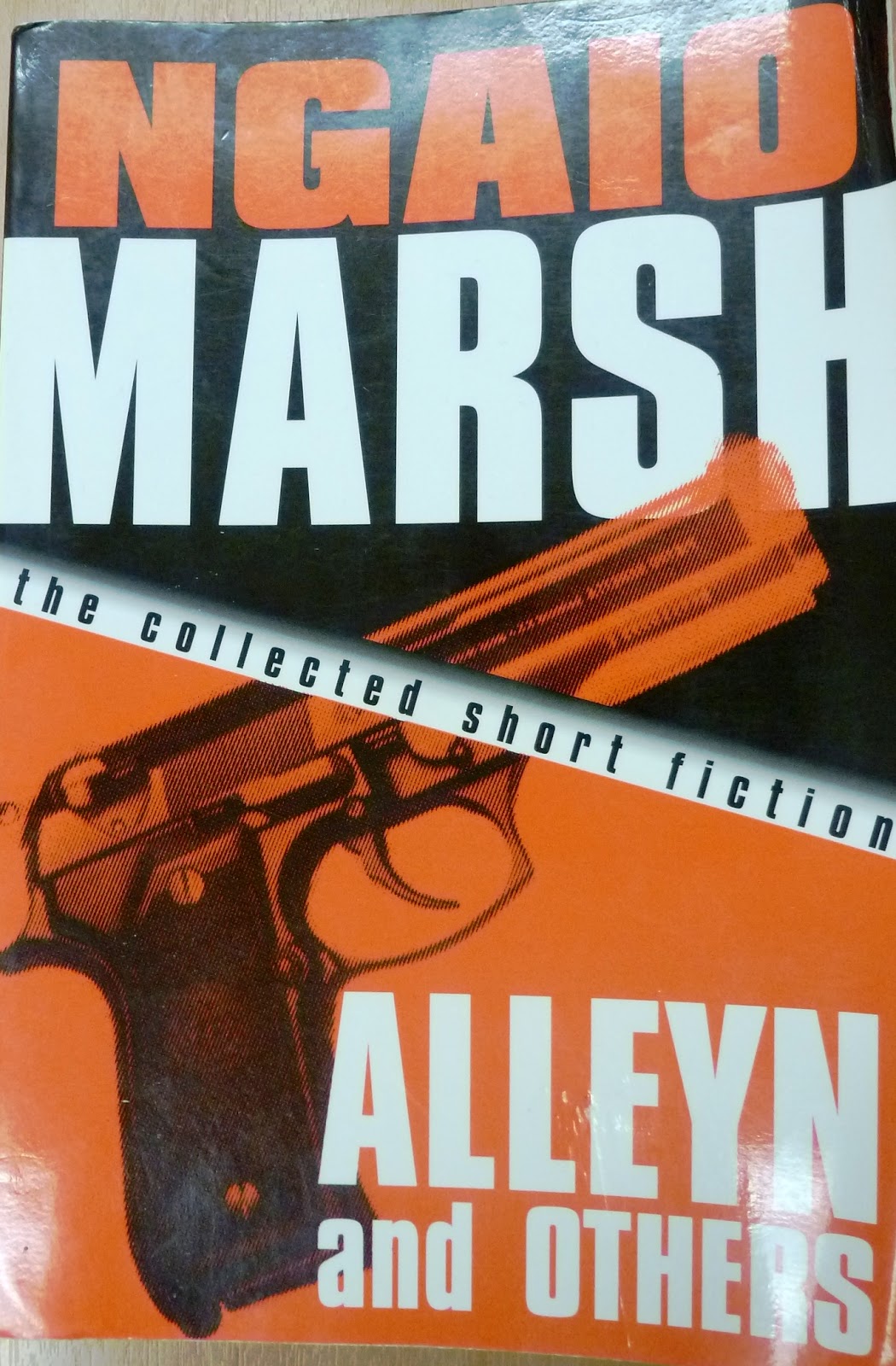
Alleyn and Others: The Collected Short Fiction of Ngaio Marsh

I love browsing through secondhand bookstores. I'm always on the look out for out-of-print and hard-to-find Kiwi crime novels, and other interesting books. Recently, while I was back visiting family in Nelson I stumbled across this little gem in Brett's Book Exchange in Richmond.

ALLEYN AND OTHERS: THE COLLECTED SHORT FICTION (1989)  is touted as "Dame Ngaio's last book", but is special for more than just that fact. Along with several short stories written by Dame Ngaio starring her longtime detective Roderick Alleyn, it also includes a then-recently discovered story which is believed to be her first published fiction, "The Figure Quoted", which had never before appeared in US publication (and had been out of print elsewhere for more than sixty years).

In addition, this little book includes essays by Dame Ngaio herself about her characters Roderick Alleyn and Agatha Troy, a telescript, and a good introduction to the collection by Douglas G. Greene.

I'm only partway through this collection, but it's very cool reading Dame Ngaio's own words describing the creation of Alleyn on a dreary day full of "remorseless" rain in London in 1931.

Do you like browsing secondhand bookstores? What gems have you discovered?

Friday, September 2, 2011

Ngaio on the 'Quake Case: one-night only fundraiser

“Ngaio Marsh – Crime Queen”

A Film Screening – One Night Only

A fundraising screening for The Court Theatre
Hosted by Peter Elliott as Inspector Roderick Alleyn

When: Monday 26 September 2011, 7.30pm
Cost: $25 per ticket
Where: The Aurora Centre for The Performing Arts, cnr Greers Rd & Memorial Ave
Run time: 70 mins – plus a Q&A for 20 minutes with the film makers.

DVD’s: DVD’s of Ngaio Marsh – Crime Queen will be sold with tickets and on the night at a reduced price
Cost: $20 – with all proceeds also going to “The Shed.”

Books: Harper Collins NZ is presenting the compendium of Ngaio’s detective stories and a signed copy of Joanne Drayton’s biography of Ngaio Marsh which will be raffled. on the night. Cost: $10 per ticket (Retail value $300+)

Total package: Ticket & DVD - $45
bookings@courttheatre.org.nz or Ph: 03 963 0870

All funds raised will go to the Court Theatre’s fundraising appeal for “The Shed.”

This event is funded by Creative New Zealand.

You can read more about the film, Ngaio Marsh - Crime Queen, below.

“Ngaio Marsh – Crime Queen”

(The Unsolved Mystery)

Detective Inspector Alleyn on the case of his creator, Ngaio Marsh

Chief Inspector Roderick Alleyn (Peter Elliot), the urbane English police officer and the detective who stars in all thirty two of Ngaio Marsh’s internationally renowned best selling detective novels, comes to life to go in search of his creator, Ngaio Marsh.

In his investigation Alleyn is teased by glimpses of Ngaio as she walks down a London street, sits reflecting in a café or slips into a radio studio for a recording. ‘Ngaio’ is adept at luring her Detective on, only to evade and escape revelation. This is a cat and mouse game played by two professionals. Who is stalking who and why? Does Ngaio want to be discovered, to finally reveal who she is behind her masks? If anyone can coax out the fact behind the fantasy, it is her Detective Inspector.

Alleyn leads the investigation into what is behind the masks and hidden in the fantasies - the contradictions and controversies of his mistress’s life. Ngaio Marsh has been the architect of his fictional world; now he explores her factual world. Does his investigation enable him to better understand the complex nature of his creator?

Does he discover that Ngaio Marsh’s fictional and factual worlds blur – or that he, a fictitious creation, is, in fact, an essential character in his mistress’s life. Ngaio Marsh – Crime Queen is on the case.

Dame Ngaio loved her city and she loved the theatre; this is her night to help out.

The filmmakers will hold a Q & A following the screening, which will include producer/director Aileen O’Sullivan, and actor Peter Elliot who features as Ngaio’s Detective Inspector Roderick Alleyn in Ngaio Marsh – Crime Queen.

NZ on Air and TVNZ funded the making of “Ngaio Marsh – Crime Queen”.

For more information contact – Ali Jones, Ali Jones PR (for The Court Theatre) on 027 247 3112

NB – Remember - $10 for raffle of Compendium of Ngaio Marsh books (ALL 32)

-----------------------------------------------------------------------------------------------------------
 
This sounds like a terrific evening out - and I'd heartily encourage anyone in the Canterbury region, or driving distance away, to head along and support a great cause. Dame Ngaio actually received her 'damery', as she called it, largely for her work with New Zealand theatre - she was a driving force behind creating a theatre culture in New Zealand, and I'm sure she would love that a documentary about herself is being used to raise funds for the Court Theatre, an iconic theatre in Canterbury that, like many other things there, has been adversely affected by the series of devastating earthquakes over the past year.

Friday, June 10, 2011

Ngaio Marsh doco-drama to screen this Sunday!


Several months ago (last year), I shared a scoop about an upcoming documentary on the life of Ngaio Marsh. Then in February I shared more details about Ngaio Marsh - Crime Queen, which was due to screen on TV ONE as part of its Artsville series, that month. Fortunately or unfortunately, depending on how you look at it, that screening was postponed (the doco-drama was scheduled for a midnight timeslot - viewer feedback/outrage resulted in a delay in screening until later in 2011, at a more suitable timeslot).

Now those of us in New Zealand can finally get to see the documentary this weekend, with Ngaio Marsh - Crime Queen due to be broadcast on TV ONE this Sunday, 12 June, at the somewhat more reasonable time of 10.20pm. It should also be available 'On Demand' from the TVNZ website following the screening (I'm not sure whether overseas Internet users can watch or not, given regional licensing etc).

I'm looking forward to seeing this, as it seems like a fascinating production that has been put together - acclaimed actor Peter Elliott (Until Proven Innocent, Heavenly Creatures, Shortland Street) plays Inspector Alleyn, the urbane English gentleman police detective who stars in all thirty two of Marsh's internationally renowned best selling detective novels, who comes to life to go in search of his creator, Ngaio Marsh. Elliott (pictured above, as Alleyn) says of his role, "I found playing Detective Inspector Roderick Alleyn one of the most peculiar experiences of my life. It was like shipping coals to Newcastle, interviewing Eton and Oxford educated personalities in England as a private school, University educated, upper class character. It was a phenomenon both very odd and most enjoyable, this process of sleuthing around."
Elliott concludes, "Ngaio Marsh has joined the company of people to whom I am very grateful. She came to feel like a compatriot, a parent, a friend. I came to feel like one of Ngaio's Boys."

Producer/director Aileen O'Sullivan says of making the show and learning more about Marsh: "It is a documentary I have wanted to make for several years and found the figure we discovered even more complex, more extraordinary and more engaging than I'd originally suspected." Sullivan discovered Marsh fans exist in all corners of the globe, she says "we shot in Christchurch, New Zealand and in England, and in both countries were given tremendous support by crime aficionados and the friends and colleagues who treasure and respect Ngaio Marsh's work. It was strange to realise that while Dame Ngaio Marsh has been well celebrated here as a theatre director, the huge reputation she enjoys internationally as one of the all time Queens of Crime Fiction, has never been fully appreciated in New Zealand."

Amen to that, Aileen. It's amazing how much Ngaio is overlooked and under-appreciated amongst our literary heritage, although hopefully that is changing with the likes of Dr Jo Drayton's excellent recent biography, this doco-drama, and the creation of the Ngaio Marsh Award for Best Crime Novel.

Artsville: Ngaio Marsh - Crime Queen takes us behind the scenes and behind the public persona of this most private woman. We meet the people who were intimate and important in her life. There are her acting protégés from her days directing student theatre at the University of Canterbury in Christchurch. It is like a cast party after one of her Shakespearian productions: Elric Hooper, Jonathan Elsom, David Hindon, Gerald Lascelles, Brian Bell and Annette Facer are all interviewed. These, were her student ‘players’ whom she referred to as ‘sons and daughters of the house’, because they were not just actors, they were her family. They share both their reverent and irreverent memories of Ngaio – and in so doing bring her alive for a new audience. Their stories are compelling reminders that there is a fascinating history here at risk of being lost.

You can read some more information about the involvement of people in Canterbury, who knew Ngaio Marsh from her theatre days in Canterbury, here.

Elliott as Chief Inspector Roderick Alleyn and biographer Jo Drayton walk the streets of Knightsbridge in England, Ngaio stayed with actor Jonathan Elsom and the Rhodes family that she adored, and we see the flat where she wrote her first crime detective novel A Man Lay Dead (1934). Alleyn is teased by 'glimpses' of 'Ngaio' during his investigation as she walks down a London street, sits reflecting in a café or slips into a radio studio for a recording. 'Ngaio' is adept at luring her Detective on, only to evade and escape revelation. This is a cat and mouse game played by two professionals. Who is stalking who and why? Does Ngaio want to be discovered, to finally reveal who she is behind her masks?

Artsville: Ngaio Marsh - Crime Queen, TV ONE, 10.20pm, Sunday 12 June 2011.

Friday, March 25, 2011

NZBM Review: DIED IN THE WOOL by Ngaio Marsh

Died in the Wool
By Ngaio Marsh (HarperCollins, 1945)


Reviewed by Craig Sisterson

To close out NZLawyer’s celebration of New Zealand Book Month, it seems only fitting to look at a book from one of our all-time greatest authors, perhaps our most popular ever on the global stage, whose books are still in print more than 75 years after she was first published – our Grande Dame of mystery writing, Ngaio Marsh.

Christchurch born-and-raised Marsh penned 32 murder mysteries starring her English gentleman detective Inspector Roderick Alleyn between 1934 and her death in 1982, and is world-recognised as one of the ‘Queens of Crime’ of the Golden Age of Detective Fiction (alongside Agatha Christie, Dorothy Sayers, and Margery Allingham), with international critics even calling her “the finest writer in the English language of the pure, classical, puzzle whodunit”.

Died in the Wool is one of four Alleyn tales Marsh set here, and is made even more interesting as it was actually published during the Second World War, and incorporates aspects, issues, and perspectives on the war climate into the murder mystery plotline. Being written before Marsh would have even known when or how the war would end, some of the settings and characterisations can give insights into New Zealand at that time that no recently written historical novel, no matter how well researched, can match.

One summer evening in 1942, formidable Member of Parliament Florence “Flossie” Rubrick goes to the wool shed on her high country property to rehearse a patriotic speech, and disappears. Three weeks later, she’s found – dead inside a bale of wool at an auction. Inspector Alleyn, in New Zealand on war security matters, comes to the high country sheep station more than a year later, after Rubrick’s husband has also passed away from illness, and tries to piece together what really happened to the polarising MP, based on the testimonies of several acquaintances. At the same time, concerns are raised about the top-secret security work being carried out by two young men – have the blueprints for the new anti-aircraft device been leaked?

In effect, Marsh has transported the classic British ‘country house’ murder mystery, with its closed environment and small amount of characters – all of whom have a motive for killing the victim, into a rural New Zealand setting during the war. But she also does a few things differently that help Died in the Wool stand out. Alleyn arrives months after the murder, so can’t rely on the crime scene clues and observations usually available to detectives – instead he has to weigh the differing recollections of the residents (each has its own chapter, eg “According to Terence Lynne”). This device gave Marsh not only a different structure and investigative method, but the opportunity to ‘voice’ varying views and concerns about what was going on during the war, through her different characters.

In general, Marsh’s plots weren’t quite as intricate as Christie’s puzzles, but she was the superior writer when it came to setting, description, and giving her characters more depth and layers. Compared to today’s crime novels, the pace is somewhat languid, and at times, the language used dates the book, but decades after it was published, Died in the Wool remains an absorbing, enjoyable read.

Reprinted many times over the decades, Died in the Wool is now available as Volume 5 (in trio with Final Curtain and Swing, Brother, Swing) of the Ngaio Marsh Collection set of omnibus editions, published by HarperCollins UK to commemorate Marsh’s Diamond Anniversary.

---------------------------------------------------------------------------------------------------------------------

This article was published in today's (25 March 2011) issue of NZLawyer, and is republished here with permission.

---------------------------------------------------------------------------------------------------------------------

Have you read DIED IN THE WOOL? Any of Ngaio Marsh's murder mysteries? Do you still enjoy 'old style' cosy mystery novels? What makes them so re-readable decades later?