Wednesday, December 21, 2011

Festive greetings

I am now on holiday back in my hometown of Nelson, with almost all of my work done for the year. Sporadic Internet access means there may not be many posts on Crime Watch for the next couple of weeks, so I just wanted to take this opportunity to say thanks to everyone who has visited this blog in 2011, and particularly those who've taken the time to post a comment and share their views about the various crime fiction news, happenings, and issues raised here.

I hope you all have a truly wonderful festive season, filled with plenty of fun, friends and family.

Kia Kaha from Aotearoa

PS The image is of the pohutakawa tree - known as the New Zealand native Xmas tree. A nice sight along the New Zealand coastline over summer. Have a very Merry Xmas everyone!

Tuesday, December 20, 2011

The Thrillers of the Year

Well, it's that time of year when all the 'best of' and 'favourite' lists are made for various things, including books. It's interesting to see the different perspectives (and breadth of reading) on show with various lists from around the world that are regularly cropping up this month. In terms of New Zealand, I've already mentioned the prestigious New Zealand Listener 100 Best Books List - it was great to see several local and international crime/thriller titles make the cut in 2011 (you can now read the full list and reviewer comments about each book online here).

Another great publication in New Zealand, when it comes to book features and reviews, is the Canvas magazine supplement in the Weekend Herald newspaper. And recently, Canvas published a comprehensive "essential Christmas book guide", surveying what its reviewers saw as the best books of 2011, across a variety of categories. Reviewer Michele Hewitson, who provides the regular crime/thriller round-up for Canvas, chose the following five thrillers as top of the tree in 2011:
  • LITTLE STAR by John Ajvide
  • THE AFFAIR by Lee Child
  • THE DROP by Michael Connelly
  • DEATH COMES TO PEMBERLEY by PD James
  • FEAST DAY OF FOOLS by James Lee Burke.
It seems like a solid group of choices by Hewitson. The Burke book was also on the Listener list, and I've seen PD James' book also feature on other lists overseas, as has THE DROP (which I really enjoyed too). I liked THE AFFAIR, and thought it was Child's best in a while, although I personally wouldn't have featured it ahead of several other great thrillers from 2011 (eg IRON HOUSE by John Hart, THE WRECKAGE by Michael Robotham, THE LEOPARD by Jo Nesbo, COLLECTING COOPER by Paul Cleave etc).

But that's the great thing about such lists - they can expose the readers to books we may not have read or thought about ourselves, and they also provide some great discussion-starters for us hardcore crime fiction readers. So, what have been your personal favourite crime novels of 2011? And what do you think are the best crime novels of 2011 (favourites and 'best' aren't always the same - we can like a book that we realise isn't as 'great', but like it anyway).

Monday, December 19, 2011

Jo Nesbø talks about Harry Hole (video)

Tonight, I have a late-ish night ahead, as I have the privilege of interviewing superstar Norwegian crime writer Jo Nesbø, who will be touring New Zealand in March next year. Given the time differences between New Zealand and Norway, the interview doesn't start until midnight my time. Still, not a bad way to spend a Monday night/early Tuesday morning - getting to chat to someone like Jo Nesbø.

To mark the occasion, and to prime Crime Watch's New Zealand viewers for Nesbø's upcoming New Zealand tour, I thought I'd share with you a video of Nesbø talking about the character of Harry Hole, his popular and intriguing detective:

New Zealand set crime by a South African hand

Back in 2009, in amongst my regular crime fiction-related browsing online (search for interesting crime fiction tidbits and happenings of both a New Zealand and international flavour), I stumbled across an intriguing South African author, Chris Marnewick, who had been shortlisted for the prestigious Commonwealth Writers Prize for a novel that was packed with crime content, and blended fact and fiction. The news got my attention for a couple of reasons: a 'crime novel' being shortlisted for a major literary award, and the fact that the author was a South African lawyer. For those who aren't aware, I am a former lawyer myself, and now currently work fulltime for a legal magazine.

Marnewick's novel, SHEPHERDS AND BUTCHERS, which examined the death penalty via the tale of a young warden who goes from caring for then executing condemned men to a killing spree that sees him face the gallows himself, also went on last year to win the K Sello Duiker Memorial Literary Award (which forms part of the South African Literary Awards), amongst other accolades.

Now, Marnewick has returned with another crime thriller, and this time he brings his talent and storytelling skills to New Zealand shores, with A SAILOR'S HONOUR, published by Umuzi in September. Here's the blurb:

Pierre de Villiers has walked a hard road. Tortured by his own army, his family killed, surviving cancer; his new life in New Zealand is supposed to bring him peace. But just when his life seems to be on an even keel, his daughter is kidnapped in Auckland and his brother-in-law's wife abducted in Durban. What possible common enemy might the brothers-in-law have? The clues to the riddle stretch from Nazi u-boats of Africa's coast to a sinister Third Force pulling the strings of darkest South African history. Determined to defend his family. De Villiers is cast opposite "the major" in a life-or-death battle raging from Auckland to Durban and Hamburg. And on a bigger stage, the major's Force is not done yet; its final statement will be its most violent."

It certainly sounds intriguing. And it's always interesting to see foreign authors using New Zealand as a setting, and to see how they utilise and evoke my home country - a place that probably seems a touch exotic and definitely at the ends of the earth for most people.

You can read a recent interview with Marnewick on the Crime Beat blog, here.

Friday, December 16, 2011

Idris Elba scoops Golden Globe nomination

Idris Elba, the star of BBC AMERICA’s critically acclaimed crime drama, Luther, has been nominated for a Golden Globe® Award, it was announced this week. He was nominated in the category Best Performance By An Actor in a Mini-series or Motion Picture Made for Television.

Perry Simon, BBC Worldwide America’s GM, Channels says: “Idris’ portrayal of John Luther breaks the mould of TV detectives. He is a central character that is quite possibly just as dangerous as the criminals he’s chasing. Idris’ stellar performance truly deserves this nomination and has set a bench-mark for quality drama on BBC AMERICA.”

Elba plays the title role in the BBC AMERICA co-production about a brilliant and emotionally impulsive detective. The mini-series was lauded by fans and critics alike when it was first broadcast on BBC AMERICA in October. TV Guide said it was, “Criminally good... Luther is Prime Suspect on crack,” USA Today called it a “...terrific six part thriller... you have to watch,” and Variety declared “Luther is well worth the investment… there haven't been many recent offerings in this genre on either side of the pond superior to Luther.”

Luther was created and written by Neil Cross, the acclaimed suspense novelist and one of the lead writers on MI-5. You can watch a trailer for Luther below:

Untold stories: an interview with Kiwi true crime writer Peter Graham

Largely retired Hong Kong barrister Peter Graham talks to Craig Sisterson about a life filled with orchards, cider, and delving into history through the door of true crime writing

Writing was something that long-time barrister Peter Graham had always seen, “in the back of my mind or further forward”, as something he’d wanted to do. “I’ve always been a great booklover and reader, and yes I think it’s been an ambition of mine for a very long time,” says Graham, whose second ‘true crime’ book, So Brilliantly Clever (Awa Press, 2011) was released last month, to great reviews and a spot on the local non-fiction bestseller list.

Now largely retired from a long life in the law, including three decades as a Crown Counsel then barrister in Hong Kong, Graham spent the past three and a half years extensively researching one of New Zealand’s most notorious crimes and trials – the 1954 Parker-Hulme murder. It’s a case that has fascinated Graham since as a young lawyer he worked in the 1970s as an assistant to Brian McClelland, who had been junior counsel for Juliet Hulme.

“Before I went to Hong Kong I had the idea that I wanted to write a book about the Parker-Hulme case, because I’d become so interested in it,” recalls Graham. “In fact I tried to get hold of the Wynn Williams file on the case, with the help of Brian McClelland, but the file had gone missing. I went on to Hong Kong, and the need to earn a living intervened.”

Graham, who completed his law degree at Victoria University and worked at Chapman Tripp before moving to Christchurch, spent five years as a prosecutor in Hong Kong – for the Crown then the Independent Commission Against Corruption, which “mainly prosecuted policemen who’d amassed mega fortunes in some cases… pretty fascinating stuff” – before going to the bar. It was while working as a barrister there that he came across the story that would become his first true crime book, Vile Crimes: The Timaru Poisonings (CUP, 2007).

Vile Crimes centres on one of the most sensational court cases of the nineteenth century; in 1886 charming Timaru businessman Tom Hall Jr, the nephew of former New Zealand premier Sir John Hall, was tried first for the attempted murder of his wife, then the murder of his father-in-law, Captain Henry Cain, one of the founding fathers of Timaru, whose body had to be exhumed for evidence. “It was the most terrific scandal in its day, absolutely earth-shattering stuff,” says Graham, who stumbled across a contemporary account of the trial in a rare book catalogue. “I thought it was a great story, and it was also very fully reported, because it caused a scandal. And for me it was an interesting window into the period as well – it wasn’t just about the crime itself, it seemed to me to provide quite a bit of insight and a lot of detail into what life was like in this small, rather snobbish community in the 1880s.”

Graham, who at the time still had the idea of a book about the Parker-Hulme murder bubbling away in the back of his mind, thought the Timaru poisonings would be an easier story to tell – “which it proved to be” – due to the fact there was less material, and it was all documentary in nature, rather than involving interviews and other sources. “I thought I could teach myself to write a book by starting with this,” he says. He found time to write amongst his legal schedule, and started leading “this kind of dual life” as a lawyer and writer.

By the time he later began working on what became So Brilliantly Clever, Graham had largely retired from legal practice, to a small farm he and his wife had bought near Dunsandel. Apart from supervising a few pigs, pottering around with a small farm “and rather big garden”, writing, and a little bit of law and travelling, they grow apples, says Graham. “We have a business making apple juice and cider, so in a way that’s my day job. We make single variety apple juice called Camla Farm, and it’s my job to do the labelling, bottling, dispatching, and deliveries and that sort of thing. That occupies me some of the time.” A hint of pride creeps into his voice as Graham notes their cider has won gold medals, and they are “probably the only people in New Zealand making cider commercially with cider apples”.

Despite the fact that Graham’s first two books, and the one he has now started researching – on the case of Francis Sheehy Skeffington, an Irish pacifist and suffragist arrested without reason and executed by British Army soldiers during the 1916 Easter Rebellion – all involve historic true crime, the former barrister doesn’t think he’s “more interested in crime than anyone else”. In fact, he’s primarily interested in the past. “I can’t imagine myself writing a book about a murder that’s happened last week in Wellington, or something,” he says.

For Graham, finding such fascinating incidents merely provides an interesting doorway to explore the world as it was in a particular place during a particular time – whether it’s 1880s South Canterbury, 1950s Christchurch, or Dublin during the First World War. “I think the starting point would have to be that I’d like to think I know a good story when I see one,” he says. “You’re not just writing about a crime, you’re writing about it very much in the round. It’s a way to look at the world. You’re seeing people in extreme situations, aren’t you.”

Graham also likes to comprehensively explore untold stories – whether stories that most people have heard very little about, such as the Timaru poisonings, or stories that are very famous and people think they know about, but don’t really, such as the Parker-Hulme murder. While the incident at the core of So Brilliantly Clever had been touched upon in plays, film, and some fiction and non-fiction works, Graham felt that there was still a gap, a lack of “a full account”. He also felt that if left any longer it would become harder to gather facts, as more people involved would have passed away. “I thought it had to be done now.”

The reaction of one of the first people to read the finished book, TV journalist Janet McIntyre, probably sums up the perceptions many New Zealanders have about how much they know about the Parker-Hulme case. “She said, ‘you know, I thought I knew all about this case, but then I realised after I read about five pages, that I didn’t know about it at all’,” recalls Graham, who applied to the Court to get access to the transcript of Pauline Parker’s diary, amongst other research. “It is so much a part of history and culture in New Zealand, that everybody thinks they knew about it, but actually [we don’t], and I had to work quite hard to put together some of the most basic facts about it.”

Graham is grateful for his long and interesting career as a lawyer, but says writing non-fiction books is “the most fascinating thing” he’s ever done. “I just love it. My heart is really in this, and I really try my very, very hardest to do my very, very best. It’s something I want to do, and feel I can do. So it’s something I will keep doing as long as I’m sound of mind and limb.”

------------------------------------------------------------------------------------------------------------

This article was first published in the print edition of NZLawyer magazine, issue 175, 16 December 2011, and is reprinted here with kind permission.

------------------------------------------------------------------------------------------------------------

Thursday, December 15, 2011

First thoughts on a controversial remake

Later this month, the English-language Hollywood remake of the outstanding Swedish film adaptation of Stieg Larsson's juggernaut bestseller THE GIRL WITH THE DRAGON TATTOO opens in cinemas.

Crime fiction fans around the world seem to have very mixed feelings about this latest Hollywood effort to cash in on foreign creativity, and make it more accessible/palatable for a wider (ie American) audience who perhaps aren't too keen on subtitled films, no matter how good.

Will Rooney Mara be able to provide a performance as Lisbeth Salander in the same league as Noomi Rapace, who set the bar so very high and seemed to embody Larsson's creation? Does the fact that terrific director David Fincher is involved give sceptics more hope than if other Hollywood heavyweights had been involved? Ditto for screenwriter Steve Zaillian? We'll all just have to wait and see.

Unless, that is, we were lucky enough to attend the world premiere in London this week. Like renowned crime fiction afficianado and commentator Ali Karim, who has written and edited for the likes of The Rap Sheet, Shots! ezine, January magazine, Crimespree magazine, and many other specialist crime fiction publications. People think I've interviewed a tonne of crime writers, but I've got nothing on Mr Karim, who has been at the forefront of crime fiction commentating for many years.

Now, Karim has shared his thoughts on the English-language remake on The Rap Sheet:

"Let me say that I enjoyed the original Swedish version directed by Niels Arden Oplev, so I was intrigued to see what the Americans might accomplish with the same material. I was not disappointed, as this new version is, in a word, mesmerizing."

Karim has much more to say about the film, and you can read his full review here.

So, are you looking forward to seeing a new version of Larrson's blockbuster? Comments welcome.

Former M15 director Stella Rimington to headline AWRF

Okay, in the past I may have quietly grumbled about the noticeable lack of crime and thriller writers on the extensive lineups of the Auckland Writers and Readers Festival (AWRF)the past three years. To recap: other than a one-off special event with Michael Connelly this year (which was outside the AWRF proper, but was an amazingly successful event that sold out, was moved to a bigger venue, and sold that out), there haven't been any crime or thriller fiction writers, international or local, invited to New Zealand's largest literary festival during the past three years that I've been back in New Zealand. This, at a time when local crime writing is going from strength to strength, and plenty of fantastic international authors have visited Auckland of their own accord at other times of the year (sometimes, very close to the Festival timeframe).

But having dealt out a few deserved brickbats to the AWRF about this ongoing oversight, now I will have to be fair and give out a bouquet to the organisers, who have just announced thriller writer Dame Stella Rimington, the first female Director-General of MI5, will attend the 2012 festival. There are many more authors, local and international, still to be announced - but hopefully this is a good sign of things to come. Rimington's attendance was announced along with two other internationals: Roddy Doyle (THE COMMITMENTS) and Australian young adult writer Emily Rodda.

Dame Stella will headline the Festival’s highly popular Soul Bar Lunch event alongside main programme appearances, is the British author of a number of gripping ‘insider’ spy novels, most recently RIPTIDE.

“It’s such a pleasure to reveal this taster of the rich line-up planned for May 2012,” says Artistic Director Anne O’Brien. “Dame Stella Rimington, Roddy Doyle and Emily Rodda will all bring fine craft, great minds and broad experiences to Auckland, not to mention providing the perfect Christmas reads, setting the tone for what will undeniably be another outstanding Auckland Writers & Readers Festival.”

The Auckland Writers & Readers Festival is New Zealand’s largest literary and ideas festival. In 2012 AWRF will run Wednesday 9 May to Sunday 13 May and will present another exciting list of international and New Zealand writers in more than 70 events, guaranteed to excite and stimulate hungry minds. The schools programme will be available in February 2012 with the full programme announced in the second half of March 2012 and tickets on sale from that time at buytickets.co.nz.

I've heard some whispers that the AWRF may be interested in (at long last) including some New Zealand crime or thriller writers in their line-up as well - which would be a terrific move, adding to what is already a very successful festival. Fingers crossed for some good news on that front as the fuller line-ups are announced early next year.

Who would you like to see at the 2012 Auckland Writers and Readers Festival?

Wednesday, December 14, 2011

Crime wave to strike Hamilton!

The programme for the 2012 Waikato Times Hamilton Garden Arts Festival has just been announced, and I'm very pleased to share that the organisers have picked up on the quality and growth of New Zealand crime writing, and have included what should be a terrific crime writing event.

The Waikato Times Hamilton Garden Arts Festival runs for the last couple of weeks of February, and consists of many terrific events, ranging from visual arts to music, comedy, film, theatre, dance, food and wine, and books. Held during what is often the best time of the New Zealand summer, it should be great.

There are four literary/books events at next year's festival, including a crime writing one. I say crime writing because it's a bit of a double header event, covering both true crime writing and crime fiction, with five fantastic New Zealand writers in attendance. At only $10 to attend, it's a complete steal. Here's the line-up of writers for the event:

Crime Writers
"Delve into the mind of crime"

Scott Bainbridge
New Zealand law means that all unsolved murder files are inaccessible for a period of 70 years. Even after this period, restricted access is rarely given. Bainbridge has been given unprecedented access to the police files for ten of New Zealand¹s most baffling unsolved murders.

Joan Rosier-Jones
In Joan's latest book, market gardener Chow Yat, lives on the outskirts of Whanganui in post-WWI New Zealand, a time of particularly rampant xenophobia. In 1922 this humble, hardworking Chinese man was brutally shot and the murder remained unsolved. Through sound enquiry Rosier-Jones single-handedly all but solves the case.

Ben Sanders
At 20 years of age, Ben Sanders fascination with crime fiction has paid off having just signed a two-book contract with HarperCollins Publishers. Ben's sophisticated and edgy writing style signals the emergence of a major new talent.

Vanda Symon
Vanda is the author of the Sam Shephard detective fiction series. Her latest novel Bound, went straight to number one in the New Zealand bestsellers lists.

Paul Cleave
At 24 Paul wrote The Killing Hour. A year later he wrote The Cleaner. In 2006, six years after it was written, The Cleaner was published. It became one of the biggest selling books ever to come out of New Zealand, picking up several international contracts within it's first year and introducing Joe, the 'loveable' serial killer who works at the Christchurch Police Department.

The Crime Writers event will be held at 5pm on Sunday 19 February 2012 at the Garden Terrace restaurant. Penny's Bookstore will be selling a range of the writers' books at the event.

Hope to see some of the North Island-based Crime Watch readers and crime fiction fans there on the night. Should be a great evening! Thanks to the organisers of the 2012 Waikato Times Hamilton Garden Arts Festival for embracing local crime writing in such a great way.

Scottish crime writer to give the Girl with the Dragon Tattoo a graphic twist

It has been reported today (NZT) that Scottish crime writer Denise Mina, who's recently been in the news down this way with the announcement she would be a guest at the 2012 New Zealand International Arts Festival (and was the subject of a very good feature by my fellow Ngaio Marsh Award judge Bernard Carpinter in a recent New Zealand Listener) willl take the reins of the "Girl with the Dragon Tattoo" series. Not to complete any rumoured fourth manuscript, but to bring Lisbeth Salander and her escapades to full vivid colour via graphic novels.

Alison Flood of The Guardian has said that, "Mina has been chosen by Larsson's literary estate to adapt the late Swedish novelist's The Girl with the Dragon Tattoo and its sequels The Girl Who Played with Fire and The Girl Who Kicked the Hornet's Nest into six graphic novels for DC Comics. The author, whose latest novel The End of the Wasp Season was shortlisted for the Gold Dagger award, said she had nearly finished adapting the first book, with the first volume to be out next March. The illustrator is Leonardo Manco, with whom Mina has previously collaborated on the Hellblazer comics."

You can read Flood's full article here.
 
It will be interesting to see Mina's graphic novel take on the Swedish crime tales. I'm fascinated by how some writers produce excellent work in a variety of mediums, while others concentrate solely on one. Different strokes for different folks, of course. Amongst the crime writers I've spoken to this year, our own Neil Cross writes film and television scripts in addition to bleak and gripping thriller novels, Robert Crais went from TV scripts to private eye novels, and Gregg Hurwitz juggles thriller writing with graphic novels, film, and TV scripts. And I thought my life was busy!
 
Hat tip to another of my fellow Ngaio Marsh Award judges, Graham "Bookman" Beattie, for the heads-up with the news about Mina.

Tuesday, December 13, 2011

Michael Connelly talks THE DROP, and future of the book business

A nationwide crime spree: my tiki tour for NZ Author magazine

a nationwide crime spree
there’s been a noticeable growth in locally-written crime fiction in recent years. Craig Sisterson surveys the landscape from north to south, looking at the emerging hotspots

When the four finalists for the 2011 Ngaio Marsh Award for Best Crime Novel gathered in Christchurch recently for the well-attended “Setting the Stage for Murder” event, not only did they represent some of the best examples of contemporary Kiwi-written crime fiction, but also its geographic spread across the country: Alix Bosco (revealed as playwright and screenwriter Greg McGee) from Auckland, Neil Cross from Wellington, winner Paul Cleave of Christchurch, and Paddy Richardson from Dunedin.

From Northland to Southland and everywhere in between, it’s becoming clear that more and more we have a number of local storytellers who are capable of weaving top quality tales of mystery, murder, and mayhem. Writers who have something interesting to offer readers, here and abroad, who enjoy this most thrilling (and globally popular) of genres.

As can be seen, there’s a diverse array of storytelling, setting, and styles on offer – something for everyone, reading-wise – as we take a little ‘tiki tour’ around the country.

An archaeological dig amongst the beauty of the Kaipara Harbour was the setting for Waiheke Island resident Dorothy Fowler’s intriguing debut mystery What Remains Behind (Black Swan, 2009). Switching narratives between the sabotage-affected modern-day dig and diary entries detailing events prior to a 120-year-old tragedy, Fowler also evokes a good sense of rural small town Northland, then and now. Just down the road in Mangawhai, travel specialist and former journalist Roy Vaughan has also recently debuted on New Zealand bookshelves with The Mereleigh Record Club Tour of New Zealand (Eloquent Books, 2009), which centres on a group of 60-somethings who unwittingly get caught up with an international drug ring, and a police and customs sting, as they tour New Zealand trying to recapture the rock’n’roll days of their youth.

Gulf Harbour resident Michael Green is partway through penning a page-turning thriller trilogy focused on a small group of survivors of a global pandemic. The second instalment, Blood Bond (Arrow, 2009), is set locally, and in England and on the high seas and countries in between, and Green is currently working on the third book in the series.

Overseas, many the career of a bestselling crime writer has had as its spine the creation and crafting of an intriguing hero (or two) capable can carrying an ongoing series. Readers will follow a beloved character as much (if not more) than an author. As such, it’s been terrific to see two fascinating local protagonists emerge over the past couple of years in nascent but promising series set in our biggest and most cosmopolitan city. First, we were introduced to middle-aged legal researcher Anna Markunas in Cut & Run (Penguin, 2009), a terrific thriller kickstarted by the tabloid fodder murder of a famed rugby player while in the arms of a high-profile socialite. Markunas is a terrific creation; a troubled but likeable heroine, filled with inner conflict, contradictions, doubts and authentic emotions. Combined with Bosco/McGee’s vivid and pacy storytelling, and great touch for the Auckland setting (the glitz-gilded grittiness of the CBD to the ‘mean streets’ of the southern suburbs), it’s easy to see why Cut & Run was praised by Scottish crime fiction star Val McDermid at an event last year, and went on to win the inaugural Ngaio Marsh Award in November 2010. Markunas continued to develop as a fascinating and complex heroine in Slaughter Falls (Penguin, 2010), a finalist for the 2011 award, and readers will be hopeful the series continues in coming years.

Last year also saw the introduction of Detective Sergeant Sean Devereaux, the main character in local wunderkind Ben Sanders’ The Fallen (HarperCollins, 2010), which sat atop the bestseller list for several weeks and was one of the biggest-selling New Zealand books of 2010, and By Any Means (HarperCollins, 2011). Devereux is an enigmatic, intriguing hero, and his narration is peppered with pithy comments, asides, and observations. The talented Sanders, a 21 year old uni student, has a punchy, crisp prose style, and a good touch for both pace and ‘telling details’ that give you a great sense of character and place. Like Bosco/McGee, he evokes Auckland well as a gritty backdrop to his thrillers, providing international quality crime fiction in a decidedly local setting, with bodies found in Albert Park, motorway car chases, and drive-by shootings in the CBD.

The regions between our biggest city and our capital city currently provide slimmer pickings when it comes to contemporary crime fiction, despite what would seem like a plethora of intriguing landscapes, geographic and demographic, and issues that could provide great fodder and colour for a well-told thriller story. Back in the day, Dame Ngaio Marsh even brought her English gentleman detective Inspector Alleyn to the volcanic plateau in Colour Scheme (1943), a murder mystery tinged with war intrigue.

Nowadays, one pleasing exception to the central North Island crime fiction drought is Palmerston North teacher Ken Benn, who has begun a young adult thriller series with Lethal Deliveries (Penguin, 2010), an exciting tale of sports-loving teenagers who get caught up in the world of gangs and drug dealing. Shortlisted for the LIANZA Young Adult Fiction Award this year, Benn’s debut bluntly addresses the tough circumstances and troubling issues some Kiwi kids face, leaving readers on tenterhooks for book two.

The capital’s king of contemporary crime fiction is undoubtedly acclaimed screenwriter and novelist Neil Cross, who from his home in the Wellington suburbs has penned a number of terrific psychological thrillers, as well as creating the award-winning BBC TV crime drama Luther, starring Idris Elba (The Wire) in the titular role. While Cross sets his crime stories, books and TV, in his native Britain rather than his adopted home, he is a key part of the local crime fiction landscape: a twice finalist for the Ngaio Marsh Award (for Burial (Simon & Schuster, 2009) and Captured (Simon and Schuster, 2010)); a popular speaker at various arts and books festivals here and abroad; and serving as an example that New Zealand-based writers can succeed on the world stage.

Cross is a master of brooding, slightly off-kilter tales in bleak yet menacing settings populated with characters neither starkly good nor evil, but smudged shades of grey. Although his novel Always the Sun, a frightening tale of the steps a gentle man takes after learning his child is being bullied, was longlisted for the 2004 Booker Prize, Cross has said that he is continually irritated and baffled by the idea that books labelled ‘literary’ are often considered superior or “more important” than books labelled ‘popular’ or ‘genre’ fiction, regardless of quality. “All that’s important is that I tell an interesting and engrossing story,” he says. Books can delve into a variety of deep themes, and should be informed by a writer’s views and how they see the world, but such complexity and insights “should come through the telling of the story” – something done very well by the best crime fiction writers here and overseas– rather than being “stapled onto the book”.

Last year, TV writer-producer Donna Malane joined Cross in the Wellington crime writers’ fraternity when her debut novel Surrender (NZSA, 2010) was published to good reviews after winning the NZSA-Pindar Publishing Prize. Powered by a vivid and captivating narrative voice (first person, through the eyes of heroine Dianne Rowe), Surrender has an absorbing mystery storyline as Rowe delves into the seedy underbelly of Wellington; a drug-fuelled world of strip clubs, sex workers, and hidden dangers.

Earlier this year, Upper Hutt author Cat Connor added to her series starring FBI Agent Ellie Conway, available in e-book form from the likes of Amazon and iTunes, with an exciting third instalment, Exacerbyte, which brings Conway and her colleagues to New Zealand, on the trail of an elusive child trafficker. Wellington is also home to maritime expert Joan Druett, who has marvelously combined mystery and history in four novels and several short stories starring her part-Maori seaman Wiki Coffin.

Heading across the Cook Strait to the sun-drenched Top of the South brings us to horse-loving poet, playwright, and children’s author Lindy Kelly’s debut adult thriller Bold Blood (HarperCollins, 2009). The Nelsonian’s tale of assaults, arsons, horse theft and murder set in the high stakes world of horse breeding proved popular with readers, and hit #1 on the local bestseller list. Nelson is also home to iconic New Zealand author Maurice Gee, who over the decades has penned dozens of beloved tales, ranging from children’s to adult, fantasy to realism, and the occasional dip or two into psychological crime and thriller with the likes of In My Father’s Den and Crime Story. His latest (and perhaps last) adult novel, Access Road (Viking, 2009) scratches at the surface of a fictionalised West Auckland, revealing the menace beneath the mundane as an elderly everywoman searches for the historic reasons behind her bedridden brother’s silence.

Down the (west) coast we find ourselves amongst some of New Zealand’s most spectacular scenery for former national park worker Trish McCormack’s debut mystery, Assigned to Murder (Poutini Press, 2009), which is being taken to the Frankfurt Book Fair this year. Glacier guide Philippa investigates the murder of her old flatmate in an intriguing mystery packed with complex human relationships and stunning landscapes.

Several modern-day New Zealand crime and thriller writers call Canterbury home, the most prominent of which is Paul Cleave, winner of the 2011 Ngaio Marsh Award for his fourth dark Christchurch-set thriller Blood Men (Random House, 2010). Cleave’s acclaimed locally-set and written crime novels have been translated into many languages, and appeared on bestseller lists in several countries, including Germany, France, and Turkey, selling several hundred thousand copies abroad. Like Dame Ngaio herself, Cleave is succeeding abroad as a crime writer while being somewhat overlooked or underappreciated by the wider books community here at home. And, like Cross, he is showing that New Zealand crime writers can excel on the world stage, and that we should not feel any ‘cultural cringe’ about our own writing. Recently, his fifth novel, Collecting Cooper (Atria, 2011), perhaps his best novel yet, became his second book published in the United States. It sees the return of former cop and private eye Theo Tate, who after being released from prison finds himself reluctantly on the trail of a dangerous killer, and a missing student. It’s easy to see why Cleave’s writing has attracted international attention: his vivid prose crackles with energy, his characters are compelling and complex, and he delves deeply into psychology and other issues while never taking his foot off the storytelling accelerator.

Joining Cleave in calling Canterbury home are contemporary thriller writers Steve Malley – Poison Door (Createspace, 2011), a gritty Christchurch-set thriller featuring a tough cop, a troubled teen, and a vicious drug kingpin, is now available on Kindle and Smashwords.com – and Grant Shanks. The latter writes thrillers under the name Andrew Grant, including the Ngaio Marsh Award longlisted spy tale Death in the Kingdom (Monsoon Books, 2007), and its sequel Singapore Sling Shot (Monsoon Books, 2009), both of which have recently become more readily available here in New Zealand.

Heading further south we find ourselves in another hotbed of contemporary Kiwi crime fiction, as several talented authors call Dunedin home; Vanda Symon, Paddy Richardson, Liam McIlvanney, and Andrew Porteous. Earlier this year Symon, a previous Ngaio Marsh Award finalist, released Bound (Penguin, 2011), the fourth and possibly best instalment yet in her acclaimed series starring Sam Shepard, who has risen through the police ranks from sole-charge Mataura cop in Overkill (Penguin, 2007) to put-upon junior detective for the Dunedin CID. Symon hasn’t yet been published as broadly as Cleave or Cross internationally, but her storytelling skills, snappy dialogue, vivid characters and settings, and flashes of humour have impressed readers and reviewers here and abroad.

Symon was joined in the Dunedin crime family by Paddy Richardson in 2008 (creepy psychological thriller A Year to Learn a Woman), recent Scottish immigrant Liam McIlvanney in 2009 (superlative thriller All the Colours of the Town, set amongst the sectarian violence of Glasgow and Belfast) and Andrew Porteous in 2010 (A Political Affair, which was published after winning a UK-based unpublished manuscript award, and introduced part Maori Dunedin detective Lachlan Doyle).

Clearly there’s something in the water down south. Richardson has also penned Hunting Blind – a superb tale melding family drama and psychological suspense as a woman tries to uncover what happened to her kid sister, many years go – and will soon have another book hitting shelves. Traces of Red, a psychological thriller centred on a failed TV journalist who believes a convicted triple murderer is innocent, is released in November. McIlvanney is also reportedly working on another thriller starring journalist Gerry Conway, and like himself, may even emigrate his hero to New Zealand in future.

Without a doubt, New Zealand crime fiction has experienced pleasing growth in recent times, numbers and quality-wise, thanks to the books and authors mentioned here, and a few more. The snowball has started rolling down the hill, and it will be fascinating to see just how big it can get, here and abroad, if local readers who enjoy a bit of mystery and thrills in their reading become more willing to discover the talents we have right here.

-------------------------------------------------------------------------------------------------------------

Craig Sisterson writes for a variety of publications in several countries. He is the Judging Convenor of the Ngaio Marsh Award for Best Crime Novel, and the creator of Crime Watch, a website focused on New Zealand crime and thriller writing: http://www.kiwicrime.blogspot.com/.

-------------------------------------------------------------------------------------------------------------
This article was first published in the October/November issue of New Zealand Author magazine, the official publication of the New Zealand Society of Authors. It is reprinted in full here with the kind permission of Editor Adrian Blackburn.

Monday, December 12, 2011

Paddy Richardson talks about TRACES OF RED

Last week, Paddy Richardson's third psychological thriller, TRACES OF RED, was officially launched at an event in Dunedin. The early reviews have been very positive. Richardson was of course one of the finalists for the 2011 Ngaio Marsh Award for HUNTING BLIND. You can read US mystery author Margot Kinberg's review of that book here.

Yesterday, she spoke to Radio New Zealand about writing TRACES OF RED, which again underlines Richardson's skill at mixing creepy thriller plots that echo real life headlines with personal stories of people and relationships.

Here's the blurb for TRACES OF RED:

Rebecca Thorne is a successful television journalist, but her world is thrown into turmoil when her Saturday night programme is axed because of falling ratings. Not only will she lose her job but her big story on the convicted triple murderer Connor Bligh, whom Rebecca believes is innocent, has to be abandoned.

Rebecca's lover Joe, a married man and the barrister representing Bligh, also thinks Bligh is innocent – or does he? And if he loves Rebecca so much, why is he prepared to cast her off?

Meanwhile Bligh languishes in jail, convicted of three brutal murders and continuing to protest his innocence. He's clearly not a saint – but did he do it? Rebecca refuses to let the matter lie...

In a review for the Herald on Sunday, I said TRACES OF RED showed "Richardson excels at evoking the human aspects behind the plotline". My fellow Ngaio Marsh Award judge Graham Beattie also reviewed the book last week, saying TRACES OF RED was "psychological crime fiction at its best", and "the best she has written, and that is high praise" (read here). In a year which has seen some truly terrific crime fiction released by New Zealand authors, Richardson's latest further illustrates the growing depth and quality of the genre here. The 2012 Ngaio Marsh Award for Best Crime Novel is going to be another difficult call for the judges.

You can listen to Richardson talk about the writing of TRACES OF RED here. Hopefully New Zealand readers will get out there and buy this book, supporting quality local crime writing.

Sunday, December 11, 2011

Through Scarpetta's Eyes: my interview with Patricia Cornwell

Recently, I had the privilege of interviewing Patricia Cornwell, who in a way sparked the whole forensic fiction sub-genre (which has since influenced many writers in books, film, and television) with her 1990 debut, POSTMORTEM, which introduced Kay Scarpetta and won a host of awards.

From the CSI franchise to Body of Proof, Bones, and dozens more TV shows that fill the nightly line-ups, it's easy to see that once Cornwell let the forensic/pathology/scientific side of crime fiction out of the box, it's something that has really taken hold for creators, readers, and viewers worldwide.

I had a very enjoyable half an hour chatting with Cornwell about a variety of topics, by phone, while she was touring the United Kingdom in support of her latest Kay Scarpetta novel, RED MIST.

Today, a feature article I wrote based on the interview was published in the Sunday Star-Times, New Zealand's most widely-read Sunday newspaper. If you are in New Zealand, you can read the article on page F8 of the Culture magazine in the newspaper. Go and grab a copy - there's plenty of other interesting stories in today's issue as well.

Friday, December 9, 2011

Denise Mina talks about doing things differently

Recently it has been announced that acclaimed Scottish crime writer Denise Mina would be visiting New Zealand early next year, as part of the 2012 New Zealand International Arts Festival.

As noted on the Festival website, "Mina is a Scottish crime writer and playwright whose style has been described as ‘tartan noir’. She is the author of the Garnethill trilogy and another series featuring Patricia ‘Paddy’ Meehan, a Glasgow journalist. Mina’s first Paddy Meehan novel, The Field of Blood, has become a BBC drama."

Ian Rankin has previously described Mina as "one of the most exciting writers to have emerged in Britain for years". Last month, Mina was interviewed by my fellow Ngaio Marsh Award judge Bernard Carpinter, who writes the monthly crime fiction column for the New Zealand Listener. That article is now available to read in full online. Amongst other things, Mina talks about being bored by "everything's awful endings", her most recent novel, THE END OF THE WASP SEASON, writing about a sex worker as "a full human being" rather than a caricature just to be brutally killed, why she began writing crime fiction, and much more.

It's a good piece by Carpinter, and I recommend you go and have a read (click here).

Thursday, December 8, 2011

Neil Cross makes Variety's list of "Ten Screenwriters to Watch"

There are many that think, due to our geographical location, that creative New Zealanders need to leave the country in order to succeed on a bigger, or global, stage. And while opportunities aplenty do exist all over the world, there are certainly examples that show you can have a world-class career, based right here in New Zealand. It may not be a well-trodden path, but it is possible.

Peter Jackson (amongst others behind the cameras, from costume designers to special effects wizards) have proven it with film. Paul Cleave is on the rise in the crime ficiton world (particularly amongst non-English speakers). And now, as highlighted by a recent article in Variety magazine (the Hollywood bible), Wellington-based Neil Cross, twice a Ngaio Marsh Award finalist, is showing that you can have one heck of a career from New Zealand suburbia.

Cross, who along with producing several terrific thriller novels has been lead writer on the acclaimed British spy show Spooks and creator and writer of the award-winning BBC series Luther, all from his Wellington home, has been chosen by Variety as one of "Ten Screenwriters to Watch", due to the film projects he is working on. Books, television, and now film; Cross could be accused of quietly taking over a small piece of the world, in a thriller writing sense.

"Don't let his dark stories and disturbed characters fool you; for a guy who has made a living out of weaving tales of crooked cops, mass murderers and scheming psychopaths, Neil Cross is a damn funny man. It's a fact that sometimes takes fans by surprise," begins the article by Justin Shady for Variety.

Read the full article here.

Almost three years ago, Cross was one of the first author interviews I ever did - for a feature in Australian books magazine, Good Reading. I remember him talking about how he'd taught himself screenwriting by adapting his own Booker longlisted novel, ALWAYS THE SUN, into a teleplay. That never sold, but it did provide a foot in the door for Cross to become involved with Spooks.

"I just like the idea of scriptwriting," he told me at the time. "It's portrayed with a sense of mystery, like you have to be one of the initiated to understand it. But, actually, I decided in the end - and I'd read a few books about how to do it - that the only way to do it was teach myself to do it."

Learn by doing; it's not a bad way to go when it comes to creative endeavours.

I've really enjoyed Cross's novels (so far I've read Holloway Falls, Burial, Captured, and Luther: the Calling) and his TV screenwriting - on both Spooks and Luther - so I am looking forward to seeing how his big screen projects turn out. As Variety have noted, he is certainly a writer to watch.

Hello Crime Writing Month!

CWA launches two major new initiatives to connect writers with readers

The Crime Writers’ Association (CWA) has announced two major new initiatives, an association to put readers in touch with writers and the expansion of the successful Crime Writing Week to an entire month next year.

Due to launch in February 2012 with a new website, the Crime Readers’ Association (CRA) will offer readers information about forthcoming books, exclusive interviews, and articles from CWA member authors. Readers will be invited to sign up to receive regular enewsletters featuring events, exclusive content, and news. In future, it’s planned that the CWA will also organise events for readers to meet authors.

National Crime Writing Week, which has run for two years, has seen members of the CWA taking part in readings, discussions, readers’ group events and workshops in bookshops, libraries, arts centres and other venues all over the country. The CWA has now decided to expand it to Crime Writing Month, beginning at the Crimefest event which runs between May 24-27 in Bristol and features some of the planet’s most successful crime writers. In a new initiative, Crime Month will wrap up with a black-tie event, where the CWA Dagger Awards will be announced. The event will incorporate all of the CWA’s non-TV awards, including for the first time the Diamond Dagger and Ellis Peters Award for historical crime.

CWA Chair Peter James said: “We’re very excited about launching these new initiatives. The idea behind the CRA is to bring readers and writers closer together. The CRA will create a bond between fans and writers and promote further the crime writing genre.

“In an age when crime writing is so popular it made sense to find a way of helping writers and readers connect. Authors could not survive without readers and the CRA acknowledges the fact and celebrates the role of the reader in the burgeoning success of the genre. The CWA has showcased members’ events and books on our website for several years now– wee see the CRA is an extension of this and we hope it will help our members to grow their careers.

“Crime Writing Month further underlines the point. Running it over a month will allow members to take part in more events than ever, getting out to meet their readers and support their local libraries. The CWA has long been concerned about the threat to libraries and Crime Writing Month will allow us to champion them as they face cutbacks. The month should be a really exciting event.”

More details of both initiatives will be announced over the coming months.

Please contact Claire McGowan at info@thecwa.co.uk for more information, or visit www.thecwa.co.uk

Wednesday, December 7, 2011

Margot Kinberg reviews HUNTING BLIND

Recently San Diego mystery author and professor Margot Kinberg visited New Zealand for a conference, which gave me the opportunity to meet Margot in person, show her around Auckland, and finangle a few Kiwi crime novels into her hands. I'm pleased to see that Margot not only enjoyed her time in New Zealand, but she's already read and enjoyed some of the Kiwi crime ficiton she took home with her. Today, Margot is here on Crime Watch as a guest reviewer, sharing her thoughts on Paddy Richardson's HUNTING BLIND, which was a finalist for the 2011 Ngaio Marsh Award.

HUNTING BLIND by Paddy Richardson (Penguin, 2010)
Reviewed by Margot Kinberg

Paddy Richardson’s Hunting Blind is a compelling story that has stayed with me. It all begins in 1988 at a school picnic in Wanaka, South Island, New Zealand. Minna Anderson and her four children are enjoying the lakeside picnic with everyone else when the unthinkable happens: Minna’s four-year-old daughter Gemma disappears. Everyone takes part in searching for the child but there is no trace of her, not even a body. The family is torn apart by the tragedy, but there is no evidence so eventually the investigation is called off. Each of the Andersons moves on as best they can but Gemma’s disappearance has left scars on everyone.

Fourteen years later, Gemma’s older sister Stephanie is finishing her psychiatry program in Dunedin. She does function, but even she admits that she cannot face the pain of her sister’s loss and really, she has never healed. Then she’s assigned a new patient Elizabeth Clark, who’s attempted suicide and is completely uncommunicative. Stephanie tries to reach out to Elizabeth is at first unsuccessful. Bit by bit, though, Elizabeth begins to trust her doctor and soon tells Stephanie her terrible story. Elizabeth’s younger sister Gracie disappeared one night, and no trace of her has been found.

Stephanie is haunted by how eerily similar Elizabeth’s story is to her own. She’s reluctant to pursue this because she knows the risks of getting too close to one’s patients. She feels compelled though and gently probes until she finds out as much as she can. Stephanie guesses that the same person who abducted Gracie might have abducted her own sister, so against her more rational judgement, she starts putting the pieces of Gemma’s disappearance together and trying to find out who wrought that havoc on her family and Elizabeth’s.

For me, this novel is much the story of how survivors of tragedy cope as it is anything else. In fact, that’s why Stephanie begins what even she admits is an irrational quest – she wants to cope and move on. Richardson effectively portrays the sense of guilt that each member of the Anderson family has for not being able to take better care of Gemma. She also shows clearly how guilt and pain affect the members of the family. The characters stay with one because they are authentic.

In fact, that authenticity is one of this novel’s strongest points. People really do behave as the members of both Stephanie Anderson’s and Elizabeth Clark’s families do in the wake of horrible loss. I found myself caring about these people because they aren’t uni-dimensional. What’s even better is that they don’t all behave in the same way. We get a real sense of how differently people cope with sudden devastating loss.

Another very strong point in this novel is the unforgettable setting. As Stephanie searches for Gemma’s abductor, she travels to several places on South Island, and each is described in lovely but not overburdening detail. One gets a really authentic sense of life there not just from the physical setting but from several other little touches that really add to the context.

The mystery itself is not an intellectual puzzler. Soon after Stephanie begins asking questions, it’s evident who abducted the two girls and how that person got close to them. But the solution makes sense given the kind of story it is, and Richardson reveals the solution in a believable way.

The story moves back and forth a bit in time, and even though I had no problem figuring out what time period was being discussed, that did stop me a bit. Also, the story’s written for the most part in the present tense. That’s not my preference, and I found it a bit difficult at first. But those are minor quibbles to be sure, and mostly a matter of preference. Overall Richardson tells a gripping and truly human story of what happens when families have to cope with the unthinkable. And to her credit, she does so with no gore, brutal, ugly violence or gratuitousness. I recommend Hunting Blind. Thanks again, Craig, for inviting me to review it.

-------------------------------------------------------------------------------------

Margot Kinberg is a mystery novelist and professor who loves to read and talk about mystery and crime fiction. She is the author of PUBLISH OR PERISH and B-VERY FLAT, and blogs about crime fiction at Confessions of a Mystery Novelist.

Thank you Margot for the well-written and comprehensive review.

Tuesday, December 6, 2011

Books to film: Katherine Heigl as Stephanie Plum?

I love books. Always have. I also love movies and TV. Always have. So of course I'm always interested to see when characters and storylines from one medium jump to the other. As we all know, the best books don't always make the best movies. But there have also been some very good moviews adapted from books (good, bad, and mediocre) over the years.

In the past couple of years, I've really enjoyed the film versions of The Girl with the Dragon Tattoo, The Lincoln Lawyer, and Shutter Island, amongst other crime fiction adaptations. I'm also looking forward to seeing how Angelina Jolie might portray Kay Scarpetta, if that project comes together.

Another big name crime writer whose work, and popular heroine, is coming to the big screen soon, is Janet Evanovich. Until recently, I hadn't read any of Evanovich's books, and in all honesty I'd probably fallen prey to listening to a few people who described the very, very popular author's work as a touch formulaic. So with a TBR pile tottering at over 300 books on my home bookshelves, I wasn't rushing to dive into a Stephanie Plum tale ahead of the many other new-to-me authors and characters to explore.

In one of those great lessons about perception and reality, last week I received a review copy of the latest Plum tale, EXPLODING EIGHTEEN, and for whatever reason, decided to read it next. And I really, really enjoyed it. I found Plum to be a very interesting heroine, with a nice mix of skills, personality, and doubts, and I particularly loved the balance of humour and action in Evanovich's storytelling. The the intriguing cast of supporting characters - that although could perhaps seem to border on caricature-ish on occasion, given their eccentricities etc, actually had some depth too - were another big plus. I found myself laughing out loud at times at the character relationships and interplay, and there was a nice narrative drive too.

Now, EXPLOSIVE EIGHTEEN was my first Stephanie Plum novel, and as I read more (as I most certainly will, having enjoyed it so much), I may find that perhaps the series is a touch 'samey' - but for now, I can hand on heart say that I was wrong to make assumptions about this popular series.

Given all that, I'm also now looking forward to seeing the film adaptation of ONE FOR THE MONEY, the first Stephanie Plum tale, due for release in January 2012. I'm not a huge Katherine Heigl fan, and she wouldn't have been who I may have pictured in the role - but like with the books, I need to be open to being impressed. Here's the trailer (which I think looks kind of fun - in that action/comedy genre that can be great to watch):


What hitherto un-adpated crime series would you most like to see brought to the big screen? Who are some of the actors or actresses that you could 'see' playing your favourite crime fiction characters? What do you think of this trailer? Of the Stephanie Plum novels?

'literary crime' novel wins Lillian Ida Smith Award

The New Zealand Society of Authors is pleased to announce that the recipient of the Lillian Ida Smith Award is Auckland writer John MacKinven (pictured right).

Judging panel convenor Robert Elliot says John’s manuscript outline stood out for meeting the most critical elements of the criteria set for the award and his entry deserved the opportunity to move closer to completion.

John’s project, a literary crime novel, grew out of a story of the same name ("Snow on the Desert Road") that came first equal in the Heartland short story competition in 2008.

John says he is delighted and honoured to be the recipient of this award and describes it as a vote of confidence in his work so far. "It's a tremendous psychological boost. And the financial assistance will allow me to make a big leap forward to my goal of completing the first draft before the New Year, and the final draft by April 2012."

The bi-annual Lillian Ida Smith Award was originally established in 1986 when Wanganui music teacher, Lillian Ida Smith bequested part of her estate to assist people aged 35 years or over to embark upon or further a literary career. Ida Smith had long been a passionate supporter of the arts and it was her wish that this award would be used to assist someone embarking on a career or who had not yet had sufficient opportunity to fulfil his/her potential.

Selection Panel: Rae McGregor, Adrian Blackburn, Robert Elliot.

For more information visit http://www.authors.org.nz/.

Kiwi crime showcased at NZIAF

Last month I shared that international crime stars Jo Nesbo and Denise Mina would be part of the 2012 New Zealand Arts Festival in Wellington next March. It's great to see New Zealand books and arts festivals including crime fiction amongst the literary content on offer. Now, I'm very pleased to be able to share that there will also be a New Zealand crime fiction event at the 2012 New Zealand Arts Festival.

Three terrific New Zealand crime writers will be part of the event; Vanda Symon, Paul Cleave, and Paul Thomas? What, you say - Paul Thomas? But he hasn't put a crime novel out in years. That's right - but in another piece of excellent news, the King of Kiwi crime writing during the late 1990s and early 2000s is making a welcome return to the page next year with DEATH ON DEMAND, his first Detective Ihaka tale in more than a decade (read more about Thomas's crime writing here).

Here's the official blurb for the New Zealand crime fiction event:

PAUL CLEAVE, PAUL THOMAS, VANDA SYMON
New Zealand crime fiction

Three of New Zealand’s best contemporary crime writers talk about mixing violence and humour, and bringing one of the world’s most popular forms of storytelling into a distinctly New Zealand setting.

Paul Cleave’s Christchurch-set thrillers have made bestseller lists and drawn critical acclaim around the world. His debut, The Cleaner, is one of the biggest selling novels ever to come out of New Zealand, and has been optioned for film adaptation. Blood Men, a novel about a man forced to confront his violent genealogy as he hunts his wife’s killers, won the Ngaio Marsh Award. Paul Thomas dragged local murder mysteries into modernity with several critically acclaimed thrillers in the late 1990s and early 2000s. His second Detective Ihaka tale, Inside Dope, won the inaugural Ned Kelly Award. After a decade-long hiatus, Thomas and Ihaka have returned with Death on Demand. Vanda Symon is the creator of the bestselling Sam Shephard series, set in Otago and Southland. A previous finalist for the Ngaio Marsh Award, her latest novel, The Faceless, is a standalone thriller told from multiple perspectives.

-------------------------------------------------------------------------------------------

There will be an official launch of the Writers and Readers week programme on 26 January, with tickets for all events going on sale on the 27th. Hope to see some of you there!

It's terrific to see more New Zealand books and arts festivals including crime fiction. I understand that there will also be New Zealand crime fiction events at several other festivals in 2012, including the Hamilton Garden Arts Festival early in the year, and the Christchurch Writers Festival in August/September. I haven't yet heard anything about the Auckland Readers and Writers Festival, but hopefully it too will include some crime fiction, international and/or local, in its 2012 line-up.

Monday, December 5, 2011

Crime in Listener's 100 Best Books

Last year, you might recall, I was very pleased to see several crime novels make the annual 100 Best Books list put out by the New Zealand Listener magazine (especially as the list the year before had had a distinct lack of crime, mystery or thriller fiction titles, New Zealand or international). The New Zealand Listener has long been considered one of our premier magazines. It is a weekly current affairs and entertainment magazine, renowned for having one of the best books sections around.

Near the end of each year the Listener has a “100 Best Books of the Year” issue, where its reviewers, with help from nominations from booksellers and others, compile their list of best novels, short stories, poetry, biography, memoir, and other non-fiction (eg history, science, journalism and essays, art, and food and drink) books of the year.

The 100 Best Books issue (see cover image above right) for 2011 has now hit newstands etc, and I am very pleased to share that it too includes several crime, mystery or thriller titles on the latest list:
  • BEFORE I GO TO SLEEP by SJ Watson
  • BOUND by Vanda Symon
  • DEATH COMES TO PEMBERLEY by PD James
  • FEAST DAY OF FOOLS by James Lee Burke
  • LUTHER: THE CALLING by Neil Cross
  • AN UNCERTAIN PLACE by Fred Vargas
  • THE WRECKAGE by Michael Robotham
So a nice mix of UK, US, New Zealand, Australian, and continental European authors, and a variety of different 'types' of crime or thriller fiction there, which is cool to see. Some cracking books there, and hopefully more Kiwi readers might give some of them a go, after reading about them in this week's issue of the Listener. Congratulations to the Kiwi crime writers who made the list.

Have you read any of the crime novels mentioned? If so, what did you think? If not, which ones catch your eye? Thoughts and comments welcome.

Paddy Richardson's TRACES OF RED launched this week

Just a quick reminder that Dunedin author Paddy Richardson's third psychological thriller, TRACES OF RED, will be officially launched at Marbecks on George Street in Dunedin on Thursday night. 

Richardson's last psychological thriller, HUNTING BLIND, was a #1 bestseller in New Zealand, was listed in the Listener's 100 Best Books for 2010, and was a finalist for the Ngaio Marsh Award.

Early reviews for TRACES OF RED have been very positive. Here's the 'backcover blurb':

Rebecca Thorne is a successful television journalist, but her world is thrown into turmoil when her Saturday night programme is axed because of falling ratings. Not only will she lose her job but her big story on the convicted triple murderer Connor Bligh, whom Rebecca believes is innocent, has to be abandoned.

Rebecca's lover Joe, a married man and the barrister representing Bligh, also thinks Bligh is innocent – or does he? And if he loves Rebecca so much, why is he prepared to cast her off?

Meanwhile Bligh languishes in jail, convicted of three brutal murders and continuing to protest his innocence. He's clearly not a saint – but did he do it? Rebecca refuses to let the matter lie.

Paddy Richardson's fourth novel is psychological crime fiction at its best.

You can read Nicky Pellegrino's interview with Paddy Richardson about HUNTING BLIND here, and my 9mm interview with Richardson here.

Hopefully any crime fiction fans in the Otago region might head along to Marbecks on Thursday night and support this terrific local writer. And if you do, remember to get some pics and send them in!

Friday, December 2, 2011

Photos wanted - New Zealand-related crime writing events (win prizes)

I have a favour to ask from all the Crime Watch readers out there that might have been to any author events with New Zealand crime writers (anywhere in the world) or international authors visiting New Zealand.

We're starting to build up some photo albums on the Ngaio Marsh Award for Best Crime Novel page on Facebook - of such events - and it would be fantastic if you could send in any photos you might have taken - whether at a local book launch, a visiting author event (eg see my picture of Val McDermid reading from TRICK OF THE DARK at the Women's Bookshop in Ponsonby last year, above), images of yourself with an international author in New Zealand, or a New Zealand author anywhere in the world (eg perhaps you met Paul Cleave or Neil Cross at Harrogate, or Vanda Symon at SheKilda, etc).

It would be great to build up some nice albums of crime writing related pics. If you or anyone you know has any such photos that you are happy to share, then please send them in to ngaiomarshaward@gmail.com. There will be numerous random draw spot prizes (win free books) for those that send in photos, from wherever you are in the world.

Thanks in advance for all your help.

Thursday, December 1, 2011

Happy Birthday Bev Robitai

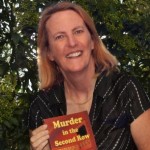
Just a quick note to wish New Zealand mystery writer Bev Robitai a Happy Birthday. I stumbled across Robitai and her work online last year, and read and enjoyed MURDER IN THE SECOND ROW, her debut novel, a theatre-set cosy-style mystery (see my review here, Reactions to Reading review here).

I've since met Robitai at a few Auckland-based book events, and she's a great supporter of New Zealand writing, as well as being a talented author herself. Along with getting her own books published, she has helped other local authors get their projects into ebook and paperback form, and available on sites like Smashwords, as well as distributed to stores through independent channels.

Robitai's second book, originally entitled EYE FOR AN EYE, was released earlier this year. The tale of a woman hunting down a conman who has ruined many lives has recently been re-released with a new cover, and a new title, 22 WAYS TO GET REVENGE.

Feel free to join me in wishing Robitai a very happy birthday here on Crime Watch, or on her author Facebook page here. Or, if you feel like it, perhaps give her a present she'd really appreciate, by trying one of her books, and then leaving some feedback or a review for her - I can certainly recommend MURDER IN THE SECOND ROW as a light, fun read with a great theatrical setting.

Ellis Peters Historical Award: Wartime tale wins

Overnight (NZT), the winner of the 2011 Ellis Peters Historical Award was announced. Here is the official press release from the Crime Writers' Association:

Wartime tale wins historical crime fiction award

A dark tale of wartime intrigue has been named by The Crime Writers’ Association as the winner of this year’s prestigious Ellis Peters Historical Award.

Andrew Martin’s novel THE SOMME STATIONS, published by Faber and Faber, was selected for the £3,000 first prize.

The award is sponsored by the Estate of Ellis Peters, Headline Book Publishing Company and Little, Brown Book Group. It is given to the best historical crime novel (set in any period up to 35 years prior to the year in which the award will be made) by an author of any nationality, and commemorates the life and work of Ellis Peters (Edith Pargeter) (1913-1995), a prolific author perhaps best known as the creator of Brother Cadfael.

The judging panel said of THE SOMME STATIONS: “Martin’s novels featuring railway detective Jim Stringer reveal their treasures in subtle fashion with a winning synthesis of period atmosphere, intriguing plotting and a passion for steam railways.”

THE SOMME STATIONS plunges into the horrors of World War One trench combat. Stringer and his unit must undertake dangerous nocturnal assignments: driving the trains taking munitions to the front. Death is everywhere, as the trains travel through blasted surrealistic landscapes, and a single-minded military policeman continues to investigate a killing that occurred before the departure for France.

CWA chair Peter James said: “Yet again, our judging panel had a tough task but after much deliberation came up with a truly worthy winner. Historical crime fiction is certainly in a healthy position with so many talented writers at work.”

The winner was announced at the Athenaeum in London.

The shortlist was:
  • Rory Clements PRINCE
  • Sam Eastland THE RED COFFIN
  • Gordon Ferris THE HANGING SHED
  • RN Morris THE CLEANSING FLAMES
  • Imogen Robertson ISLAND OF BONES

JUDGING PANEL
  • Eileen Roberts (Chair) - Originator and organiser of St Hilda’s annual crime symposium in Oxford, mystery and crime enthusiast
  • Geoffrey Bailey - Bookseller specialising in crime
  • Barry Forshaw - Edits Crime Time and is a talking head for the ITV Crime Thriller author profiles and BBC TV documentaries. A prolific writer, he has been Vice Chair of the Crime Writers’ Association.
  • Sir Bernard Ingham - Press Secretary to Prime Minister Margaret Thatcher and crime fiction fan
  • Jake Kerridge - the crime fiction critic of the Daily Telegraph

The CWA has also announced some changes to the award, effective from 2012. The Ellis Peters award will once again become a CWA Dagger and submission dates will gradually move to correspond with the other CWA awards. The changes are in line with the CWA's commitment to increase the profile of their non-TV Dagger awards. It's planned that the Ellis Peters and the other Dagger awards will be presented as part of a new awards ceremony in summer 2012. Publishers are asked to contact the CWA or visit the Daggers sub-site for the new rules in full..

For press enquiries or more information on the CWA, please visit the website, www.thecwa.co.uk, or contact media.enquiries@thecwa.co.uk