Showing posts with label forgotten books. Show all posts

Saturday, March 26, 2016

Review: MURDER AT THE MICROPHONE

MURDER AT THE MICROPHONE by Freda Bream (Ulverscroft, 1995)

Reviewed by Craig Sisterson

During a radio broadcast Lance Temple suddenly shocked his listeners by saying he was dying and that it was murder. Sure enough, Temple was found slumped over the controls with a knife in his back. When it becomes obvious the staff at Broadcasting House were all lying about their movements, amateur sleuth The Reverend Jabal Jarrett, vicar of the parish of St. Bernard's, Auckland, helps in the investigation.

Schoolteacher and postie (a term we use in New Zealand for the person who delivers the mail) Freda Whale wrote non-fiction books about both her careers, but for mystery fans her legacy lives on in a series she wrote as a retiree in a rest home, centred on amateur sleuth and Auckland clergyman The Reverend Jabal Jarrett. In the last decade and a half before her death (the 1980s-1990s), she wrote 13 mysteries in her series, under the pen name Freda Bream.

Murder at the Microphone is the penultimate book in the Jabal Jarrett series, and by now the amiable reverend has quite the reputation for finding the truth in tricky cases. This time he finds himself tangled up in a murder investigation due to his radio duties - he's scheduled to record a spot for the 'Faith for Today' slot at Broadcasting House, and while he's there Lance Temple is reading the regional news round-up only to announce some breaking news: his very own murder.

When Chief Inspector Trevor Chambers arrives on the scene and finds out Jarrett was in the building at the time someone stuck a knife in Temple's back, live on air, he quickly summons the priest. Not for last rites, but because Jarrett "is one of the shrewdest men I know when it comes to identifying the person responsible for murder". And so starts a dual investigation over the coming days, with the police trying to piece together what led to Temple being stabbed, and Jarrett nosing around.

This is the first of Bream's mystery novels I have read, and I found it to be a very pleasant and enjoyable read. It is cosy in nature, with a bit of a sense of humour and 'lightness' to it that reminds me a lot of watching an episode of Murder She Wrote. The Reverend Jarrett is an unassuming man who seems comfortable in his own skin, who has a sharp eye and mind to go with a nose for people that has led to him playing amateur sleuth on several occasions. In his role as a priest he has a knack for listening to people's problems, and getting them to feel comfortable and open up to him.

It's easy to see how he could be an engaging series character, the kind of old-fashioned one that may not change much throughout a number of books, but is like an old friend you enjoy catching up with.

Bream writes in a straightforward manner, constructing a classically styled mystery plot that has plenty of suspects among a contained group (those in the radio station building at the time), an interesting location or 'world' for the murder (radio broadcasting), and a series of suspicions, red herrings, and motives that come out as the police and Jarrett find out more about all the staff. The mystery largely unfolds through a number of conversations and deductions by Jarrett rather than a whole lot of action - again a classic puzzle style in terms of pacing and plot structure.

There is nothing particularly innovative or stand-out about Murder at the Microphone, but I found it to be a diverting and pretty pleasant read. It flowed well, had some nice touches of light humour, and overall was just a nice wee read, not trying to be more than it was. I think fans of cosy mysteries, especially those who like tales set in the 1980s and 1990s (ie more modern than Golden Age, but not current-day with cellphones and internet and other technological aspects) would enjoy this series.

One for fans of Murder, She Wrote and Midsomer Murders and the like.


Craig Sisterson is a journalist from New Zealand who writes for magazines and newspapers in several countries. He has interviewed more than 140 crime writers, discussed crime fiction at literary festivals and on radio, and is the Judging Convenor of the Ngaio Marsh Award for Best Crime Novel. Follow him on Twitter: @craigsisterson 

Friday, September 4, 2015

Forgotten Book Review: EXECUTION LULLABY (2000)

EXECUTION LULLABY by Nigel Latta (HarperCollins, 2000)

Reviewed by Craig Sisterson

Before New Zealand psychologist Nigel Latta became renowned for his many parenting books and his lively television appearances that focus on 'cut through the crap' advice for parents and families, he was a forensic psychologist who had spent a career dealing with the much darker side of human nature. Several years ago he fronted a popular television show, Into the Darklands, which provided viewers with remarkable insights into 'the criminal mind', and the motivations behind some of New Zealand's most horrifying real-life crimes.

Into the Darklands was inspired by Latta's 2003 non-fiction book of the same name, where he confronted readers by lifting the curtain on the realities of his career, tiptoeing through the psychological minefields that were the personalities and lives of some of our most notorious and dangerous offenders.

Nigel Latta lived up close and person with real-life crime and horror, and that insight comes through clearly in his one work of fiction, EXECUTION LULLABY, a disturbing crime thriller he published back in 2000, long before television celebrity came calling. Unsurprisingly given its title, EXECUTION LULLABY is a death-row thriller - Simon Chance is counting the nine weeks he has left before the state ends his life in retribution for a series of lives it says he ended. Seven teenage girls, wiped from existence.

As his time dwindles, Chance reflects on his happy marriage to Juliette, and how things irrevocably changed when he discovered a terrible secret. How did he really end up behind bars, preparing to walk the green mile? The reader follows along as Simon tells his story, almost as if we're the priest at final confession.

EXECUTION LULLABY isn't the easiest read out there - Latta take the reader to some dark places in terms of serial murder and sex crimes, threading in an intriguing whydunnit - as much as whodunnit - to power the narrative. As I read EXECUTION LULLABY I found the book settling into that 'good not great category', with some very interesting parts, plot and character-wise, but not quite the depth or texture of the better crime fiction. For a debut though, it showed a lot of promise, and was compelling and very clever.

But then Latta ramped things up significantly as Simon's time (and the remaining pages) diminished. He powered to a strong finish, that left me pondering for quite a while. His insight into human nature and the criminal mind, the dark things that lurk inside, coupled with some nice storytelling choices, made for a slick and gripping read, and left me hoping that Latta would write more crime fiction one day.

------------------------------------------------------------------------------------------------------------

I bought this book back in the mid 2000s, before the recent resurgence in New Zealand crime writing. I read it and wrote a mini-review at the time, but have now expanded my thoughts on this out-of-print book. 

Latta, along with the likes of Simon Snow and Michael Laws, was one of a few local authors to publish a crime thriller in the gap between Paul Thomas's groundbreaking Ihaka books of the 1990s and the new wave of New Zealand crime writing spearheaded by the likes of Paul Cleave, Vanda Symon, Paddy Richardson, Donna Malane, and Ben Sanders over the past few years. 

-----------------------------------------------------------------------------------------------------------

Friday, July 17, 2015

Forgotten Books: THE DEAD DON'T MATTER (1960)

There are some wonderful old crime, mystery, and thriller tales that have fallen by the wayside over the years, no longer remaining in print, but available here and there through secondhand dealers, online and bricks-and-mortar stores.

I love browsing secondhand stores, coming across authors and tales I hadn't heard of - and how great were some of those old covers from the post-war era? Much more evocative than a lot of what's out there nowadays.

Here's a recent find: THE DEAD DON'T MATTER (John Long, 1960) by Spenser Smith - an author who in a way followed in the footsteps of Fergus Hume (creator of the bestselling crime novel of the 1800s) - being born in England, moving to New Zealand, and then later shifting across the Tasman to Australia, where he set his debut mystery novel.

Smith also served in the Australian military in the Second World War, being stationed in the Middle East and in northern Australia, before becoming an author later in life. THE DEAD DON'T MATTER was published in 1960, and copies of the original edition are still available online, as well as a Mystery Guild edition.

Here's a review of the original release, from The Spectator archive (p30 of 5 February 1960 edition):
"Four tough and rather over- described Sydney layabouts get together to tunnel into a bank and half a million quid. Quite exciting to watch whether they'll get the money and which of them will kill whom first as they fall out over it. Not very stylish but pretty well plotted."
Sounds like a precursor to the 'crims turning on each other' stories I saw onscreen growing up, like Fargo and A Simple Plan.  I'm curious to learn more about this book and author, so please share in the comments if you've read this book, or know anything more about Spenser Smith the writer.

Sunday, May 31, 2015

Forgotten Books: SLEEPERS CAN KILL (1968)

SLEEPERS CAN KILL by Simon Jay (Collins, 1968)

The story: Members of a communist group meet once on an Italian beach as the war is ending and agree to stay inactive in the years ahead, until the call comes. Thus an espionage cell, "sleepers" is created, infiltrating New Zealand. Michael Connor is a discredited servant of New Zealand counter-espionage who is recalled as the sleeper cell comes violently awake, its puppet-masters finally pulling the strings. SLEEPERS CAN KILL is an exciting, complex and unusual espionage story, filled with murder and betrayal while offering something different in terms of a detailed New Zealand setting, strong characterisation, and a welcome sense of humour. Author Simon Jay breaks new ground for himself and adds to the espionage vogue by "discovering new spies and heroes in an authentic and unusual setting".

The author: Simon Jay was a thriller writing pseudonym used by New Zealand doctor Colin James Alexander (1920-2007). Alexander was born in Lincolnshire, but immigrated to New Zealand with his family at a very young age. He saw active service in Italy from 1945-1947, and was a doctor and surgeon before becoming a Professor of Radiology. He wrote two thrillers, DEATH OF A SKIN DIVER (1964) and SLEEPERS CAN KILL (1968), along with having a lot of medical work published.

Further comment: The idea of a 'sleeper cell' seems very common today, with all the talk of terrorism in the news, and its heavy use in crime and thriller dramas on screen and in books. Almost fifty years ago however, the idea would have been quite novel (pun intended), and for a New Zealand professor and doctor to insert it into a spy story, along with setting his tale of intrigue half a world away from the Euro-centric or North American-based mainstream of the time, would have been something quite unusual and interesting.

I'm very pleased to have stumbled over this book, which I purchased online from a secondhand dealer in the UK after I read about it in a footnote to some research I was doing. I'd heard of Simon Jay before, having sourced DEATH OF A SKIN DIVER - which was more of a murder mystery - a few years ago.

------------------------------------------------------------------------------------------------------------

What are some of your favourite out-of-print crime or mystery titles? Do you like reading old hardcover tales from the 1950-1970s that have fallen from fame? Comments welcome.

Saturday, March 21, 2015

Forgotten books: THE FEARED AND THE FEARLESS (1956)

THE FEARED AND THE FEARLESS by Guthrie Wilson (Corgi, 1956)

The blurb: The story starts in a British post behind the German lines in Italy. This little group of men was commanded by Captain Markham Faulkner, a hard and domineering man, feared by both friend and ally, and known throughout Italy as Il Brutto. To the post came Maria Cresswell, an American girl who fell under Il Brutto’s almost hypnotic spell. The war was over, Maria was happily married and living in New Zealand, Il Brutto was dead, but the past could not be forgotten. Often Maria tried to brush away the phantom from the past that crept back into her mind … telling herself that it was all over … finished …

Then one day it became a stark reality!

A swift and gripping novel of love and passion, of ambush and murder, of a manhunt that began in northern Italy and ended long after the war in the peaceful hills of New Zealand. This is a suspense story of high literary quality. Readers of Guthrie Wilson’s BRAVE COMPANY know with what consummate skill he can write of men in combat. To that skill he has added remarkable understanding of the mind of a man whose brain has been warped by the lust for power and shattered by injury. To Il Brutto’s story Guthrie Wilson brings stark reality in a superb novel of tension and terror.

The author: Guthrie Wilson was born in 1914 at Palmerston North, New Zealand. He attended school there and later became a student at Victoria University College, Wellington, where he gained his MA. He taught at Marlborough College, Blenheim, until 1941, when he joined the New Zealand Territorial Forces. From 1943-1945 he served in the New Zealand Infantry in the Middle East and Italy. He was captured just before the end of the war and ultimately awarded the Military Cross.  He returned to New Zealand, took up teaching again, and wrote BRAVE COMPANY and JULIEN WARE, both of which are Corgi bestsellers.

Critical reception: In the academic work, The New Zealand Novel, 1860-1965, Guthrie is noted for winning overseas acclaim as a novelist at the time, and this book seems to be analysed more on its merits as a war novel. Looking with modern eyes, some of the analysis in The New Zealand Novel, 1860-1965 in general seems stuffy or overly academic (in fairness, it was an academic tome providing an overview of New Zealand writing for a century), with a barely-contained sneer towards anything that hinted at what we'd call popular fiction. It's a good resource though, which I've used to discover many long-forgotten crime, thriller, mystery and suspense titles written by New Zealanders before 1965.

In the case of Guthrie and his war novels, including THE FEARED AND THE FEARLESS, Guthrie is praised for his evocation of war but skewered whenever it's felt he veers more towards entertaining readers with his storytelling:
"This is a deliberately violent study of "Brutto" (Scarface), the New Zealand leader of a partisan group; it is about blood and guts and murder and madness, about evil inextricably mixed with good, about pity for suffering and admiration for strength. Brutto, made repulsive by his raw head wound in the manner of Gothic terror novelists, terrifies all about him. Probably he is meant to symbolise the horror of war in what it does to the body and to the spirit. In both Brutto is feared, is fearless, is maimed, is strong. 
However this psychological theme is too much for the author, whose obsession with brutality exploited in strained rhetoric reminds one of the turgidities of cheap sensational fiction... This book raises doubts about Guthrie Wilson's artistic control. Is he merely making a blatant appeal to the popular market for blood-and-sex?"

Heaven forbid a 1950s New Zealand author would actually appeal to the masses...

In contrast, in a 1997 academic paper examing the classic physically hard and emotionally tough 'Man Alone' figure in New Zealand literature (something akin to the Tough Guy of Hemingway's writing and early American crime fiction etc), Dale Benson of the University of Otago noted that Wilson's portrayal of Il Brutto in THE FEARED AND THE FEARLESS implied a moral judgment about the heinous character, rather than simply just emphasising perversion and murder for its own sake. Benson writes that:
"When Il Brutto in The Feared and the Fearless kills many of the people who threaten to curtail his freedom Wilson's careful exposition of his past promotes the idea that, because Il Brutto's personality has been altered by a severe head injury, he is not responsible for his psychotic behaviour... Yet Wilson's displacement of his characters' personal responsibility on to their environment does not mitigate their fate..."
Similarly, the Oxford History of New Zealand Literature in English (1991) calls Guthrie Wilson "the only substantial New Zealand novelist to emerge from the (barren) early 1950s".

So perhaps tales of murder and mayhem, even those written in 1950s New Zealand against a wartime backdrop, can be both entertaining, and substantial. It certainly has me intrigued to read this sixty year old novel, and very grateful that I stumbled across it in a wonderful secondhand bookstore. 

------------------------------------------------------------------------------------------------------------

I found this book at Arty Bees Books in Wellington, in August last year. I first discovered Arty Bees when participating in the New Zealand International Arts Festival in 2012. It is an outstanding bookstore that for my money has by far the best out-of-print and hard-to-find New Zealand literature section I've ever seen. Both times I've visited I've found one or two old crime or thriller novels I didn't yet have, and I'd already compiled an amateur collection of more than 150 New Zealand crime novels from earlier days. So it is very hard for me to find anything I don't already have. If you're in Wellington, definitely check out Arty Bees, they have more than 100,000 books. It's a delight wandering their aisles and perusing their shelves. I was there for an hour plus on each of my visits. Just a great store.

Thursday, August 21, 2014

Forgotten book: LIGHT SPEED (1996)

LIGHT SPEED by David Frame (Quoin Press, 1996)

The blurb: Who killed the lovely Claire Bartlett, New Zealand's youngest, prettiest, greenest Member of Parliament? Was it Rufus Trout, MP for Nowhere in Particular and thwarted lover; Dale Thomas, fiscally correct crusader, or one of the many other characters who swarmed around the Golden Girl of Greendom?

Before being blown to bits by her briefcase on a Greencorp boat, Claire had single-handedly given a grateful nation the Light Speed Act 1999, but not everyone is delighted by a nifty piece of legislation which severely retards the speed of light in the name of Environmental Awareness...

Enter Morton Mains, physics lecturer, sceptic and reluctant detective. As he stumbles through the increasingly obscure world of professional politics in an attempt to piece together the last hours of Claire's life, Mort finds he's in a race against time like no other.

The author: Dave Frame was born in Invercargill in 1969. He was educated at Otatara Primary School and Southland Boys High School and majored in Physics and Philosophy at the University of Canterbury, from which he also holds a Masters degree in Astrophysics. He wrote LIGHT SPEED concurrently with his PhD thesis. He plays rugby and cricket and likes to borrow money from his mates. This is his first novel.

------------------------------------------------------------------------------------------------------------

I found this book last week at Arty Bees Books in Wellington. An outstanding bookstore that for my money has by far the best out-of-print and hard-to-find New Zealand literature section I've ever seen. Both times I've visited I've found one or two old crime or thriller novels I didn't yet have, and I've compiled an amateur collection of more than 150 New Zealand crime novels from earlier days. So it is very hard for me to find anything I don't already have. If you're in Wellington, definitely check out Arty Bees, they have more than 100,000 books. It's a delight wandering their aisles and perusing their shelves. I was there for an hour plus.

From what I can gather, and there's not much available online about LIGHT SPEED or its author, Frame went on to work at the Treasury for two years after finishing his PhD, and is now Director and Professor of Climate Change at the School of Geography, Environment, and Earth Sciences at Victoria University in Wellington, New Zealand's capital. You can see his faculty page here. He does not appear to have written any more fiction, although he has written several academic papers.

I'm looking forward to reading this books, which apparently is a bit of a satirical thriller.

------------------------------------------------------------------------------------------------------------

What out-of-print or hard-to-find crime fiction have you discovered and loved?


Friday, March 30, 2012

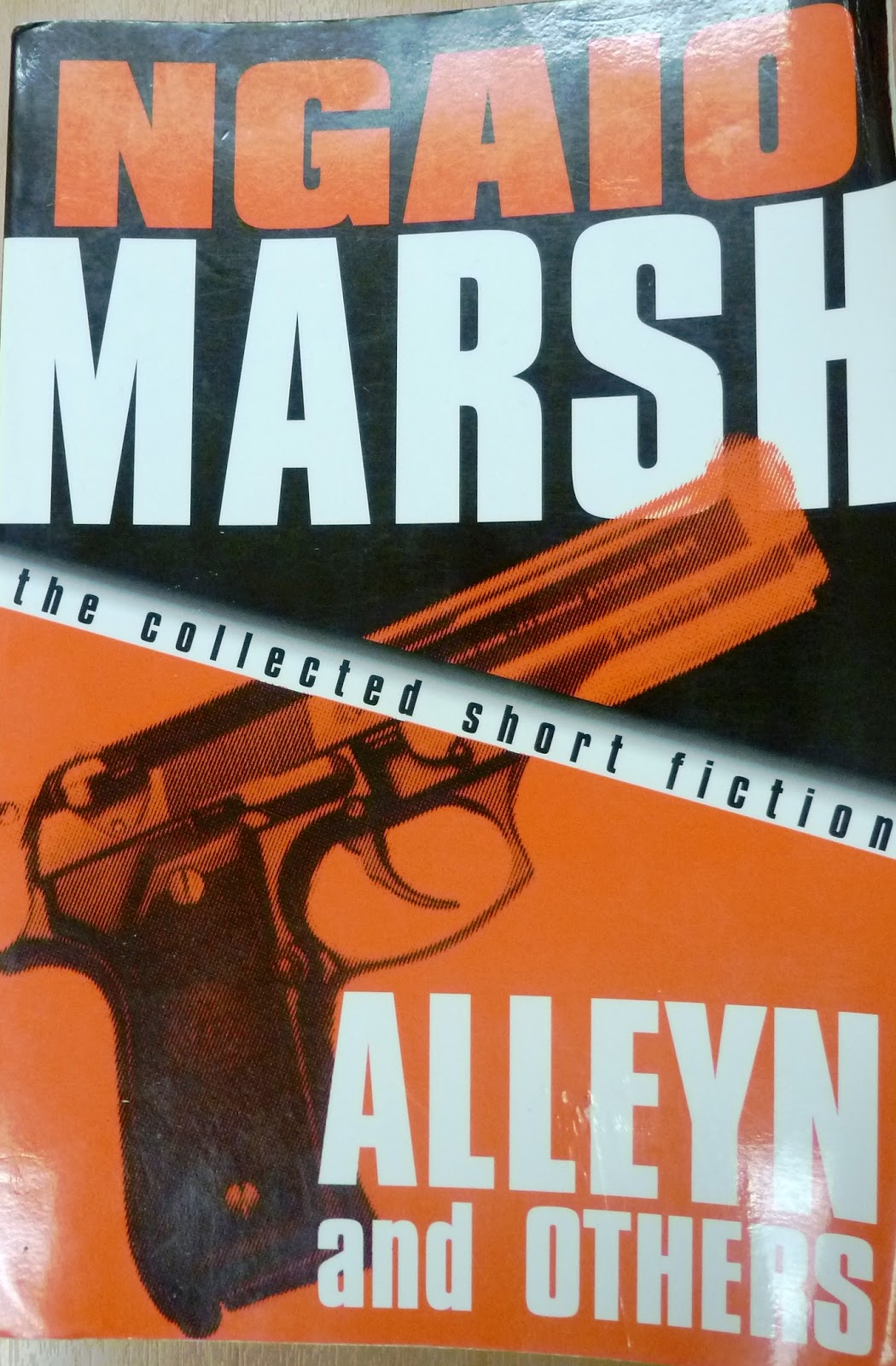
Alleyn and Others: The Collected Short Fiction of Ngaio Marsh

I love browsing through secondhand bookstores. I'm always on the look out for out-of-print and hard-to-find Kiwi crime novels, and other interesting books. Recently, while I was back visiting family in Nelson I stumbled across this little gem in Brett's Book Exchange in Richmond.

ALLEYN AND OTHERS: THE COLLECTED SHORT FICTION (1989)  is touted as "Dame Ngaio's last book", but is special for more than just that fact. Along with several short stories written by Dame Ngaio starring her longtime detective Roderick Alleyn, it also includes a then-recently discovered story which is believed to be her first published fiction, "The Figure Quoted", which had never before appeared in US publication (and had been out of print elsewhere for more than sixty years).

In addition, this little book includes essays by Dame Ngaio herself about her characters Roderick Alleyn and Agatha Troy, a telescript, and a good introduction to the collection by Douglas G. Greene.

I'm only partway through this collection, but it's very cool reading Dame Ngaio's own words describing the creation of Alleyn on a dreary day full of "remorseless" rain in London in 1931.

Do you like browsing secondhand bookstores? What gems have you discovered?

Monday, August 15, 2011

Five Favourite Kiwi Thrillers - a brand new Crime Watch series

Now that we've passed the two year blogosphere anniversary of Crime Watch, I thought it might be a good time to introduce a new recurring series - Five Favourite Kiwi thrillers - inspired by New Zealand writer David McGill, who I interviewed for the 9mm series last month.

Unlike 9mm (which will continue, don't worry - we have to get to at least 100 interviews before that series is retired), this brand new series won't just focus on crime and thriller writers, but instead will involve crime and thriller fiction readers - a much wider group. So over the next few months you'll see a variety of faces here on Crime Watch, from celebrities in and out of the books world to everyday readers, talking about their favourite Kiwi thriller novels (could be crime thrillers, spy thrillers, adventure thrillers, whatever).

The series arose from an email conversation I was having with McGill (pictured  above right), who has written 45 books on a very wide range of subjects, including several that fall within the thriller category (for example, IN XTREMIS). He shared with me his all-time five favourite Kiwi thrillers, caveated by the comment that his selection probably "dated" him somewhat. You can read more about McGill, his career, and his wide variety of acclaimed books, at his website here.

To kick-off the new series, here is a run-down of David McGill's Five Favourite Kiwi Thrillers (as far as I'm aware, in no particular order):

THE IDIOT PLAYED RACHMANINOV by Michael Brown
Summary: In the near future, when danger is in the mind and violence lurks behind every smile, a rural community foster a terrorist group called The Little Red Hen to defend themselves against the right-wing state. At the centre of the confrontation is the beautiful Rosa with the mentality of a child.

Note: Currently out-of-print, but you may be able to find copies in second-hand bookstores and/or libraries (I did, and have seen it a few times).

McGill's take: "international class and really thrilling in paranoid tradition".

SMITH'S DREAM by CK Stead
Summary: When Smith is left by his wife and goes to hide away in the bush in the Coromandel he never imagines he will become the most wanted man in the country. In a right-wing coup one man, Volkner, has seized power in New Zealand and is using army and special police to maintain his government. Smith's Dream forces us to imagine such a situation and to ask ourselves: Where would you stand? How far would you go?

Note: Recently reprinted as part of the 'Popular Penguin' series. Was adapted into a film, Sleeping Dogs, starring Sam Neill, which was the first New Zealand film released in the United States.

McGill's take: "I prefer the Sleeping Dogs title, and indeed the movie is as good B-grade as they get, and also the paranoia in the Big Brother tradition".

THE SCARECROW by Ronald Hugh Morrieson
Summary: A hilarious Gothic melodrama of a sex killer in a small town. Klynham is a sleepy little New Zealand town in which not a lot happens. But then one moonlit night the Scarecrow arrives, swilling brandies and looking for victims. Something sordid and even macrabre lies ahead.

Note: Widely renowned for having 'the greatest opening line in New Zealand literature': "The same week our fowls were stolen, Daphne Moran had her throat cut." Also adapted into a film in 1982. Recently re-released as part of the 'Popular Penguin' series of classic novels.

McGill's take: "Truly scary. Only Maurice Shadbolt patronage persuaded publication, which says much about our publishers (I know the chap who turned down THE BONE PEOPLE twice as publisher with different houses!)"

OLD SCHOOL TIE by Paul Thomas
Summary: Involves the unlocking of a dark 25-year-old secret relating to a teenage girl's mysterious suicide at a private school ball. Freelance journalist Reggie Sparks' investigation spills over into an underworld turf war involving the Sydney mafia and a ferocious Maori gang, the Blood Drinkers.

Note: Also known as 'Dirty Laundry'. Recently re-released as part of THE IHAKA TRILOGY, along with the Ned Kelly Award winning INSIDE DOPE and GUERILLA SEASON.

McGill's take: "Fresh and genuine crime talent".

BROKEN OCTOBER by Craig Harrison
Summary: The Treaty of Waitangi is stolen by Maori Guerillas. A weak Prime Minister resigns, and his power-hungry successor can't cope with the internal and international problems which rapidly follow. Industrial unrest flares overnight into violent racial conflict. New Zealand splits into two colours; And then the dominoes begin to fall. In one sense this novel is a straightforward narrative of violent revolt and savage repression - a 20th century Maorit Land War fought with all the weaponry and psychological techniques so grimly familiar to the 1970's. Fantastic ? Or eerily credible......

Note: This novel is out of print, but can be found in second-hand bookstores and online, and in libraries. I picked up a copy from a second-hand bookstore a few months ago, and have seen it elsewhere too.

McGill's take: "At time a breakthrough, I thought. More paranoia – must be Kiwi schtik".

-------------------------------------------------------------------------------------------------

What do you think about the new series? About McGill's picks of some lesser-known thrillers from days gone by? Have you read any of these novels? What do you think of McGill's penchant for dystopian tales of a New Zealand gone bad or mad at the highest, governmental level? Is that something New Zealand writers do well? Who else would you like to see be part of the new 'Five Fantastic Kiwi Thrillers' series? Comments, critiques and suggestions appreciated.

Monday, June 20, 2011

Ngaio judge reissues more thrillers

Last year I shared how British crime writer and renowned crime commentator Mike Ripley was part of a project to reissue classic British thriller fiction that had fallen from print and remembrance due not to its quality, but other vagaries of the world of publishing. Ripley is the author of the award-winning ‘Angel’ comic thrillers, co-editor of three Fresh Blood anthologies promoting new British crime writing and, for ten years, was the crime fiction critic of the Daily Telegraph. He is now well known for his great “Getting Away with Murder column” in Shots Ezine. He has also given his time to help recognise quality crime fiction from down this part of the world, as part of the judging panel for the Ngaio Marsh Awards for Best Crime Novel.

Ripley edits the Top Notch Thrillers series for Ostara Publishing, which re-issues titles that "have unjustifiably become unavailable either through the ravages of time or the forces of publishing economics". Ostara specialise in Crime and Thriller fiction titles and their range goes from the 1920s through to the 21st century. They publish thematically under several series, such as 'Cambridge Crime', 'Clerical Crime', and 'Medieval Mysteries'. Top Notch Thrillers was established in 2009 to revive Great British thrillers “which do not deserve to be forgotten”, using the latest print-on-demand technology and offering many titles as eBooks for the first time.

Next month, Top Notch Thrillers will reissue two great British thrillers from the early 1980’s, "both of which are fine examples of ‘flight and pursuit’ novels in the John Buchan tradition": ROGUE JUSTICE by Geoffrey Household and FUNERAL SITES by Jessica Mann. Here's what Ripley and Ostara have to say about their new releases:


"Geoffrey Household (1900-88), often seen as the natural successor to John Buchan, is rightly famous for his 1939 classic ROGUE MALE about an aristocratic English big game hunter’s failed attempt to assassinate Hitler and his subsequent fight for survival as the hunter becomes the hunted.

More than 40 years after that ground-breaking thriller, Geoffrey Household gave us the sequel, ROGUE JUSTICE, where the background to the previously anonymous ‘Rogue Male’ is revealed as he declares his own private war on Nazi Germany, blazing a blood-stained trail from Poland to Greece to dispense his own type of justice on the brutal ideology which has destroyed the Europe – and the woman – that he loved.

Not only is ROGUE JUSTICE a sustained, fast-moving action thriller, told with all Household’s usual skill when it comes to a pursuit over wild terrain and his self-depreciating humour, it is at heart a dark, nobly romantic but fatalistic love story. For the rogue hero this time, it is not a question of whether he will survive, but how he will choose to meet his death....

Jessica Mann is well-known as a broadcaster, journalist and crime-writer and is currently the crime fiction critic for the Literary Review. Her 1981 novel FUNERAL SITES is nothing less than an updated, feminist take on John Buchan’s famous tale of flight and pursuit, THE 39 STEPS, as the main character finds herself on the run from her politically ambitious (and murderous) brother-in-law. In a frenzied escape from a Swiss alp via London’s club land to a Cambridge hospital, she finds a lone ally in feisty archaeologist Tamara Hoyland, who was to become Jessica Mann’s series heroine, and the chase comes full circle in a dramatic showdown back in the Swiss mountains.

FUNERAL SITES is a frantic, breathlessly-paced chase thriller which puts a female stamp on what had seemed until then a very male preserve and whilst staying true to the form, the novel cheekily references the work of John Buchan – and indeed Geoffrey Household, another master of the genre.

Jessica Mann is the first woman to join the ranks of British authors reissued under the Top Notch Thriller imprint, who include: John Gardner, Victor Canning, Brian Callison, Duncan Kyle, Francis Clifford and Adam Hall."

Both books certainly sound quite interesting, and worthy additions to the Top Notch Thrillers canon that Ripley and Ostara are steadily building. By September 2011, there will be 20 Top Notch Thrillers available in print and (in many cases) electronic formats. They can be purchased through good bookshops or Amazon and via the Ostara website (http://www.ostarapublishing.co.uk/) which contains much additional information of TNT books and authors.


Do you like reading crime and thriller novels from another era? What good and great out-of-print crime novels have you stumbled across in libraries, secondhand bookstores and elsewhere? What are some of your favourite out-of-print books that you think would still stand up well today? Comments welcome.

Monday, June 6, 2011

U is for UNCERTAIN QUEST (1965)

For my second go around at the Crime Fiction Alphabet (read my 2010 posts here), I've set myself the challenging task of focusing not only just on New Zealand-themed posts, but just on Kiwi crime fiction books (ie I won't do any author profiles etc this time around) - although sometimes it may be the author's name that is relevant to the letter of the week.

This week I’m highlighting another lesser-known New Zealand mystery novel from decades past, UNCERTAIN QUEST by Elizabeth Messenger.

UNCERTAIN QUEST is set in the scenic Fiordland region of New Zealand, which is near the bottom of the South Island. High in the forbidding mountains a man named Grant has died in what was reported to have been an accident. However his widow, Lalia Grant, felt there was some mystery behind the accident and she flew across the world to discover the truth, certain that it would only be found at the scene of the tragedy. The first shock came when she arrived at the Palmer homestead to find her hostess murdered. Lalia immediately realised that someone wished the truth to remain hidden and that someone who had already committed murder would not hesitate to do so again.

Lalia, with her life in constant danger, continues her search for information but, when she finally discovers who murdered Vera Palmer, there awaits her a surprise that is to change the whole course of her life.

UNCERTAIN QUEST was published in hardcover in the UK in 1965 by Robert Hale, and is now only available via libraries and some second-hand dealers. It is a real shame that Messenger’s crime writing, which received good reviews in the UK on publication, has now been forgotten by New Zealanders. I’ve managed to source several of her crime novels, and I’m looking forward to reading them, and seeing how Messenger evokes 1950s-1960s rural New Zealand, and whether her characters and storylines stand up decades later.

Like most Kiwi writers of the time, and many of the 'genre' writers in much more recent times, Messenger was published by an overseas publisher (Robert Hale in London). "Elizabeth Messenger’s novels, once popular enough to be serialised and translated into other languages, are now difficult to obtain," says DNZB. I've certainly found that - even after trawling through countless online and real-life second-hand bookstores, and regularly searching the Internet and other resources as part of my unofficial research into New Zealand crime, mystery, and thriller writing, I only found out about her fairly recently. I have managed to source several of her books, but it's been a battle.From what I can gather, Messenger wrote at least nine crime/thriller novels in the 1950s/1960s, in addition to her journalism and cookery writing. They are:


  • MURDER STALKS THE BAY

  • MATERIAL WITNESS

  • DIVE DEEP FOR DEATH

  • LIGHT ON MURDER

  • THE WRONG WAY TO DIE

  • A HEAP OF TROUBLE

  • YOU WON'T NEED A COAT

  • PUBLICITY FOR MURDER; and

  • GOLDEN DAWNS THE SUN.

Not a bad output, and it makes it even more remarkable - especially given our purported dearth of crime and thriller writers (other than Dame Ngaio Marsh) pre-1990 - that we seem to have almost completely forgotten about her. Just goes to underline that popular perception (eg New Zealand doesn't have much of a crime fiction history) is not necessarily reality.

What do you think of my 'U' choice? Have you ever heard of Elizabeth Messenger, or read any of her books (crime or otherwise)? Do you like reading older crime novels that are out of print, to see how ‘things have changed’ or to enjoy a different style? And what is it about the smell of old hardcover books? Comments welcome.

Monday, April 4, 2011

M is for MURDER AND CHIPS (1981)

For my second go around at the Crime Fiction Alphabet (read my 2010 posts here), I've set myself the challenging task of focusing not only just on New Zealand-themed posts, but just on Kiwi crime fiction books (ie I won't do any author profiles etc this time around) - although sometimes it may be the author's name that is relevant to the letter of the week.

This week I'm featuring MURDER AND CHIPS by Laurie Mantell. From 1978-1984, Mantell wrote five Wellington-set murder mysteries featuring Detective Sergeant Steve Arrow of the New Zealand Police - her books were published in the UK and the US as well, I understand. She also wrote a sixth crime novel, the standalone MATES, in the late 1990s. Unfortunattely Mantell passed away at the age of 93 last year.

MURDER AND CHIPS (1981) was Mantell's third murder mystery, following on from her debut MURDER IN FANCY DRESS (1978) and A MURDER OR THREE (1980). Although 'Fish'n'chips' have always been a very popular takeaway in New Zealand, and the title is probably a play on that, in the novel the chips in questions are actually wood, not potato.

MURDER AND CHIPS continues the adventures of Detective Sergeant Steve Arrow and his wife’s uncle, Chief Inspector Peacock. Here’s the blurb from the inside flap: “First, Cody Pyke is found smothered in a wood chip pile... Accidental death? Steve Arrow doesn’t think so, but that’s what the coroner, under pressure, decides. And then Carter Ancell is bashed to death. No doubt that it’s murder this time; but is the robbery - of no more than some costume jewellery - merely a cover for what the police call a ‘domestic’ crime? The investigations of the two deaths become most cunningly interwoven, and it might be said that each crime leads to the solution of the other. It’s a beautifully dovetailed plot, and another bright feather in Laurie Mantell’s hat.”

After her funeral last year, her family sent me some rembrances of Mantell. At her funeral service, Ray Mantell spoke of how his mother took everything she saw in, and often used it later in her mystery stories: "When I was young I set up my 8mm movie camera to take time motion of flowers opening & closing etc. One day I set it up on the roof to film cloud movements and thought mum did not even know what I was doing. Then in one of her books there it was a boy who set up a camera with time motion on the roof of his house to film a possum in the tree next door and in one of the frame he had the killer on film... [Another time], Linda & Barry took Mum & Dad down to Nelson and Mum saw the wood chips piles waiting to be shipped so she came up with MURDER AND CHIPS."

Some copies of MURDER AND CHIPS can still be found in secondhand stores (physical and online) and libraries, although the book does unfortunately fall into the 'out of print and hard to find' category. I have sourced a copy, thanks to the family, and I'm looking forward to reading this one. I enjoyed Mantell's Steve Arrow books A MURDER OR THREE and MURDER TO BURN last year.

Have you read Laurie Mantell? Do you like trying some out of print crime fiction from days gone by, from libraries or secondhand stores, to go with the modern stuff on booksellers' shelves?

Friday, April 1, 2011

Forgotten books: DEATH OF A SKIN DIVER (1964)

Over the past couple of years I've been keeping a keen eye out for any New Zealand-written crime, mystery or thriller fiction, both contemporary and from days gone by. Here at Crime Watch I have shared some information about such 'forgotten' Kiwi crime writers, whose work isout-of-print and had to find, including the likes of:

  • Laurie Mantell (five Steve Arrow murder mysteries, 1978-1984, plus a standalone in the lates 1990s);

  • Freda Bream (who while retired published 13 murder mysteries starring the Rev Jabal Jarrett between 1982-1997);

  • Edmund Bohan (who wrote five historic Inspector O'Rorke novels between 1996-2003);

  • Carol Dawber (who wrote three Top of the South-set mysteries around the same period);

  • Elizabeth Messenger (who wrote at least nine crime thrillers that I know of, in the 1950s-1960s); and

  • V. Merle Grayland (at least three books in the 1960s).

Another forgotten Kiwi author from the era of Messenger and Grayland is Simon Jay, who published two mystery novels in the 1960s. I first read about Jay in the digital version of Joan Stevens' book THE NEW ZEALAND NOVEL 1860-1965 (Reed, 1966), available courtesy of the New Zealand Electronic Text Centre. In a subsection on crime fiction, Stevens says:

" Another sub-type flourishing in recent years is the detective story, where we have at least one remarkable success, Simon Jay's Death of a Skin Diver, 1964. This has a tight plot, good writing, and a really knowledgeable exploitation of the New Zealand setting. What could be better ingredients for a local thriller than skindiving, yachting and yachtsmen, expeditions by day and by night on the intricacies of the Waitemata Harbour (with maps), plus some smuggling, some science, some humour, and some murder? Simon Jay is a pseudonym disguising an Auckland pathologist; his amateur detective is, naturally, also a pathologist, Dr Peter Much, who looks like a winner."

It certainly sounds intriguing to me, although I have found the book very hard to find. I am also curious as to what constituted a "remarkable success" for DEATH OF A SKIN DIVER - perhaps it had great reviews or large sales for a New Zealand book of the time, although I haven't been able to find much more in the way of information.

Thanks to Scott McPherson at the Classic Crime Fiction website, you can read a short biography of 'Simon Jay' (with photo) and a decent synopsis of DEATH OF A SKIN DIVER here.

Monday, January 31, 2011

D is for DIVE DEEP FOR DEATH

Now fully caught up in relation to the fantastic Crime Fiction Alphabet series created and run by my fellow Anzac and book blogger Kerrie at Mysteries in Paradise - I'm raring to go at the start of this 'D' week.

For those who've been rock-sheltering, the Crime Fiction Alphabet is a great series where each week crime fiction bloggers from around the world write about a notable crime fiction novel or author (first name or surname) starting with a particular letter of the alphabet, all linking to each other.

You can read the 27 posts from my 2010 effort (I did two posts for one letter), here. Last year I included 11 posts relating to New Zealand crime writers or crime novels. Not a bad strike-rate, in terms of highlighting Kiwi crime fiction to the world.

As I said last week, I've now decided that I am going to this year set myself the very challenging task of focusing not only just on New Zealand-themed posts, but just on Kiwi crime fiction books (ie I won't do any author profiles etc this time around), although sometimes it may be the author's name that is relevant to the letter of the week. So you will get a review or profile of more than 26 Kiwi crime/thriller novels over the course of this series (given that some weeks I'll feature multiple books, like the 'B' post which had five Bs over three book titles).

This week, for the letter 'D', I've decided to dig back into the Kiwi crime and thriller fiction past, peeling back the decades to feature a book by a somewhat forgotten author, Elizabeth Messenger, who wrote several New Zealand-set thrillers back in the 1950s and 1960s. Niftily for 'D' week, the book I'm going to focus on is called DIVE DEEP FOR DEATH (3Ds).

DIVE DEEP FOR DEATH (Robert Hale, 1959) was Messenger's third crime thriller novel. "What was the secret of the Takaka Hills which Brendan Burch took to his death? Was that death an accident? Who were the people gathering back at the scene and what were there particular interests? Who was the beautiful girl who kenw so much about Alistair Alleyn, a complete stranger in a strange country? Did the answers to all these queries lie hidden in the heart of a marble mountain from which an icy underground torrent gushed forth?

These were just a few of the riddles Alleyn had to solve almost as soon as he landed in New Zealand, a country he had chosen at random in an attempt to forget his past and the fact that he had ever been a doctor. He was not allowed to escae, however, but was foreced to perform the strangest and most terrible operation of his life, besides risking injury and death himself, before he discovered the answers.

Messenger was a journalist, cookery writer, and crime novelist (you can read a full bio here) born in the Coromandel in 1908. According to the Dictionary of New Zealand Biography, Messenger's thrillers, "which she produced at the rate of one or two a year from 1958, were set in tourist spots such as the Marlborough Sounds (Murder stalks the bay), Lake Taupo (Material witness) and the Bay of Islands (A heap of trouble)."

DIVE DEEP FOR DEATH is set in Takaka, at the top of the South Island of New Zealand. This is also a nice tourist/holiday area - and another thing that drew me to this book, since I grew up 'just down the road' in Nelson. I visited Takaka Hill several times as a youngster - I remember looking forward to the Ngarua Caves on the hill, though dreading the drive over it when we holidayed at lovely beaches in Golden Bay.

Like most Kiwi writers of the time, and many of the 'genre' writers in much more recent times, Messenger was published by an overseas publisher (Robert Hale in London). "Elizabeth Messenger’s novels, once popular enough to be serialised and translated into other languages, are now difficult to obtain," says DNZB.

I've certainly found that - even after trawling through countless online and real-life second-hand bookstores, and regularly searching the Internet and other resources as part of my unofficial research into New Zealand crime, mystery, and thriller writing, I only found out about her fairly recently. I have managed to source several of her books, but it's been a battle.

From what I can gather, Messenger wrote at least nine crime/thriller novels in the 1950s/1960s, in addition to her journalism and cookery writing. They are:
  • MURDER STALKS THE BAY
  • MATERIAL WITNESS
  • DIVE DEEP FOR DEATH
  • LIGHT ON MURDER
  • THE WRONG WAY TO DIE
  • A HEAP OF TROUBLE
  • YOU WON'T NEED A COAT
  • PUBLICITY FOR MURDER; and
  • GOLDEN DAWNS THE SUN.
Not a bad output, and it makes it even more remarkable - especially given our purported dearth of crime and thriller writers (other than Dame Ngaio Marsh) pre-1990 - that we seem to have almost completely forgotten about her. Just goes to underline that popular perception (eg New Zealand doesn't have much of a crime fiction history) is not necessarily reality.
What do you think of my 'D' choice? Have you ever heard of Elizabeth Messenger, or read any of her books (crime or otherwise)? Do you like reading crime novels from different eras, eg actually written back in the 1950s, 1960s etc - not just set then? Comments welcome.

Tuesday, January 25, 2011

Forgotten Fiction: ON THE LIP OF A LION

As regular readers of this blog will know, over the past year or more, I've been gradually building up a collection of out-of-print and hard-to-find New Zealand mystery, crime, thriller and suspense novels from days recent and gone by. While many people seem to think New Zealand historically has little in the way of crime fiction, other than Dame Ngaio Marsh of course, I've stumbled over many interesting books and authors, and even a number of overlooked recurring detectives (eg Steve Arrow of Laurie Mantell's books, Reverend Jabal Jarratt of Freda Bream's books, and Doug Fisher and Liz Gresham of Carol Dawber's books, etc).

While the pace has slowed, I am still quite regularly adding to my Kiwi crime collection, and recently I purchased another book online, ON THE LIP OF A LION by Roy Jenner. Here is the back-cover blurb: "Enjoying a respite between marriages, Kris Neven is reunited with his teenage daughter at the height of the Christmas season. After casually disregarding a threat to separate him from his daughter, and his money from his bank account, Neven is plunged into a month of audacity, intrigue and violence, which rampages from the heart of Auckland to the shores of Lake Taupo as he responds to the demand for a monster ransom. Love, humour, violence and deception spill from the pages of this novel, holding the reader’s attention into the small hours."

ON THE LIP OF A LION was published Gauntlet Paperbacks, an imprint of Hazard Press, in 2004. Unfortunately Hazard Press went under soon after, taking with it the budding careers of several New Zealand popular fiction authors. I haven't been able to find any other books that Roy Jenner may have written since, and his website is now inactive.

Here is some biographical information, from the Hazard website (which is still operational, although the company is not): Roy Jenner was born in London and spent his youth in Kent. After serving in the Army he worked in the retail meat trade before moving to Auckland, New Zealand with his wife and first two sons. A shift to the real estate profession proved to be a wise move for Roy; he enjoys considerable success and features regularly in the top five per cent of sales people in New Zealand.Roy also writes short stories, poems and song lyrics.

It may interest some of you to know that the book's title, ON THE LIP OF A LION, comes from a Shakespeare quote, from Henry V:

"That's a valiant flea that dare eat his breakfast
On the lip of a lion."

From what I can gather online, the book appeared to get some good reviews on release. I am looking forward to reading it, when I get the chance.

Do you like the sound of ON THE LIP OF A LION? Do you like discovering out-of-print or hard-to-find crime and thriller titles? What are some of the lesser-known New Zealand authors or books you have stumbled across? Thoughts and comments appreciated.

Friday, November 12, 2010

Forgotten books: MUSSOLINI'S MILLIONS (1970)

I've been scouring the secondhand bookshops and dealers again recently, and have stumbled across some more intriguing out-of-print and hard-to-find Kiwi novels that seem to perhaps fall within the crime, mystery, or thriller fiction categories.

A book I thought I'd highlight today was written by someone who was quite a well-known New Zealander in the early-mid 20th century, for activities away from the page as well: MUSSOLINI'S MILLIONS by John A. Lee.

Lee (1891–1982) seems like he was an interesting character who lived a long and very full life - he was awarded the DCM for gallantry in the First World War, joined the Labour Party on his return, was a Member of Parliment from 1922-1928 and 1931-1943, and from 1936 to 1939 he was Under-Secretary to the Minister of Finance and responsible for the introduction of state housing in New Zealand. While an MP in the 1930s he became famous as a novelist and writer on socialism, and then was expelled from the Labour Party for attacking the Prime Minister in a pamphlet (as an aside, in one of those funny coincidences of history, we've just had another Labour Party MP here in New Zealand expelled from the party for attacking the leader in word form).

He went onto become a well-known left-wing socialist, founding another political party, and disseminating his views through John A. Lee's Weekly in the 1940s, and then from the 1950s he was a successful writer and bookseller in Auckland. As the Oxford Companion to New Zealand Literature states, "although he miscalculated politically in 1940, he never lost the legendary status he had achieved by that time, a status owed in large part to his writings and gift of oratory".

Lee wrote several non-fiction political books, including one that had an introduction by British Labour Party leader Clem Atlee, as well as 'autobiographical fictions' and "potboilers he wrote originally as serials to boost the circulation of his Weekly" - the latter included MUSSOLINI'S MILLIONS, which was published in novel form in 1970.

In MUSSOLINI'S MILLIONS, "James Burns returned from incarceration in a Vietnamese prisoner-of-war camp more injured in mind than body. He went to recuperate at the New Zealand sheep ranch of Kevin McArthur and his lovely daughter Jean. It was there he stumbled on two kinds of treasure - the sinister and mysterious hoard with which Mussolini had intended fleeing his defeated country; and the love and affection he had not known he craved.

Isolated and immobilised on a lonely New Zealand sheep farm, Jimmy Burns and Jean McArthur found that their discovering of a fantastic treasure placed them in deadly danger. A few desperate men guarded the secret of Mussolini's millions. It was a secret they were determined would never be shared."

I'm looking forward to seeing how Lee's famous skills of writing and oratory translate into this mid 20th-century 'potboiler'.

You can read more about John A. Lee at the New Zealand Book Council website here, New Zealand History Online here, the Te Ara Encyclopaedia of New Zealand here, and Wikipedia here.

Friday, October 1, 2010

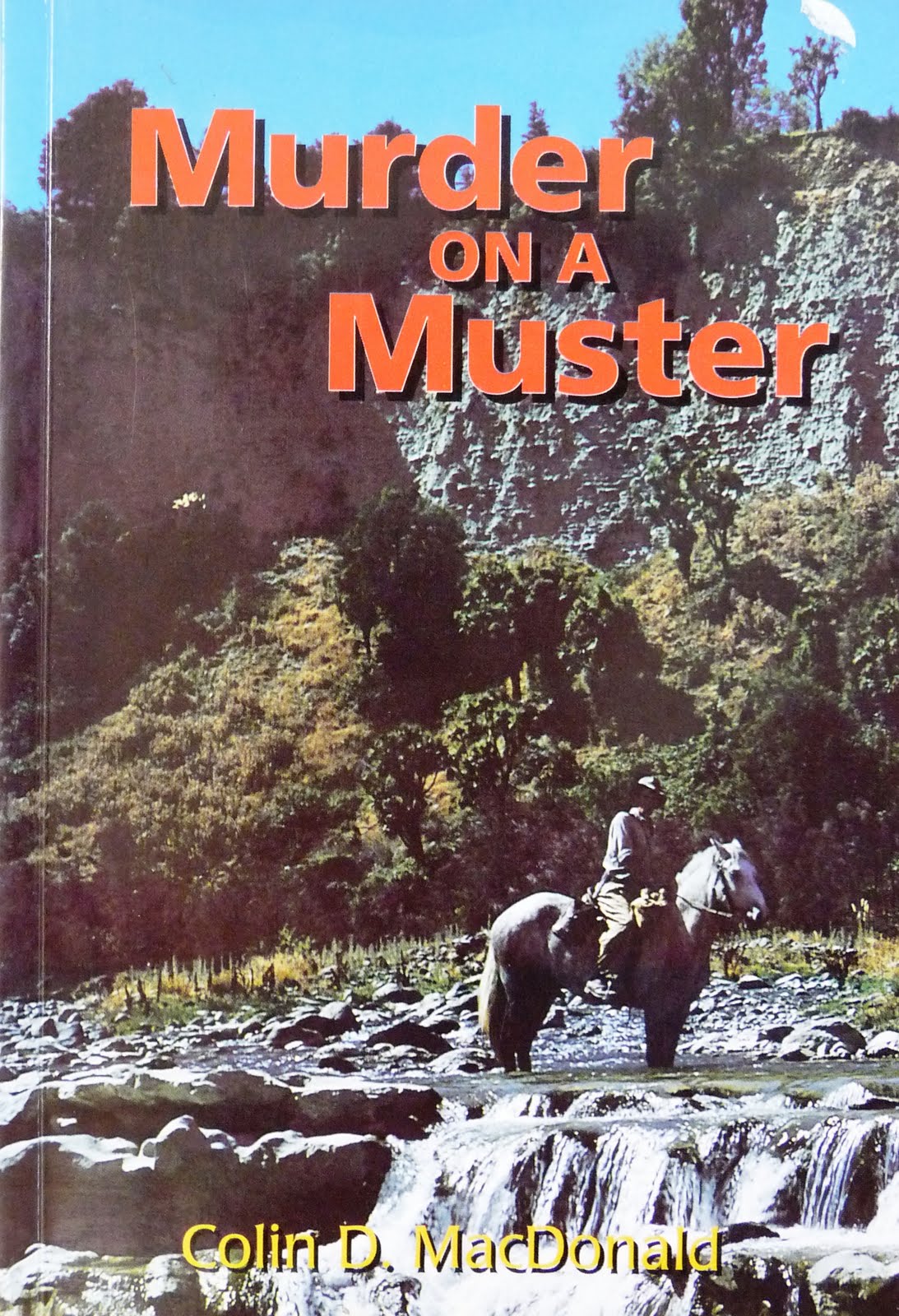
Forgotten books: MURDER ON A MUSTER (1997)

As I've noted before here on Crime Watch, including with my 'Kiwi crime bookshelves' photo back in July, I've found myself collecting a lot of out of print and hard to find Kiwi crime, mystery and thriller titles over the past year or so. There have been some terrific finds in various online and 'real' secondhand bookstores etc. Along with a strong present and a (hopefully) very bright future, New Zealand crime fiction has a much richer history than most people realise.

One out-of-print or hard-to-find book that I stumbled over recently has a very 'Kiwi' setting: a high country farm. Colin D. MacDonald's MURDER ON A MUSTER is a slimline mystery novel that was published by Certes Press in Christchurch in 1997.

In MURDER ON A MUSTER, "Hill country farmer Hamish Nicholls is well aware fo the dangerous nature of potholes that reach deeped below his pastures on Limestone Hills. His new huntaway dog, however, hasn't yet learnt to step carefully and early one frosty mustering day while in excited pursuit of some breakaway sheep, he falls down a pothole. Hamish, fond of the dog and mindful of its value, ventures down after him in a rescue attempt which results in a grisly discovery. The events which follow plunge Hamish into a nighmarish encounter with violence and lawlessness. Suddenly all that he holds most dear and most certain is under threat."

As far as I have been able to ascertain thusfar, MURDER ON A MUSTER may be the only book former farmer Colin D. MacDonald published. According to the book's back cover, MacDonald was born and brought up on a North Canterbury sheep run, and had extensive experience at managing and owning farms in Canterbury and on the West Coast, and had been on many musters similar to the one depicted in MURDER ON A MUSTER. At the time of publication he was retired and living in Christchurch, married with three children.

According to the jacket, "Author Colin MacDonald's experience of North Canterbury farming and his feel for the landscape provide an authentic backdrop to this tale of murder and the desperate flight of a violent, vindictive man who has nothing more to lose".

Sounds intriguing, and at only 117 pages in length, I'll probably find myself giving it a go sooner rather than later. Might be a nice change from all the city-based crime I've been reading lately.

Do you like crime fiction set in isolated rural areas? How important is an interesting setting in mystery writing? Had you heard of MURDER ON A MUSTER before? Does it sound like the kind of book you might like to try? Thoughts and comments welcome.

Wednesday, September 29, 2010

Kiwi Author skewers Dame Ngaio?

As I've noted before here on Crime Watch, including with my 'Kiwi crime bookshelves' photo back in July (see right), I've found myself collecting a lot of out of print and hard to find Kiwi crime, mystery and thriller titles over the past year or so. There have been some terrific finds in various online and 'real' secondhand bookstores etc - and since July I've probably added another 20-25 books, as well as found out about several others that could be added (if or when I can get my hands on them). Along with a strong present and a (hopefully) very bright future, New Zealand crime fiction has a much richer and more varied history than most people realise.

Recently I headed down to Nelson (my hometown) for a bit of a break, and browsed a couple of cool secondhand bookstores while I was there. There are a handful of out of print Kiwi crime books and authors that I've been trying to find copies of for quite a while, so I'm always looking out for them, along with any other books that fall within the genre that I might stumble upon. At one store I ended up walking out with about 8-10 such 'forgotten' Kiwi crime novels, including three I'd been trying to find for ages - one of which was BLUE BLOOD by Stevan Eldred-Grigg.

Eldred-Grigg isn't someone most New Zealanders would associate with crime fiction - he's an historian and author who writes in a eclectic variety of 'genres' and styles. When I was at high school we had to read ORACLES AND MIRACLES, his first novel. It's a story about two girls "living in a world of dreams while growing up in poverty" in historic Christchurch. I remember thinking it was okay, but not that great - but in fairness that was probably more to do with being a high school student who read a lot, and so was primed to be a little against the 'old, boring stuff' that the teachers 'forced' on us. I do remember enjoying the novel more than I thought I would (I thought it was okay, whereas most of my classmates hated it), and I'd probably appreciate a lot more about it if I read it now.

Eldred-Grigg's most recent book is the acclaimed non-fiction work DIGGERS, HATTERS, AND WHORES, a very lively account of the gold rushes from the 1850s to the 1870s which were "the biggest single event in the history of colonial New Zealand".

Back in 1997 though, Eldred-Grigg wrote his one and only 'crime novel', a book that stirred a little controversy at the time. BLUE BLOOD is touted as a "parody, and a darkly comic deconstruction, of the classic interwar crime novel" - I'd stumbled across a reference to it online several months ago, and had been looking out for a copy ever since, so was stoked to discover one in the secondhand bookstore on Hardy Street in Nelson (opposite Lone Star).

BLUE BLOOD is set in 1929, and the back cover blurb reads as follows:

"Summer, 1929. Three young women are rocketing across the hot Canterbury Plains in a fast roadster: smoking, drinking - laughing. But soon all this is to change. In a plot worthy of a Ngaio Marsh fiction, lives are about to be shattered by shafts of jealousy, madness and revenge.

The young Ngaio herself, seated at breakfast a few weeks later in the family bungalow on Cashmere, bites into a slice of toast and sight with irritation as her mother rustles the newspaper and comments on page one's shocking story. Two young local women, severely mutilated, pots of blue paint spilled on the bodies...

Stevan Eldred-Grigg's brilliant novel is a tough tale about a woman at the turning point of her creative and emotional life. It is also an enquiry - both mischievious and disturbing - into the psychopathology of a murder which might affect even the author herself."

It certainly sounds intriguing. On its release there was some media debate about whether or not the novel "cruelly defames... a cultural icon of New Zealand". Auckland journalist and reviewer Claudia Marquis called it "an enjoyable hour or two of bitchy pleasure". At least Dame Ngaio was being recognised as a cultural icon, I guess. In some ways we seem to have forgotten her a little now - at least in the wider public consciousness - although hopefully that is changing.

So I'm very much looking forward to trying BLUE BLOOD for myself, both to see Eldred-Grigg turn his hand to crime fiction (parody or not), and to form my own opinion on the (now largely-forgotten, like the book) controversy.

Have any of you read (or even heard of) this hard-to-find piece of New Zealand crime fiction history? What do you think of crime novels that incorporate fictionalised versions of real characters? Do you like scouring secondhand bookstores? What are some of the coolest books you've found in secondhand stores? Please share your thoughts and comments.

Sunday, August 29, 2010

Forgotten Kiwi crime: V. Merle Grayland

As I noted last month, and some of you would no doubt have already been aware of, for some time now I have been gradually searching out lesser-known Kiwi crime, mystery and thriller writers from both modern times and days gone by (and where possible, acquiring some of their books).

It has been quite a surprising journey, especially as I have come across several lesser-known or otherwise forgotten Kiwi writers who produced several crime novels in their time. Many were even quite popular, but have now been largely (completely?) forgotten

Regular readers may recall the completely unexpected comments and happenings that eventuated after I stumbled across the works of Wellington writer Laurie Mantell (five Steve Arrow murder mysteries, 1978-1984, plus a standalone in the lates 1990s) earlier this year.

I have also previously touched on the likes of Freda Bream (who while retired published 13 murder mysteries starring the Rev Jabal Jarrett between 1982-1997), Edmund Bohan (who wrote five historic Inspector O'Rorke novels between 1996-2003), Carol Dawber (who wrote three Top of the South-set mysteries around the same period), and Elizabeth Messenger (who wrote at least nine crime thrillers that I know of, in the 1950s-1960s).

Another such forgotten Kiwi crime writer I recently 'discovered' thanks to the back cover of an old circa 1960s Elizabeth Messenger hardcover, is V. Merle Grayland. According to the sleeve of the copy of THE GRAVE-DIGGER'S APPRENTICE that I've managed to acquire:

"Valerie Merle Grayland was born in the old New Zealand gold-mining town of Thames. She has been writing since she was seven, when her first short story was published in the children's page of a newspaper. She had had numerous short stories and articles published and for a time concentrated on humourous writing. She is married to a New Zealand journalist and author, Eugene C. Grayland and together they run a small private press as a hobby; the Colenso Press, named after one of New Zealand's pioneer printers, William Colenso. She also enjoys reading, gardening and cats, but most of all seeing New Zealand."

It seems that as well as writing other books under her name Valerie Grayland, Valerie also collaborated with her husband Eugene on some New Zealand non fiction geography/history style books focused on the region where she live das well, eg TARAWERA, HISTORIC COROMANDEL, and COROMANDEL COAST.

In terms of her crime fiction, the 'blurb' for THE GRAVE-DIGGER'S APPRENTICE, which was published by London's Robert Hale and New Zealand's Whitcombe & Tombs in 1964, says:

"What was wrong with the lanky Benny Meer? What was he frightened of and why was he so interested in death? Why did he haunt cemeteries asking questions about a grave that did not seem to exist? And who put the poison in the pie - and why? Maori Detective Hoani Mata and his old friend, Inspector Plimsoll, seek the answers to these and other puzzling questions in a crime investigation with an unusual angle to it. Although The Grave-Digger's Apprentice was a name given in jest it proved to have a sinister double meaning in this New Zealand double murder case."

According to the inside flap, V. Merle Grayland wrote at least two other crime thrillers:
  • THE DEAD MEN OF EDEN
  • NIGHT OF THE REAPER
I've also seen mentioned elsewhere on the Internet a book called JEST OF DARKNESS by V. Merle Grayland, so it seems Valerie Grayland wrote at least four crime thrillers under this semi-pseudonym.
Have any of you heard of V (Valerie) Merle Grayland? Read any of her work, crime fiction or otherwise? Do you like stumbling over long-forgotten crime writers? Seeing the difference between crime writing then and now? And what is it about the smell of old books? Thoughts and comments welcome.

Monday, July 26, 2010

Forgotten Kiwi writers: Elizabeth Messenger

As I noted last week, and some of you would no doubt have already been aware of, for some time now I have been gradually searching out lesser-known Kiwi crime, mystery and thriller writers from both modern times and days gone by (and where possible, acquiring some of their books). It has been quite a surprising journey, especially as I have come across several lesser-known or otherwise forgotten Kiwi writers who produced several crime novels in their time. Many were even quite popular, but have now been largely (completely?) forgotten.

Regular readers may recall the completely unexpected comments and happenings that eventuated after I stumbled across the works of Wellington writer Laurie Mantell (five Steve Arrow murder mysteries, 1978-1984, plus a standalone in the lates 1990s) earlier this year, and I have also previously touched on the likes of Freda Bream (who while retired published 13 murder mysteries starring the Rev Jabal Jarrett between 1982-1997), Edmund Bohan (who wrote five historic Inspector O'Rorke novels between 1996-2003), and Carol Dawber (who wrote three Top of the South-set mysteries around the same period), amongst several others.

Another such forgotten author I recently 'discovered' thanks to a fair bit of random Internet and second-hand bookstore browsing, is Elizabeth Messenger, who wrote several crime thrillers in the late 1950s and early/mid 1960s. Messenger was a journalist, cookery writer, and crime novelist (you can read a full bio here) born in the Coromandel in 1908. According to the Dictionary of New Zealand Biography, Messenger's thrillers, "which she produced at the rate of one or two a year from 1958, were set in tourist spots such as the Marlborough Sounds (Murder stalks the bay), Lake Taupo (Material witness) and the Bay of Islands (A heap of trouble)."

Like most Kiwi writers of the time, and many of the 'genre' writers in much more recent times, Messenger was published by an overseas publisher (Robert Hale in London). "Elizabeth Messenger’s novels, once popular enough to be serialised and translated into other languages, are now difficult to obtain," says DNZB.

I've certainly found that - even after trawling through countless online and real-life second-hand bookstores, and regularly searching the Internet and other resources as part of my unofficial research into New Zealand crime, mystery, and thriller writing, I only just found out about her recently. Now that I've been alerted, and can search in a more precise way, I've managed to get hold of a couple of her books, including A HEAP OF TROUBLE (pictured above), and am in the process of acquiring a couple more. But copies are pretty hard to find.

According to the cover jacket of my copy of A HEAP OF TROUBLE, Messenger also wrote:
  • MURDER STALKS THE BAY
  • MATERIAL WITNESS
  • DIVE DEEP FOR DEATH
  • LIGHT ON MURDER
  • THE WRONG WAY TO DIE (this is the other one I already have)
  • PUBLICITY FOR MURDER; and
  • GOLDEN DAWNS THE SUN.
Thanks to the back cover of a V.Merle Grayland book from the same era, I've also discovered another Elizabeth Messenger 'Crime and Detection' title; YOU WON'T NEED A COAT.

Have any of you heard of Elizabeth Messenger? Read any of her work? Do you like stumbling over long-forgotten crime writers? Seeing the difference between crime writing then and now? Thoughts and comments welcome.

Sunday, May 16, 2010

Introducing Dorothy Eden - a forgotten Kiwi writer?

As many of you know, I've been quietly building up information on New Zealand crime, mystery and thriller writers - both those in print now, and those that have gone before. As it turns out, and as I am realising more and more as time goes on, not only does New Zealand have far more current crime writers (based both here and overseas) than most people realise right now, but in fact there is a far richer tradition of New Zealand writing in this genre as well (as you can see by the ever-growing sidebar list of Kiwi authors).

And while many of those on the sidebar list published only one or two crime/thriller/mystery novels (often via small publishers or overseas publishers, as the bigger publishing houses in New Zealand, until relatively recently, didn't really embrace Kiwi 'popular fiction') either in amongst other writing, or in total - in amongst those sidebar names there are also far more New Zealand authors who produced several mystery novels over the years, but have been largely forgotten.

Freda Bream, for instance, wrote a mystery novel almost ever year, featuring the Reverend Jabal Jarrett, while she was in her mid 60s and 70s (having retired from working life as a teacher, amongst other things) - 13 mysteries in total during the 1980s and early 1990s. Laurie Mantell wrote five mystery novels featuring Detective Steve Arrow between 1978 and 1984, as well as publishing the standalone crime novel MATES in 1996. Edmund Bohan published five historical mysteries centred on Inspector O'Rorke (set in the late 1800s) between 1996-2003.

Yesterday when I was in Rotorua, I spent an hour or so browsing through the local library's charitable book sale, searching for any books from Bream, Mantell, Bohan, or other such overlooked and out-of-print Kiwi crime/mystery/thriller authors. Amongst my finds was LET US PREY by Dorothy Eden. When I got back to Auckland I did a little research on Ms Eden, and was stunned to discover that LET US PREY was just one of many suspense novels the Canterbury-born author had written during her lifetime. Eden in fact wrote more than 40 books (some were suspense/mystery, others romance).

Eden was born in 1912 and raised in the rural area outside Christchurch (the city where Dame Ngaio Marsh was born and raised, and where Paul Cleave now sets his thrillers). Eden worked as a legal secretary, and published her first novel, THE SINGING SHADOWS, in 1940. She eventually moved to England in 1954 following a world trip - by that time she had already published ten books, including LET US PREY (1952), which was also published as CAT'S PREY. In that book, Antonia Webb travels to New Zealand to celebrate the wedding of her cousin and the opening of a small hotel Simon and his new bride had bought with money they had inherited. But instead of lighthearted festivities, Antonia's arrival is met by danger...

After her move to England, Dorothy Eden continued to write fairly profically until her death from cancer in 1982. Her 43rd and final book, AN IMPORTANT FAMILY (a historic adventure saga and mystery set amongst the colonisation of New Zealand), was published in the same year. You can read her New York Times obituary here. According to Good Reads, she was "best known for her many mystery and romance books as well as short stories that were published in periodicals. As a novelist, Dorothy Eden was renowned for her ability to create fear and suspense. This earned her many devoted readers throughout her lifetime." According to FantasticFiction.co.uk, "Eden was best known for her writings in the historical, suspense, and Gothic genres. In addition to writing novels, she also contributed to magazines, including Redbook and Good Housekeeping."

The more I research, the more I am having 'how did I never hear about this author?' type moments. It's a real shame - I have been a crime/mystery fiction fan since I first started on the Hardy Boys books almost 25 years ago, and I was open to New Zealand authors in the genre as a young adult (I bought/read one-off books from the likes of Nigel Latta, Simon Snow, and Michael Laws, as well as some from Ngaio Marsh, Chad Taylor, and Paul Thomas) - even before I became much more interested in the subject in the past 18 months. And yet, there are so many authors I've never heard about - even though I was interested. It's not until I've done a lot (and I mean a lot) of digging, that I've stumbled across some of them - even when they'd written several books that got good reviews at the time. No wonder the general Kiwi reading population knows little or nothing about most such writers.


Have any of you read any of Dorothy Eden's books (mystery or romance)? If so, what did you think? Have you come across other Kiwi authors that I haven't mentioned much (or at all) on this blog yet? Thoughts and comments welcome.