Showing posts with label true crime. Show all posts

Thursday, February 13, 2025

"A heck of a storyteller" - review of THE SURVIVORS by Steve Braunias

THE SURVIVORS by Steve Braunias (HarperCollins, 2024)

Reviewed by Craig Sisterson

True stories of death and desperation. One survivor chooses loneliness. One chooses exile. One chooses oblivion.

Some have violent tendencies, ruining lives indiscriminately. Some seal their own fate in slow motion; others do so in the blink of an eye.

In The Survivors, award-winning true-crime writer Steve Braunias retells twelve mysteries of human nature - unusual stories of how people choose to survive their own lives, and their decisions, desires, impulses... and failings.

“For thousands of years, we’ve made up stories about things largely because we haven’t understood them,” says Dr Alex Bartle in the twelfth and final chapter of Steve Braunias’s superb collection of true stories, The Survivors. The Christchurch sleep medicine specialist is talking specifically about the writings and theories of Volker Pilgrim, who feared vampires stealing his sleep, and whose fascinating story bookends The Survivors, with Braunias describing Pilgrim late on as “the governing principle of the entire book, the exemplar of surviving your own life on your own terms”.

But the timeless idea of reaching for stories to explain the unknown, seeking to understand our world and varied lives moving through it, surviving on our own terms or otherwise, applies broadly.

Steve Braunias is a heck of a storyteller, and The Survivors is a fascinating collection that draws us into lives that have attracted Braunias’s curiosity. There’s a troubled French exchange student, unlucky in love, who vanished while going to collect black sands as a souvenir for his mother. Another tale: two hardworking Chinese migrants eking out meagre existences in bleak bedsits, sacrificing to send money home, only for a misunderstanding to lead to a homicide trial. A would-be arsonist who burned himself alive, having been manipulated by a femme fatale who only faced justice due to a wedding planner turned tenacious detective. A getaway driver for a cop killer. 

Summaries don’t do the stories justice; each is soaked in small details, acute observations. Many arise from Braunias’s court reporting, his desire to write about real crimes ‘as a kind of literature’. Chapter 5, ‘Zones of Interest’ is one of the most affecting, as Braunias grapples with his own role as voyeur of horrors inflicted on others, as he reads and takes notes from a 42-volume set of Nuremberg trial transcripts. “The volumes are demonic, a collection of bad spells for extermination.” 

While The Survivors digs into some extremely dark areas of humanity, it never reads as too bleak. There are many moments of humanity and light. Braunias confesses he was “among the worst in the business” at traditional court reporting, with its focus on news, total accuracy, and distilling the day’s events. Instead, he was “immediately attracted to the background music of every trial – high comedy, low awfulness, the songs of death”. But now he says he’s putting away his true crime pen. 

This will be his final such book. It’s a fitting swansong.

[This review was first written for Deadly Pleasures magazine in the United States]

Craig Sisterson is a lawyer turned writer, editor, podcast host, awards judge, and event chair. He's the founder of the Ngaio Marsh Awards, co-founder of Rotorua Noir, author of Macavity and HRF Keating Award-shortlisted non-fiction work SOUTHERN CROSS CRIME, editor of the DARK DEEDS DOWN UNDER anthology series, and writes about books for magazines and newspapers in several countries.

Tuesday, September 3, 2024

Running backs, wrongful convictions, and the Harlem of the West: an interview with Robert Justice

Kia ora and haere mai, welcome to the 236th instalment of author interview series, 9mm, which has been resurrected this year after largely going into hibernation and only occasionally emerging in 2021-2023, for a variety of personal reasons.

Thanks for reading and sharing the 9mm series, and Crime Watch in general (and my work elsewhere) over the years. I've had a lot of fun talking to some amazing crime writers and bringing their thoughts and stories to you. You can check out the full list of of past 9mm interviewees here. What a line-up. With lots more fun to come. Thanks everyone. 

If you've got a favourite crime or thriller writer who hasn't yet been part of the 9mm series, please let me know, and now I'm back on deck more fully, I'll look to make that happen for you. We've got several interviews with cool crime and thriller writers from several different countries 'already in the can' that will be published soon, so lots to look forward to in the coming weeks and months.

Today I'm very pleased to welcome to 9mm a rising star of US crime fiction, Denver author Robert Justice, whose debut novel They Can't Take Your Name was runner-up for the 2020 Eleanor Taylor Bland Award. A sequel, A Dream in the Dark, was recently published, continuing the fight of Liza Brown and Eli Stone against the scourge of wrongful convictions in a flawed criminal justice system.

Denver author Robert Justice, who
is passionate about righting the
scourge of wrongful convictions
Robert is the host of the Crime Writers of Color podcast, and works as a non-profit leader with over thirty years of leadership experience in meeting the holistic needs of people. As he says in the Author's Note to his debut, wrongful convictions are all too real in US criminal justice; conservative estimates of only 1-2% wrongful convictions may seem like an acceptable strike rate, ie 98-99% of convictions are 'safe', but with 2.5 million people in prison in the United States, that means even at the lowest estimates, there are tens of thousands of innocent people in prison! 

Robert is passionate about righting the wrongs of wrongful convictions (he notes that almost 2,500 men and women have already been exonerated in the USA through various means, totalling more than 21,000 years lost) and it is a subject that greatly impacts his crime novels. Robert donated a share of his advance and committed to giving a portion of all future proceeds to his favourite innocence project, The Korey Wise Innocence Project at the University of Colorado. He say, "The average cost to free an innocent person is enormous, and my hope is that this series of books will raise enough money that we might actually be able to say that together we had a part in somebody’s freedom."

You can read more about Robert Justice at his website, but for now he become the latest author to stare down the barrel of 9mm. 

9MM: AN INTERVIEW WITH ROBERT JUSTICE

Who is your favourite recurring crime fiction hero/detective?
I have too many favorites! How do I choose between Attica Locke’s Darren Matthews; Mosley’s Joe King Oliver; Nadine Matheson’s Inspector Anjelica Henley; or Yasmine Angoe’s, Nena Knight?

Let’s go with my most recent favorite crime fiction hero, Glory Broussard, the wonderful creation of Danielle Arceneaux. Glory is an unfiltered, recently divorced, Black woman of a certain age who investigates murders while keeping tabs on her side hustle of as a bookie. What’s not to love?

Dallas Cowboys running back terrorised NFL
defences during his Hall of Fame career 
What was the very first book you remember reading and really loving, and why?
In my youth, I stumbled upon the biography of Hall of Fame American football player Tony Dorsett and was transfixed. For the next few years, my single-minded goal in life was to play in the NFL, but then I read the biography of Olympian Eric Liddell, and running became my ultimate love. And then I read…

Before your debut crime novel, what else had you written (if anything) - unpublished manuscripts, short stories, articles?
The decade prior to my debut novel, I wrote and published four non-fiction books on a variety of topics, including jazz. When I turned to writing novels, that’s also when I went with my pseudonym—Robert Justice - so as not to confuse my readers. My name is Robert and now I write about justice.

Outside of writing and writing-related activities (book events, publicity), what do you really like to do, leisure and activity-wise?
I’m going to have to ignore the parameters of the question and go with writing! I work a demanding job in the non-profit sector meeting people’s basic human needs. It’s rewarding but can also take an emotional toll. Writing (and reading) allows me to rest from the demands of my day-to-day life, as I create new worlds. When I go on vacation, I rarely take a break from writing because it’s not work—writing is the way I unwind!

What is one thing that visitors to your hometown should do, that isn't in the tourist brochures, or perhaps they wouldn’t initially consider?
Five Points is the historic heart of Denver’s Black community and the setting for my Wrongful Conviction Novels. Before gentrification set in, this neighborhood was where African-Americans in the Mile-High City lived, shopped, attended church and found their doctors, lawyers, barbers and beauticians. In the center of Five Points is The Rossonian, a historic jazz club where all the greats played on their way through town. If you ever make it to Denver, be sure to swing through Five Points—the Harlem of the West.

If your life was a movie, which actor could you see playing you?
Jeffrey Wright, for sure! In American Fiction, he portrayed a middle-age Black fiction writer with a salt and pepper beard. It wouldn’t be much of a leap for him to play me in a movie, though he’d have to add another two inches to his beard.

Of your writings, which is your favourite or a bit special to you for some particular reason, and why?
My latest novel, A DREAM IN THE DARK, feels pretty special. I never saw myself as a fiction writer and at some level the success of my debut, THEY CAN'T TAKE YOUR NAME, felt like a fluke. But now with the release of my second Wrongful Conviction Novel I’m starting to believe I can do this.

What was your initial reaction, and how did you celebrate, when you were first accepted for publication? Or when you first saw your debut story in book form on a bookseller’s shelf?
On the day when my debut, THEY CAN'T TAKE YOUR NAME, launched, I went to my local bookstore and to my surprise, my book was at the front of the store on the New Release shelf—face out! I spent the next couple of hours driving to other stores and taking pictures of my book on their shelves. That night I scrolled through my gallery with while sipping my favorite rum.

What is the strangest or most unusual experience you have had at a book signing, author event, or literary festival?
A man arrived late to my author talk, cradling a copy of my debut. As I spoke, tears streamed down his cheeks while he continued to hug my book close to his chest. At the signing table afterwards, he shared his wife had recently passed away and that my character, Eli (a man struggling to survive the death of his wife) was helping him face his own grief. We hugged and have kept in touch.


Kia ora, Robert, we appreciate you having a chat with Crime Watch. 

Have you read Robert Justice's wrongful conviction novels? Do you like how crime novels can explore real-life issues through the prism of page-turning fictional tales? Do you have any favourites of this ilk?

Saturday, April 6, 2019

Review: THE SHORT LIFE AND MYSTERIOUS DEATH OF JANE FURLONG

THE SHORT LIFE AND MYSTERIOUS DEATH OF JANE FURLONG by Kelly Dennett (Awa Press, 2018)

Reviewed by Craig Sisterson

Jane Furlong was seventeen when she disappeared off Auckland City’s Karangahape Road - a notorious sex strip - in 1993. Her disappearance became a media frenzy, with Jane’s face and halo of fiery red hair emblazoned on newspapers and television screens across the country. It soon emerged she was to have been a witness at the trial of a wealthy businessman charged with sex crimes. The police identified a number of suspects. No one was charged. 

Nineteen years later a woman walking her dog on a beach an hour’s drive from Auckland made a gruesome discovery: a skull was poking through the sand. The body in the windswept dunes was found to be that of Jane. Kelly Dennett unveils the story of Jane’s life, her disappearance, the frantic and unsuccessful search to find her, the huge impact on her family and her partner (who rapidly became the police's main suspect), and the abiding mystery of her killer.

Humanity. If there's one thing that resonated to me throughout talented crime reporter Kelly Dennett's first book, it's a sense of empathy and shared humanity. A quarter of a century ago, Jane Furlong vanished from a notorious red light district in New Zealand's biggest city. Jane was a teenager, a mother to a young baby, a drug user, and a prostitute. You can imagine the headlines and some of the attitudes at the time (or still now) among the general public, media, and police.

Dennett does a superb job digging beyond the headlines and bringing us a much broader and more nuanced story of Jane's life before her disappearance, and the impact on those who knew or loved her of never seeing her again. This is a fascinating, very well written book about a tragic case that remains unsolved, even after Jane's body was found a few years ago. Most New Zealander's would at least vaguely recognise the name 'Jane Furlong', without knowing much if anything about her. As Dennett shows, Jane was much more than a headline snapshot of another hooker preyed upon.

There is a heck of a lot to like about this book. It flows wonderfully, and informs without ever feeling lecture-y or soap-boxy. It touches on a lot of broader issues, as well as personal ones.

I was a little surprised to see Dennett putting so much of herself into the story at times, sharing how affected she was by her research and her interviews and interactions with those who knew Jane well, as well as her rollercoaster journey writing the book. But it works, and is quite brave at times.

THE SHORT LIFE AND MYSTERIOUS DEATH OF JANE FURLONG is a book that raises many questions about a variety of societal issues and the way people treat each other individually and in groups, while having the strong central question snaking throughout of 'whodunnit?'.

Jane's case remains unsolved, despite theories and possible suspects. Dennett canvasses a range of scenarios, letting the reader come to their own conclusions around what may have happened to Jane.

This is a very fine book about a Kiwi tragedy that unfortunately is not all that uncommon around the world. Far too many women like Jane have fallen prey to male violence. A heartbreaking tale where Dennett deals with the subject matter, and everyone involved, with compassion and authenticity.

A tale that shows the humanity behind the headlines, from an excellent writer.

Craig Sisterson is a lawyer turned features writer from New Zealand, now living in London. In recent years he’s interviewed hundreds of crime writers and talked about the genre on national radio, top podcasts, and onstage at books festivals on three continents. He has been a judge of the Ned Kelly Awards and the McIlvanney Prize, and is founder of the Ngaio Marsh Awards. You can heckle him on Twitter. 

Thursday, November 8, 2018

Review: LAW BREAKERS & MISCHIEF MAKERS

LAW BREAKERS & MISCHIEF MAKERS: 50 NOTORIOUS NEW ZEALANDERS by Bronwyn Sell (Allen & Unwin, 2009)

Reviewed by Craig Sisterson

New Zealand was supposed to be a model society at the end of the world, a utopia for "men and women of good character" who were willing to work hard for a better life. And, for most, so it proved. But this book is about the others—the misfits, the swindlers, the fallen women, the love rats, the escaped convicts, the hoaxers, the charlatans, the highwaymen, the mass murderers—from the earliest days of European settlement to the present day. 

Murder and Mischief gives the scandalous details of those who've made a name for themselves in New Zealand for all the wrong reasons. Take for example, Charlotte Badger, a pistol-wielding English thief who launched a mutiny on a Tasmanian convict ship in 1806 and sailed over to hide among the Maori of the Bay of Islands; and Amy Bock, a con woman who masqueraded as a wealthy man to marry the daughter of her landlady in 1909. Some of the people featured in this book are monsters, some are merely rascals, but all make fascinating reading. A lot of the people featured in it have somewhat disappeared into the mists of time and readers will be surprised at the shady characters in this country's past. 

Our colonial forbears made long journeys across vast oceans in search of a better life. By and large they found what has been called a ‘model society at the end of the world’, but like any society, the land of the long white cloud had its underbelly.

It’s some of the people that have made up that underbelly that award-winning journalist Brownyn Sell has focused on in her latest book. Law Breakers & Mischief Makers provides short vignettes of some of the misfits, swindlers, love rats, escaped convicts, murderers, charlatans, highwaymen, dodgy politicians, and other shady characters who have speckled New Zealand’s history.

And let’s be honest, whether it’s literature, drama, or history – it’s the ‘bad guys’ that can intrigue us the most – good stories often need great villains, whether it’s Shakespeare’s Iago, Richard III and MacBeth, or Darth Vader in Star Wars.

Sell has combed historic newspaper reports to compile an interesting collection of great Kiwi ‘villains’, and Top of the South readers will find a few recognisably ‘local’ characters, such as the Burgess gang of Maungatapu Murders infamy, and visionary if tainted settlement founder Edward Gibbon Wakefield.

Sell has done a good job mixing the famous (baby farmer Minnie Dean, Aramoana gunman David Gray) with the somewhat forgotten but equally fascinating (cross-dressing swindler Amy Bock, flamboyant Otago superintendent James Macandrew who declared his own house a prison to avoid going to the real gaol for unpaid debts). However the short chapters can leave readers wanting a little more.


Craig Sisterson is a lawyer turned features writer from New Zealand, now living in London. In recent years he’s interviewed hundreds of crime writers and talked about the genre on national radio, top podcasts, and onstage at books festivals on three continents. He has been a judge of the Ned Kelly Awards and the McIlvanney Prize, and is founder of the Ngaio Marsh Awards. You can heckle him on Twitter. 

Note: this review was originally written for a print magazine in New Zealand on the book's release. For reasons lost to the mists of time, I didn't upload this one to my then-very-new blog at the time, so have rectified that now. 

Sunday, August 5, 2018

Review: THIS MORTAL BOY

THIS MORTAL BOY by Fiona Kidman (Vintage, 2018)

Reviewed by Alyson Baker

An utterly compelling recreation of the events that led to one of the last executions in New Zealand.

Albert Black, known as the 'jukebox killer', was only twenty when he was convicted of murdering another young man in a fight at a milk bar in Auckland on 26 July 1955. His crime fuelled growing moral panic about teenagers, and he was to hang less than five months later, the second-to-last person to be executed in New Zealand.

But what really happened? Was this a love crime, was it a sign of juvenile delinquency? Or was this dark episode in our recent history more about our society's reaction to outsiders?

Albert Black has been accused of murder, and the death penalty stands, “Will goodness and mercy prevail?” – alas no, not in 1950s New Zealand, not with the shadow of the Second World War affecting how politicians make decisions, and not with the prejudicial Mazengarb Report being delivered to every household in the country, spreading moral panic.

Albert Black is a young Ulsterman who is sent off to New Zealand in 1953, when he is 18: “It was meant to be a big adventure.”  A handsome and friendly young man.  He makes a friend on board the ship, a 23-year-old Liverpudlian called Peter.  On the same voyage are several child migrants, those sent alone to New Zealand to get them out of the way, many of them ending up living hard childhoods as farm labourers.

Albert isn’t a child migrant, but he has been sent out of the way – his father thinking he is too loved by his Mum, and that a chance to start a new life is just what he needs.  Albert and Peter find work together for a while, eventually moving in with a solo Mum and her children in the Hutt Valley.

Albert becomes known as Paddy, and he is very homesick, just wanting to get home to Belfast.  There is a bit of excitement around the Hutt – in fact it has been reports of promiscuous behaviour in Lower Hutt that has been one of the reasons given for the inquiry into juvenile delinquency that has resulted in the Mazengarb Report.  But Wellington doesn’t hold much promise for raising enough money to buy passage back to Ireland, so Paddy leaves for Auckland.

Paddy washes up as a sole occupant in lodgings in Wellesley St, gets various short-term jobs, and hangs out with the bodgies and widgies at the Ye Olde Barn café.  He might not be able to afford the clothes, but he is part of a generation wanting to look different, dance different and be different from the dull era they have been born into.  Paddy makes friends, has girlfriends, falls in love, keeps in touch with Peter and the women who took him in in the Hutt, and of course with his Mum back ‘home’.

Then Paddy meets another young man living under a different name from that he was given.  Johnny McBride “… arrived in New Zealand as a child migrant, something he didn’t choose”, he is an insecure young man who comes across as a bully.  He and Paddy are at logger heads from the start, and one clash in the Ye Olde Barn café results in the death of Johnny McBride.

This Mortal Boy reads like a Greek Tragedy, we know what is going to happen:  Alfred Black was the second to last person put to death at the hands of the State in New Zealand.  We read about him, his circle, his parents and younger brother in Ireland, with the knowledge of poor Alfred’s fate.  And this is what makes it such a beautiful and poignant read.

Kidman’s depiction of the time is lush; the vomit of the six o’clock swill, the Edwardian swish of the bodgies’ outfits, the early dreams of later strip club mogul Rainton Hastie, the pulse of Auckland – except on a Sunday when “Queen Street [was] so quiet you could shoot a gun straight down the middle and nobody would come running.”  She exquisitely draws Paddy making bad choices and saying crazy things and knowing it but being too young to listen to his own voice of reason.

We follow Paddy into Mt Eden Prison, listen in on the guilt wracked Superintendent Horace Haywood, who disagrees with the death penalty, and his off-sider Des Ball, himself guilty of appalling spousal abuse, of which his neighbours know but don’t report.  This latter is one of the many contradictions and injustices Kidman highlights: outrage at teenage abusive behaviour – silence over abuse inside marriage; a post-war society where “Young men are expected to be warriors, to be pioneers and soldiers, so brave of heart” – those not privileged condemned for behaving like warriors; a young man condemned to death for an accident – another left to carry on in the community for a much worse crime, etc., etc.

The saddest contradiction is the sending of young children to a distant country for a fresh start – then ostracising them for being ‘different’.  The scenes in which the jury discuss Paddy’s case highlight all the prejudices of the time, the jury itself (all men) split neatly along class lines. In the end the verdict is brought in after only an hour and forty minutes deliberations, most of which was on other factors than the evidence against Paddy, after all: “He speaks like a bog-trotter.”

There is an obvious miscarriage of justice, including an appalling leak of information to the jurors via the press before a verdict has been reached, advising what the judge has already decided about Paddy’s fate.  And Kidman describes the earnest work of Ralph Hanan to get the verdict overturned at the highest levels.  And the barrister Oliver Buchanan trying to do the same at the Court level, realising too late that crucial evidence has not been presented.

Back in Belfast, Kathleen, Paddy’s Mum, is doing all she can do via her appeals to local politicians, New Zealand politicians, and even the Queen.  But all the pleading and appeals are in vain, because the decision to take Paddy’s life has nothing to do with him or his actions, it is all to do with power and warped principles – sharply delineated in the scene with Paddy being interviewed by a psychiatrist to see if he is “a suitable candidate for the hangman’s noose.”

“In the meantime, there is the small matter of a man’s life to be decided” – The story of This mortal boy unfolds in non-chronological pieces – in prison, in court, various episodes in Paddy’s life, in Belfast with his family.  But it is seamlessly stitched together, heartbreakingly sad at the end and just a wonderful piece of New Zealand historical fiction.


Alyson Baker is a crime-loving librarian in Nelson. This review first appeared on her blog, which you can check out here

Friday, June 8, 2018

Review: THE BLACK WIDOW

THE BLACK WIDOW by Lee-Anne Cartier (Penguin, 2016)

Reviewed by Craig Sisterson

The Black Widow almost got away with murder. But then her sister-in-law became suspicious...

The infamous Black Widow case shocked New Zealand. An average-looking suburban housewife carefully staged her husband's 'suicide'. At first it looked like she might get away with murder, but then her sister-in-law, Lee-Anne Cartier, became suspicious and started gathering evidence and presenting it to the police. Unfortunately they didn't believe it was enough to get a conviction and signed the death off as suicide. Lee-Anne then drove the case at the inquest and a finding of 'No proof of suicide' was pivotal in getting the police to reopen the case. 

This is a story that reads like something out of a movie script, but was all-too-horribly true, THE BLACK WIDOW goes behind the headlines and gives readers a much fuller story behind one of New Zealand's most infamous modern murder trials, that of Helen Milner. Milner was married to truck driver Phil Nesbit, who died in 2009. The police thought it was a suicide, but Phil's sister Lee-Anne had doubts, and grew to believe that Helen may have murdered him.

It wasn't an easy road to change minds, and THE BLACK WIDOW outlines the long, twisting struggle Lee-Anne had over more than two years, conducting her own covert amateur investigation, to find some measure of justice for her brother. It's a compelling story; Lee-Anne was a high-school drop-out with no expertise who showed Erin Brokovich-like levels of determination and resilience, even as so many people doubted, and had to put herself and family into debt to keep on going.

THE BLACK WIDOW is a compelling read about a heroic woman who put so much of herself on the line to try to right a wrong. There could be a danger in someone like that, sharing their story in book form, as coming across as trying to 'toot their own horn' (as my Mother would say) or point out how they were right and the police and 'experts' were wrong, all along. But THE BLACK WIDOW doesn't read like that. It's just Lee-Anne sharing her story so that readers understand what actually happened to her brother, and the battle that she and her family went through to prove it.

This is a very readable, very interesting story that flows along well. It's told in fairly straightforward fashion, without the literary flourishes of some true crime writing, but also without the garish or voyeuristic elements of others in the genre. It gives us an in-depth look at a victim/victim's family perspective on the machinations of the criminal justice system, which is eye-opening, valuable, and at times troubling. Lee-Anne shares things in a candid way, which is great for readers.

A book that's not going to blow you away stylistically, THE BLACK WIDOW is a tale well worth reading, especially for the underlying story of a determined and brave woman battling for justice.


Craig Sisterson is a lawyer turned features writer. He’s interviewed hundreds of crime writers and talked about the genre on national radio, top podcasts, and onstage at books festivals on three continents. He's been a judge of the Ned Kelly Awards, the McIlvanney Prize, and is founder of the Ngaio Marsh Awards. You can heckle him on Twitter


Tuesday, May 8, 2018

Review: I'LL BE GONE IN THE DARK

I'LL BE GONE IN THE DARK by Michelle McNamara (Faber & Faber, 2018)

Reviewed by Craig Sisterson

For more than ten years, a mysterious and violent predator committed fifty sexual assaults in Northern California before moving south, where he perpetrated ten sadistic murders. Then he disappeared, eluding capture by multiple police forces and some of the best detectives in the area.

Three decades later, Michelle McNamara, a true crime journalist who created the popular website TrueCrimeDiary.com, was determined to find the violent psychopath she called "the Golden State Killer." Michelle pored over police reports, interviewed victims, and embedded herself in the online communities that were as obsessed with the case as she was.

My path from learning about this recent release to reading it was a rather unusual one. Almost a year ago, I watched an episode of comedy sitcom The Goldbergs, which had one of those 'in memorium' notes at the end about McNamara. Not recognising her from in front of the camera during the series, I went online to learn more (thinking she might be a writer/director/crew etc). It turned out she was the wife of the narrator, Patton Oswalt, and a true crime writer who died young.

Intrigued, I dug deeper, and lots of articles popped up about McNamara's pursuit of the 'Golden State Killer', as she'd dubbed the man responsible for at least two cold case crime waves (the Original Night Stalker murders, and the East Area Rapist spree). She was working on this excellent book when she died, and it has been finished by some researchers she worked with (from her drafts and notes and features she'd written etc). Simply put, it's a quite outstanding piece of true crime writing.

In a way, I'LL BE GONE IN THE DARK is a story that's as much about it's author, and her obsessive chase of a killer who'd eluded captured for almost forty years, as the perpetrator himself. McNamara is drawn in to the unknowns and scattered puzzle pieces that he trailed behind him, and goes right down the rabbit-hole. She's self-aware enough to realise how obsessed she's become, and shares that with the readers in a candid way, talking about how she squirreled herself away from her family in order to spend untold hours pouring over her laptop, talking to other true crime obsessives, chasing down any potential lead, no matter how remote or loosely related.

The result is an outstanding piece of reportage that is powered by prose that sings. This is not just an accumulation of facts from police reports, newspapers, and interviews. McNamara brings the world of 1970s-1980s California to vivid life, the people and communities who were terrorised by serial rapes and vicious killings. The surviving victims, the families of those who didn't. The investigators who failed over and over again, despite their best efforts, to capture a man who brutalised so many.

This is a brilliant, must-read book for any true crime fan, and I'd also highly recommend it to crime-lovers who usually prefer fiction to fact. It's an extremely well-told story that just happens to be horribly, awfully true. It deserves to be widely read regardless, but of course recent events - a few weeks after its publication - have brought it back into the spotlight, with reports that the man McNamara dubbed 'the Golden State Killer' has finally been caught thanks to DNA matching.

It's fascinating, if you've read any of those news stories and related features, to compare the truth we so far know about that man (still not convicted, yet, of course) with what McNamara and many others in her book believed about the Golden State Killer. How did he get away with it for so long?

A flat-out five-star read. Highly recommended.


Craig Sisterson is a lapsed lawyer who writes for leading magazines and newspapers in several countries. He has interviewed almost 200 crime writers, appeared onstage at literary festivals in Europe and Australasia, on national radio and popular podcasts, has been a judge of the Ned Kelly Awards, the McIlvanney Prize, and is founder of the Ngaio Marsh Awards. You can find him on Twitter: @craigsisterson

Friday, March 30, 2018

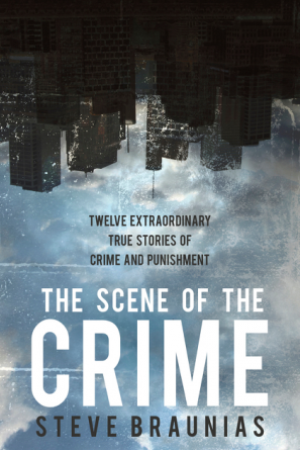
Review: THE SCENE OF THE CRIME

THE SCENE OF THE CRIME by Steve Braunias (HarperCollins, 2015)

Reviewed by Alyson Baker

Twelve extraordinary tales of crime and punishment. A court is a chamber of questions. Who, when, why, what happened and exactly how - these are issues of psychology and the soul, they're general to the human condition, with its infinite capacity to cause pain.

A brutal murder of a wife and daughter ... A meth-fuelled Samurai sword attack ... A banker tangled in a hit-and-run scandal ... A top cop accused of rape ... A murder in the Outback ... A beloved entertainer's fall from grace ... 

... these and other extraordinary cases become more than just courtroom dramas and sensational headlines. They become a window onto another world - the one where things go badly wrong, where once invisible lives become horrifyingly visible, where the strangeness just beneath the surface is revealed.

There is an inevitable melange of fiction and reality that arises from piecing together ‘what happened’ in a crime: “a trial is always going to take on the literary form of an unreliable memoir”.

Braunias is a columnist and journalist and has written numerous non-fiction books on a wide range of topics. The cases he writes about in THE SCENE OF THE CRIME are mostly New Zealand cases and mostly those that New Zealand readers will remember – Mark Lundy, Antonie Dixon, Clint Rickards. Braunias’ concerns with the Mark Lundy trial and re-trial thread through the book, and make for compelling and disturbing reading. I daresay many readers will have opinions on the guilt or otherwise of the accused, and many, like me, will have been swayed when forming those opinions by body language or thoughts of how people ‘should’ behave.

Braunias exposes this as common, shallow, and potentially damaging.

Just think of the immediate collapse into certainty a verdict delivers – newsreaders don’t have to say ‘alleged’ any more, those of us who ‘just knew’ feel our intuitions justified, a plethora of alternative versions of events evaporate. But life is often not that clear cut – and Braunias presents the disturbing possibility that the convictions of some people arise from jurors just accepting the one ‘story’ that most appeals, given their being part of a community that has already adopted a common opinion.

The book is generally quite critical of crime reporting for its role in the forming of this ‘common opinion’, but there is one captivating section devoted to his admiration for the writer of the Police notebook, a column in the Timaru Herald: “Every crime, a sentence; every sentence, a little masterpiece of brevity and accuracy, at once banal and surreal.” He was so taken with the entries he compiled some into a poem and sent it to Bill Manhire for his consideration!

Braunias’ writing draws mainly from the courtroom – as he sits and witnesses the “sheer ordinariness” of New Zealand criminal court proceedings – but it is also based on his research, and interviews with various parties to the different cases.

It is an impartial telling but also very human: he sympathises, he criticises, he worries.

The book is awash with victims – inside and outside of the court and on both sides of the cases.  Braunias speaks movingly about the families of those accused: “They are surplus to the court’s requirements.They are reduced to bystanders. They have nothing to hold on to, and they float away, like kites, always in sight, but always hovering just out of reach.”

And he also talks of those, like himself, unrelated to the cases but who choose to attend court day after day to watch the system play out. Like Mary who commuted from Auckland to Wellington to attend the Lundy re-trial: “… because she couldn’t bear to miss a second. ‘I just find the whole thing,’ she said, ‘so deeply moving.’”

THE SCENE OF THE CRIME is amusing at times but is a serious book, it is a book about how society deals with crime, how it attempts to tidy away the messiness of events into an understandable narrative, so people can feel safe and gain that figment: Closure.

Braunias reminds us that the stories we choose are not just cautionary tales, not works to make a moral point, but stories that conceal real people, people who continue to grieve, to serve their sentences, to walk free ... An exceptionally good read.

Alyson Baker is a crime-loving librarian in Nelson. This review first appeared on her blog, which you can check out here

Monday, November 20, 2017

Review: DOUBLE-EDGED SWORD

DOUBLE-EDGED SWORD by Simonne Butler with Andra Jenkin (Mary Egan Publishing, 2016)

Reviewed by Anne Cater

Double-edged Sword is a survival story like no other. In 2003 Simonne Butler’s violent partner, high on methamphetamine, cut off both her hands with a samurai sword. Her hands were reattached in a groundbreaking marathon surgery and she spent the next decade healing her mind, body and spirit.

Despite five years in an extremely physically and emotionally abusive relationship, Simonne always had an unbreakable spirit. Even when her self-confidence and sense of self-preservation was at rock bottom, she was able to source phenomenal strength that saw her survive horrendous blood loss and being left for dead for hours, holding her severed limbs in such a way that allowed revascularisation to be possible.

Facing obstacles from the very start, including a troubled childhood and an alcoholic and volatile mother, Simonne’s optimism and determination have always shone through. 

Every victim of domestic violence must read this book, and their friends and family. Even those who have never been the victim of violence will be inspired, moved and enlightened by this candid and brutal memoir. Double-edged Sword is so much more than just a story of survival, it is a guidebook for humanity – how to shrug off the oppressors and the obstacles and live your life with the greatest intensity you can muster. It’s about conquering the demons and rising like a phoenix from the ashes and learning how to live with passion, honesty and love.

Double-Edged Sword is a brave, horrific and no-holds barred account of a terrible and terrifying incident that changed Simonne Butler's life in just a few minutes.
"On 21 January 2003 the man who I was once in love with, the man who said he loved me, attempted to decapitate me with a samurai sword."

This is the first line of Simonne's extraordinary story. It's a story of a woman who thought that she had finally found someone to love her and take care of her, and who gradually realised that this 'love affair' was actually toxic.

Whilst Simonne's story is well known in New Zealand, I had not heard of her, or what happened to her before. I read this book with no prior knowledge, I hadn't seen the TV reports, or read the news articles, all I had was Simonne's voice, telling her story, in her words.

It could have been easy for Simonne to gloss over her dysfunctional family life and her history of alcohol and drugs, but she doesn't. This is a brutally honest account of a life that was difficult from childhood. Simonne's mother was an alcoholic; a functioning alcoholic for most of the time but incredibly cruel and distant towards her daughter. When Simonne finally left home, aged twenty-one and her flat-mate's boyfriend Tony began to show an interest in her she found it very difficult. On one hand she knew that he was trouble, but on the other hand, she was attracted to him.

Tony and Simonne began a relationship and moved in together. What follows is a downward spiral of danger and terror and whilst Simonne knows that she should leave, and does try, she becomes so worn-down, that even when she finds out the truth about Tony's past, she stays.

The night that Tony tries to kill Simonne and her friend is described in graphic detail and makes for incredibly painful reading. God only knows how those two women survived such a determined and brutal attack on them, but they did, and Simonne relates her healing journey with both humour and incredible insight.

This is a book that is disturbingly compelling, it almost feels voyeuristic to continue to read of Simonne's struggle to be loved. Her incredible strength after such a devastating and life-changing attack is astonishing and she tells her story with such honesty and a touch of humour.

Double-Edged Sword is a book that should be read by everyone, it is raw, inspiring and enlightening.

Anne Cater is a hospice worker in Lincolnshire who also freelances in PR and admin roles for publishers, and reviews books and other items at Random Things Through My LetterboxThis review was originally published on her website as part of the 2017 Ngaio Marsh Awards blog tour, celebrating this year's finalists across three categories, and is reprinted here with her kind permission.  You can follow Anne on Twitter: @annecater

Sunday, November 19, 2017

Review: IN DARK PLACES

IN DARK PLACES by Michael Bennett (Paul Little Books, 2016)

Reviewed by Victoria Goldman

Teina Pora, a 17-year-old car thief, was wrongly convicted and sentenced to life in prison for the murder of Susan Burdett, who had been beaten to death with the softball bat she kept next to her bed for her own protection. Tim McKinnel, en ex-cop turned private investigator, discovered the long forgotten case 18 years later, saw an injustice had been done and set out to win Teina’s freedom. 

Reaching from the mean streets of South Auckland to the highest court in the Commonwealth, this is the story not just of Tim’s quest, but also of how an innocent man who was left rotting in a prison cell for two decades found the inner strength to rise above the dark places to which he had been condemned.

In Dark Places is one of the best books I've read all year. The story is not only fascinating but also heart-breaking - of a man sentenced to life in prison for murder, a crime he didn't commit. And of the 18 years he spent there (more than half his life) before he was finally freed.

I was glued to the story of New Zealander Teina Pora and private investigator Tim McKinnel's quest to determine the truth about Susan Burdett's death. The book is compelling and fast-paced from the outset and reads like fiction.

There are cliffhangers, twists and turns, tensions and drama - everything you'd expect to find in a crime novel. Except this isn't fiction -  these are real life events and real people involved. I had to keep reminding myself of that. With his brilliant writing, Michael Bennett makes the people, places and events leap out of the pages.

The police procedure, legal framework and forensics are described in detail, yet very easy to understand. During his research, Tim McKinnel explored the science of false confessions and racism in the New Zealand justice system. This devastating miscarriage of justice left me with one word:

Why?

In Dark Places is perfect for true crime fans and those who followed Making a Murderer. But I also urge people who don't usually read true crime to pick up this book. I hadn't read any true crime for years, but now, thanks In Dark Places, I'll be reading lots more.

Victoria Goldman is a health journalist and editor who also reviews crime novels and talks about books and writing at Off-the-Shelf BooksThis review was originally published on her website as part of the 2017 Ngaio Marsh Awards blog tour, celebrating this year's finalists across three categories, and is reprinted here with her kind permission.  You can follow VIctoria on Twitter: @victoriagoldma2

Saturday, November 18, 2017

Review: THE MANY DEATHS OF MARY DOBIE

THE MANY DEATHS OF MARY DOBIE by David Hastings (AUP, 2015)

Reviewed by Kate Jackson

Dreadful murder at Opunake’, said the Taranaki Herald, ‘Shocking outrage’, cried the Evening Post in Wellington when they learned in November 1880 that a young woman called Mary Dobie had been found lying under a flax bush near Opunake on the Taranaki coast with her throat cut so deep her head was almost severed. 

In the midst of tensions between Maori and Pakeha in 1880, the murder ignited questions: Pakeha feared it was an act of political terrorism in response to the state’s determination to take the land of the tribes in the region. Maori thought it would be the cue for the state to use force against them, especially the pacifist settlement at Parihaka. Was it rape or robbery, was the killer Maori or Pakeha?

In this book, David Hastings takes us back to that lonely road on the Taranaki coast in nineteenth-century New Zealand to unravels the many deaths of Mary Dobie – the murder, the social tensions in Taranaki, the hunt for the killer and the lessons that Maori and Pakeha learnt about the murder and about themselves.

This is the first true crime book I have reviewed online. True crime is not a subgenre I dabble in much. I’m not into grisly books on Jack the Ripper, and I really didn’t enjoy Kate Summerscale’s The Suspicions of Mr Whicher (2008). It tried to be dramatic fictionalisation as well as a non-fiction text detailing the historical/social/cultural data and for me it failed on both counts. Not sure I even finished it, which is certainly a rarity for me.Therefore, to be honest, I was a little worried about trying another true crime book. However, fortunately for me, my fears were unfounded and Hastings' book is a successful book, which importantly for me delivered a writing style which was consistent, engaging, well-paced, and entertainingly informative.

The story Hastings’ book relates is of the murder of the artist Mary Dobie in 1880 in New Zealand. She, with her mother and sister, had been visiting New Zealand for three years, with her sister having married someone over there. Mary and her mother were due to soon leave for the return trip to England. Yet this was not to be for Mary, as one day when she went for a walk, she did not return and as darkness was falling she is discovered, her throat cut so deeply that she is nearly decapitated.

After an introductory chapter setting up the crime in its basic details, hinting at the role the newspapers would go on to play in the investigation of the murder, Hastings then turns back the clock a couple of years to look at Mary Dobie, her family, and their stay in New Zealand before the fateful day. In doing so Hastings deftly explores the wider context of the crime and how it coloured perceptions of the suspects involved.

The political and social context particularly intrigued me as before, during, and after the crime there was a lot of tension between the native inhabitants and the settler communities, whose government was trying to reallocate their land. Into this powder keg of tensions and barely restrained violence, Mary’s murder can be seen as a lighted match and it was especially fascinating to see how this situation affected everyone’s earnest need to know why the murder was committed and also how in turn the murder and the subsequent trial affected the land dispute.

Mary Dobie is an interesting person to read about, having not been a very conventional woman in many respects. Hastings does not romanticise her, nor whitewash her. She is not a wholly likeable woman, suffering from class snobbery in part and an imperialist outlook not every modern day reader will get along with. Nevertheless she was still a remarkable and talented woman, recording her trips around New Zealand in sketches and paintings, going to far-flung places and experiencing the out of the ordinary. One contemporary newspaper wrote that: "It is of women like her that the heroines of history are made". Hastings’ handling of her is skilled, providing a balanced picture and where her outlook on native New Zealanders is myopic, he is able to fill in the gaps. For instance in a community where Mary saw happy and healthy Maori inhabitants, Hastings counters this was a government official’s findings of a settlement riddled with tuberculosis.

Hastings does a good job of providing insightful little details into the case and its aftermath, without overloading the reader with too much data. He takes you on a journey as the case twists and turns, making you wonder how it will all end. The section on the surprises at the inquest and the subsequent trial were very interesting. In particular I enjoyed reading about the legal processes and the problems this case had with following them. Reader sympathy is not centred wholly on the victim, as Hastings brings to the readers’ attention the much wider scope of victims this crime has. Looking at the confessional evidence, Hastings pulls out of it a poignant and sad story of cultural misunderstanding and fear, which ended in violent death.

So unsurprisingly I give this book a big thumbs up. Not only was it a brilliant read, but it encouraged me to give the true crime subgenre another go. The case Hastings explores is compellingly written and you can’t help but be drawn in to the individuals and the society they were living in. The only slight niggle I had was that throughout the book photographs are referenced in text, yet they are not displayed in text nor in a middle section. Instead they are clumped together at the back. Personally I would have preferred to have had the pictures closer to the in text references, as I found it hard afterwards to connect them to what I had read. However, this is only a slight issue as I say and shouldn’t put anyone off from giving this book a go.

Kate Jackson is a teacher and mystery lover from the north of England who blogs at CrossExaminingCrime. This review was originally published on her website as part of the 2017 Ngaio Marsh Awards blog tour, celebrating this year's finalists across three categories, and is reprinted here with her kind permission.  You can follow Kate on Twitter @armchairsleuth 

Saturday, September 30, 2017

Review: THE SCENE OF THE CRIME

THE SCENE OF THE CRIME by Steve Braunias (HarperCollins, 2015)

Reviewed by Craig Sisterson

Twelve extraordinary tales of crime and punishment. A court is a chamber of questions. Who, when, why, what happened and exactly how - these are issues of psychology and the soul, they're general to the human condition, with its infinite capacity to cause pain.

A brutal murder of a wife and daughter ... A meth-fuelled Samurai sword attack ... A banker tangled in a hit-and-run scandal ... A top cop accused of rape ... A murder in the Outback ... A beloved entertainer's fall from grace ... 

... these and other extraordinary cases become more than just courtroom dramas and sensational headlines. They become a window onto another world - the one where things go badly wrong, where once invisible lives become horrifyingly visible, where the strangeness just beneath the surface is revealed.

The brutal and the banal mix in this fascinating collection of real-life crime stories from one of New Zealand's finest storytellers. Braunias is an award-hoarding journalist, though really more of a Swiss Army Knife of non-fiction writing, able to adroitly turn his pen and wit to all manner of forms and subjects. From punchy columns to longform features to books, Braunias has focused his keen and oft-sardonic eye on everything from small-town life to a passion for birds to political satire to a Herculean quest to eat his way through 55 food joints on a single stretch of a busy Auckland road.

With THE SCENE OF THE CRIME, Braunias returns to his roots, in a way, as he was assigned court reporting duties as a young scribe for a small-town newspaper on New Zealand's wild West Coast.

In the introduction to this collection of true crime stories, Braunias says that he has been attracted to sitting in a courtroom and witnessing the peculiar power of trials for many years:
"I've loved it and I've hated it, and I could seldom tear myself away. All reporting is the accumulation of minor details, and nothing is too minor in a courtroom devoted to a case of murder. There is such an obsessive quality to trials. There is no such thing as courtroom drama, and the idea that a trial is a kind of theatre is facile. It's far more powerful than that. It's a production of sorrow and paperwork, a clean realism usually conducted in a collegial manner, in dark-panelled rooms with set hours of business. The orderliness is almost a parody of the savage moments it seeks to understand."

In THE SCENE OF THE CRIME, Braunias takes readers behind the scenes, and beyond the media headlines and soundbites, of a dozen different cases he's covered. These include notorious cases and highly publicised trials involving Mark Lundy, Rolf Harris, Tony Dixon, Louise Nicholas, and others (the Lundy murders get four chapters, each offering different insights on a still-puzzling case).

It's a remarkable collection. Whether you're familiar with the cases or not (or have read the original stories Braunias published in various major New Zealand newspapers and magazines, now extensively reworked for this collection), Braunias offers something fresh here as he shows us the people caught up in ghastly deeds: perpetrators, victims, law enforcement, and their families. .

He captures the madness, badness, and oddness swirling about some of our most infamous crimes and non-crimes. He revels in tiny details that bring these true events to vivid life, creates a page-turning narrative drive, and prods readers to (re)consider what these moments say about the national psyche. THE SCENE OF THE CRIME covers brutal acts, but it's not dire or exploitative. There are moments of humour, of lightness and reflection. In his inimitable style, Braunias entertains and informs.

Among taking a deeper, more nuanced look at high-profile cases, I also really enjoyed the chapters covering lesser-known or remembered crimes. There's a fascinating chapter on a 1960s mass shooting that led to the creation of the Armed Offenders Squad (New Zealand's equivalent to SWAT), where Braunias talks to surviving policemen, family members, and the daughter of the 'madman' killer.

This is thoughtful, and thought-provoking, true crime writing.

Delivered in bite-sized chunks that you can devour in linear fashion or haphazard order, Braunias made me a glutton; I swallowed the entire degustation in a single evening.

Highly recommended.


Craig Sisterson is a lapsed lawyer who writes for magazines and newspapers in several countries. He has interviewed almost 200 crime writers, appeared onstage at literary festivals in Europe and Australasia, and on national radio and popular podcasts. He's been a judge of the Ned Kelly Awards, the McIlvanney Prize, and is founder of the Ngaio Marsh Awards. You can heckle him on Twitter: @craigsisterson

------------------------------------------------------------------------------------------------------------------------


Sunday, June 5, 2016

New Zealand True Crime: In Dark Places

Although I mainly concentrate on the crime fiction part of crime writing here on Crime Watch, I have for a long time been interested in true crime as well. As a teenager I was fascinated by real-life stories of criminal investigations, and particularly miscarriages of justice.When given the choice, eg for high school history projects, I often ended up researching and writing about things like the death penalty. I think that's one of the reasons I studied law at university, although post-uni job offers veered me into corporate rather than courtroom law. But I've always been interested in the real-life criminal justice system, the effect it has on the lives of all involved, and how it can go horribly wrong at times.

Recently, this innate fascination many of us have for such cases has been shown by the popularity of the Making of A Murder series, but of course that was just another in a long list of questionable convictions - other famous cases that immediately spring to mind include the Birmingham Six, West Memphis Three, Leonard Peltier (still in prison), Rubin "Hurricane" Carter, the Central Park Five, Lindy Chamberlain (the 'Dingo stole my baby' case), as just the tip of the iceberg.

It certainly seems miscarriages of justice aren't just restricted to particular countries or legal systems. Although we thankfully no longer have the death penalty in New Zealand, so at least systemic errors aren't fatal (anymore), we do have several famous miscarriage of justice cases. The most well-known one when I was growing up was Arthur Allen Thomas, a farmer who spent nine years in prison for 'the Crewe murders' after the police, sure he was the culprit, planted evidence to ensure a conviction. Thomas eventually received a Royal Pardon and compensation, after the court system repeatedly failed (even after his conviction was quashed, he was wrongfully convicted again at a second trial).

A more recent miscarriage of justice is the Teina Pora situation, where a 17-year-old car thief and gang prospect was convicted of rape and murder based upon a suspect confession, and later remained in prison even after DNA showed someone else, a notorious serial rapist, was the culprit. Pora was paroled after 20 years in prison, but a group of people continued to fight to fully clear his name and eventually his convictions were quashed by the Privy Council in May last year.

It's a case I've read about in various newspaper and magazine features over the past twenty years, but for those (like myself) who may like to delve a little deeper into what happened, and why, a book has now been published. In a recent review, Andrew Geddis of the University of Otago law school calls it "a sad and awful book told in a remarkably good way. You should buy it and read it at once."


IN DARK PLACES: THE CONFESSIONS OF TEINA PORA AND AN EX-COP'S FIGHT FOR JUSTICE by Michael Bennett (Paul Little Books, 2016)
Teina Pora, a 17-year-old car thief, was wrongly convicted and sentenced to life in prison for the murder of Susan Burdett, who had been beaten to death with the softball bat she kept next to her bed for her own protection.

Tim McKinnel, en ex-cop turned private investigator, discovered the long forgotten case 18 years later, saw an injustice had been done and set out to win Teina’s freedom.


Reaching from the mean streets of South Auckland to the highest court in the Commonwealth, this is the story not just of Tim’s quest, but also of how an innocent man who was left rotting in a prison cell for two decades found the inner strength to rise above the dark places to which he had been condemned.


You can read a little more about the Teina Pora case here, and Geddis' full review here.

Monday, April 11, 2016

Review: CONAN DOYLE AND THE MYSTERIOUS WORLD OF LIGHT

CONAN DOYLE AND THE MYSTERIOUS WORLD OF LIGHT by Matt Wingett (Life is Amazing, 2016)

Reviewed by Ewa Sherman

From early in his medical career, Arthur Conan Doyle was fascinated by the paranormal. As a young doctor in Southsea, he investigated séances, telepathy and hypnosis and in 1887, the year of his first Sherlock Holmes novel, he became convinced of spirit communication.

Even as Holmes’s fame grew, Conan Doyle investigated poltergeists, automatic writing and spirit photography. Then, in 1916, as the Great War’s death toll mounted, he announced to an astonished world his belief in Spiritualism, all the while, continuing to  produce stories starring his ultra-rational consulting detective, Sherlock Holmes.

You cannot live on hard evidence and logical thinking alone, even if you are the famous author of the world renowned detective Sherlock Holmes. You need a touch of spiritual, unknown or even unfathomable. You need to test ideas, have faith and keep the creative thinking process flowing. Yet the issue of ‘faith’ can take different guises…

Conan Doyle and the Mysterious World of Light was published on 11th March 2016, commemorating the hundredth anniversary of Sir Arthur Conan Doyle announcing his belief in Spiritualism in a letter on the pages of Light, and presents a fascinating commentary on Sir Arthur Conan Doyle’s spiritual journey from hard-biting science into the spectre of spiritualism over a substantial period of time. However, how did he come to believe in ghosts and even fairies? What prompted him to follow the initial interest in psychic phenomena and become one of the strongest supporters and missionaries of spiritualism?

The author Matt Wingett stands back and observes, while meticulously digging through rich archives of articles and letters that Conan Doyle wrote for Light, the obscure specialist magazine dedicated to occult, spiritualism and psychical research. In 1887, the creator of Sherlock Holmes published A Study in Scarlet, and for the first time he wrote publicly about his conversion to the Spiritualist cause, though at the time his announcement failed to attract much attention.

However, after that Doyle became a regular contributor and a generous benefactor until 1920, which spans an interesting period in terms of religion, European, and world history and the human spirit that was thrown into this mix. Before fame came knocking on his solid door Arthur Conan Doyle, a doctor working in Southsea, attended séances, performed experiments in thought transference and investigated hypnosis, while creating horror stories, romances and detective fiction.

Wingett’s impressive research into the various texts brings them to light and life; and it doesn’t just provide all reasons for Conan Doyle’s faith but also gives examples of criticism and doubts to create a balanced view of this captivating celebrated man of science. Even if the ideas and thoughts might seem incomprehensible to some people there is no denying that the process is extremely valuable, and the rationale behind faith in the face of the Great War’s casualties provided some hope and consolation, not only for him. Conan Doyle found his way of dealing with the question of Death and his relationship with religion, while not entirely rejecting the pragmatic logical exploration.

It seems that fascination with all these matters never stops, whether it’s the new writing or in television dramas hitting our screens fairly often hence Matt Wingett’s book could not appear at a better time. So here’s the last comment taken from this official ‘coming out’ hundred-years-old letter that could apply to any belief or idea: "A hundred who have examined and tested and seen must always be more convincing than a million who disagree without investigation".

Ewa Sherman lives in Bristol, where she translates poetry from Polish. She loves Nordic/Scandinavian countries, and reviews Nordic Noir for Crime Review and EuroCrime. You can follow her on Twitter: @sh_ewa


Wednesday, October 21, 2015

Review: THE INNOCENT MAN

THE INNOCENT MAN by John Grisham (Doubleday, 2006)

Reviewed by Craig Sisterson

A gripping legal thriller that's all the more compelling because it's a real-world tragic tale of life, death, and wrongful conviction

"I had a friend was a big baseball player, back in high school. He could throw that speedball by you, Make you look like a fool boy..."

Thirty years ago a younger Bruce Springsteen sang about high school dreams and adult realities, young hopes dashed on the anvil of hardscrabble blue-collar lives. "Glory Days" is an anthem about ordinary people looking back on when they were the kings and queens of high school, feeling their best days are behind them and that life slips by and "leaves you with nothing mister, but boring stories of glory days".

Around the same time a former high school baseball star was living an even harsher version of the song, having seen his big league dreams vanish in a cocktail of drink, drugs, and women. But worse was to come, and Ron Williamson of Ada, Oklahoma found himself living a real-life tragedy: the lost dreams of "Glory Days" called and raised to the dark pathos of "Nebraska", complete with a date with the electric chair.  

Williamson was destined to be the next Mickey Mantle, until he wasn't. A washed-up small-town hero, his life got even worse when on a winter's night in 1982, not far from his home, a young cocktail waitress named Debra Sue Carter was viciously raped and murdered. An unsolved killing, an investigation going nowhere.

Until it lead to Ron Williamson, the fallen idol. On the flimsiest evidence. A scandalous trial, lying witnesses, tainted evidence. But that didn't matter: six years after the murder, Ron Williamson was convicted, guilty, sentenced to die for the heinous crime. A warning to others of how far the mighty can fall. The scourge of drink and drugs and how they can take everything away from you: your hopes, dreams, career, and life.

Except Ron Williamson was innocent.

John Grisham is world-renowned for his gripping legal thrillers that explore many aspects of the legal and criminal justice worlds in fictional settings, but here he sinks his storytelling teeth into a real-life miscarriage of justice, and delivers a home run of a book. A caveat: there is more procedural and legal detail in this non-fiction work than you would find in a novel, and while I appreciated that as a former lawyer who's had a lifelong interest in miscarriages of justice and the rights and wrongs of capital punishment, for other readers THE INNOCENT MAN may seem to drag in places in comparison to Grisham's fictional thrillers.

I found this books absorbing, and heart-breaking. Grisham does a superb job at evoking the circumstances in which Ron Williamson found himself. How he went from baseball star with the world at his feet to death row inmate pondering what his last meal in this world might be. It's also an eye-opening look at how investigations can go awry, as police and others scramble to find justice for victims and their families.

Desperate times call for desperate measures, and some of the things law enforcement resorts to in the hunt for answers, the quest to find a killer, can lead to the wrong people and wrongful convictions. It is a little chilling to see how easily this can happen, and even if it's only a minuscule percentage of cases, given the vast amount of crimes investigated every year, it's no wonder that miscarriages of justice happen all too often.

This is not a happy read, where the good guys win and life goes back to normal. Any redemption is hard-earned and only partial in nature. Like a Springsteen song, there's poetry in the pain, lyricism in the struggle.

This won't be for everyone, but is an excellent book from a gifted storyteller.

I first read THE INNOCENT MAN while travelling in North America in 2008. This review is based on my notes and reviews elsewhere I did at the time, plus further reflections and research on the content and case.